
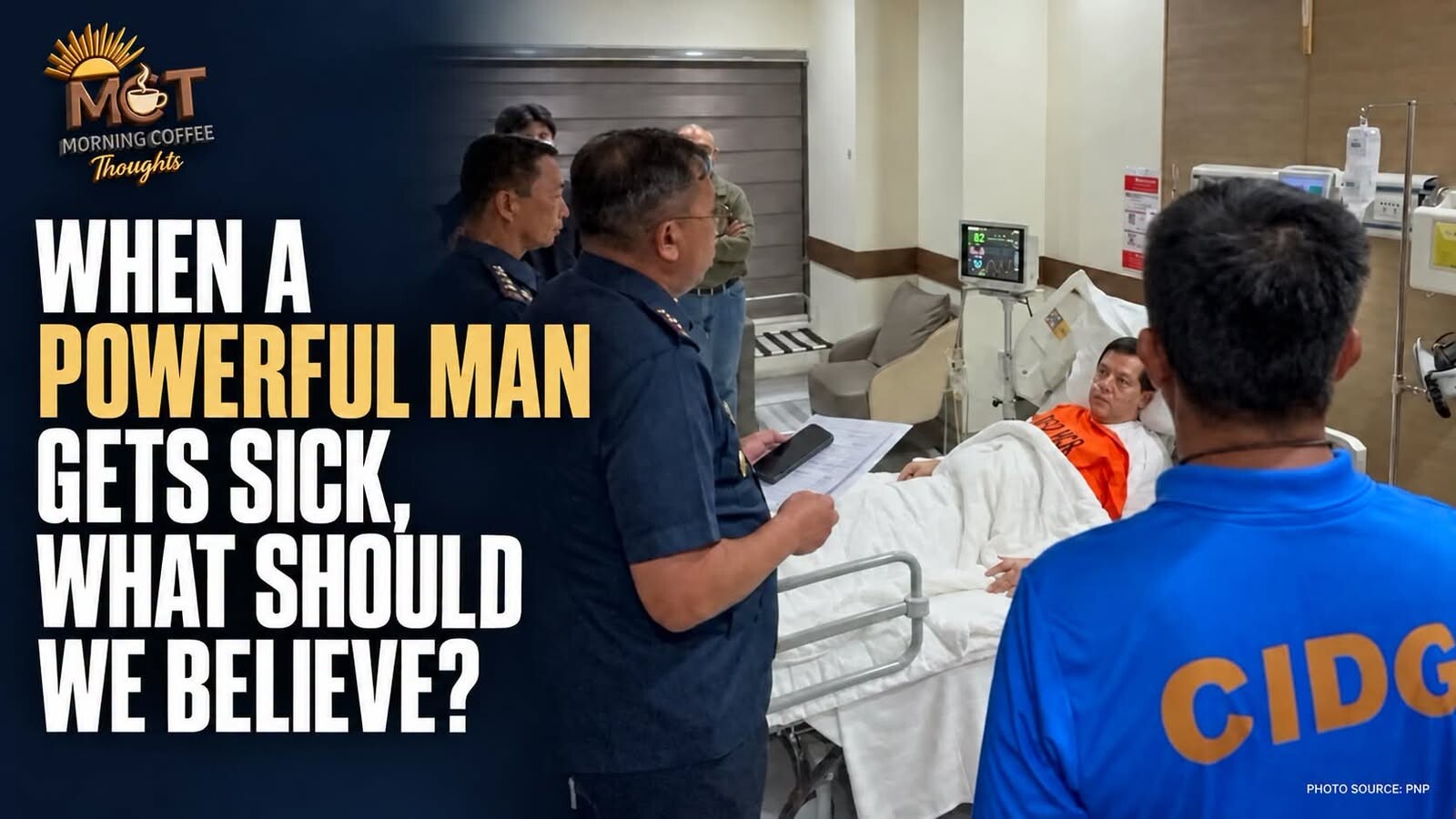
I wanted to understand what was happening to Martin Romualdez because the question was never as simple as whether he had an illness.
One doctor described his condition as a non-emergency. Other doctors warned that moving him could expose him to serious medical risks, particularly a possible heart attack. The doctor who handled his admission did not physically examine him, and a clinical abstract was prepared before he entered the hospital.
Once a powerful politician is arrested inside a hospital, the argument usually moves faster than the evidence. May sakit daw. May palusot daw. People pick a side, then treat every new detail as proof that they were right from the beginning.
The suspicion is understandable. But what do the available facts actually support?
THE LIST OF ILLNESSES DOES NOT ANSWER EVERYTHING
Romualdez’s camp reported a medical history that included coronary artery disease, unstable angina, hypertension, type 2 diabetes, cerebrovascular ischemic disease, dyslipidemia and primary hypothyroidism. It also said he had previously undergone a procedure to open a narrowed or blocked coronary artery.
Those are not minor conditions. Some describe problems that millions of families already know, even if they use simpler words for them: high blood pressure, high blood sugar, abnormal cholesterol and narrowed blood vessels supplying the heart.
Hindi naman kailangang doktor ka para maintindihan na puwedeng magsabay-sabay ang mga iyan. But a list of illnesses still leaves an important question unanswered: what care does he need right now?
A person may have several genuine medical conditions without requiring continuous confinement in one particular hospital. The issue before the court was not whether Romualdez had ever been sick. It was whether his condition required him to remain at Cardinal Santos Medical Center while under arrest.
That was where I wanted the explanation to become more concrete. What were his current findings? What treatment could not be interrupted? Could another properly equipped hospital provide the same care? What exactly made the transfer dangerous?
THE DOCTOR WHO DID NOT EXAMINE HIM
The detail that made me stop was the testimony of Dr. Kurt Allen Sibayan.
At the September 10 hearing, Sibayan said he had been advised that he could not enter Romualdez’s room and did not physically examine him. Romualdez had also gone directly to a hospital room instead of passing through the emergency room.
Sandali. Siya ang nag-asikaso ng admission, pero hindi niya nasuri ang pasyente?
Sibayan later explained that Romualdez’s attending doctors were already there, so he did not need to conduct the examination himself. He also said the clinical abstract he prepared was checked by those doctors.
But another detail remained unusual. Sibayan said the abstract had been prepared a few hours before Romualdez was admitted, after a member of Romualdez’s staff requested it through another doctor.
He told the court that a clinical abstract is usually issued when a patient is discharged.
None of this proves that no doctor examined Romualdez. It does not prove that his illnesses were invented, either. What it gives the court is a trail that can be checked: who examined him, when the examination happened, what the doctors found and how those findings appeared in a document prepared before his admission.
Those details matter because the request was not simply for medical treatment. Romualdez was asking the court to allow him to remain confined in a private hospital instead of being transferred to a detention facility.
WHY THE ACCOUNTS STILL NEED MORE EXPLANATION
Then there is unstable angina. Medical authorities generally treat it as an emergency because reduced blood flow to the heart can precede a heart attack.
That does not tell us whether Romualdez met the diagnostic criteria for unstable angina at every point of his confinement. It does make the doctors’ apparently different descriptions more important to resolve.
Sibayan described Romualdez’s condition at the time as a non-emergency, although he acknowledged the risk of a possible heart attack. Dr. Rosalio Torres cited unstable angina with underlying coronary disease in explaining why Romualdez should remain confined.
Romualdez’s cardiologist, Dr. Rody Sy, testified that his blood pressure had reached 170 over 110 on September 10, prompting an adjustment in his medication. Sy recommended waiting four to six weeks before transferring him so he could recover from conditions aggravated by stress.
Dr. Torres also told the court that Romualdez had no scheduled surgery or invasive procedure at that time. He nevertheless disagreed with the suggestion that there was no serious threat requiring medical attention, based on the evaluations of the specialists handling Romualdez.
The absence of a scheduled procedure does not mean hospital care is unnecessary. Monitoring and medication can also be medically necessary. But it sharpens the question before the court: what exact danger required Romualdez to stay at Cardinal Santos, and could PGH or another properly equipped facility manage it?
Were the doctors describing different moments in his confinement? Were they relying on different observations or test results? Did his condition change after Sibayan described it as a non-emergency?
News reports cannot answer those questions. Neither can a photograph of Romualdez lying in a hospital bed.
Hindi sapat ang “delikado” kung walang malinaw na paliwanag. Hindi rin sapat ang “drama lang” dahil galit tayo sa pasyente. The medical findings have to carry the argument.
THE TRANSFER HAPPENED. THE NEXT ANSWER COMES FROM PGH
On September 12, the Bureau of Jail Management and Penology brought Romualdez from Cardinal Santos Medical Center to the Philippine General Hospital. He arrived at PGH shortly before 9 a.m.
The Sandiganbayan ordered PGH doctors to examine him without the direct or indirect participation or influence of his doctors from Cardinal Santos. The purpose was to verify the earlier medical findings and determine whether continued hospital confinement was necessary.
The transfer was ordered to take place in an ambulance equipped to respond to his heart, brain and other medical conditions. This showed that the court did not simply dismiss the health risks raised by his doctors.
PGH was directed to submit its report and recommendation by September 13 and explain its findings in court on September 14. Romualdez was ordered to remain at PGH until the court ruled otherwise, while his arraignment was moved to September 16.
Early on September 13, PGH’s conclusions had not yet been publicly reported.
The completed transfer does not prove that Romualdez’s doctors were wrong about the risks. It confirms only that the court-ordered transfer was carried out under medical precautions.
The next useful answer must come from PGH. Its doctors should explain what care Romualdez needs, where that care can be provided and whether continued hospital confinement is medically necessary.
WHAT I KEEP COMING BACK TO
Romualdez should receive whatever treatment his condition requires. Medical care should not become punishment before judgment, and he remains presumed innocent while the prosecution tries to prove the plunder charge against him.
His wealth, name and political influence should not answer medical questions that require evidence.
If a detainee without those advantages made the same request, what documents would that person have to submit? How closely would the records be examined? Would several doctors appear in court? Would the government arrange an independent assessment at PGH before deciding where that detainee should stay?
That is the standard I want applied here.
Being under arrest does not cancel a person’s right to treatment. At the same time, a medical history should not decide where a powerful accused stays without a clear explanation of his present condition.
I started reading because I wanted to understand what was happening to Romualdez. The testimony left me asking for something more specific than either suspicion or reassurance.
Show the findings. Explain the medical need. Explain why the arrangement follows from it. Then apply the same standard to someone who has neither his name nor his influence.
Doon natin makikita kung patas.
SOURCES
- GMA Newshttps://www.gmanetwork.com/news/topstories/nation/1001868/doctor-admits-unusual-setup-in-martin-romualdez-s-hospital-confinement/story/
- GMA Newshttps://www.gmanetwork.com/news/topstories/nation/1002023/sandiganbayan-orders-pgh-doctors-to-examine-romualdez/story/
- GMA Newshttps://www.gmanetwork.com/news/topstories/nation/1002111/martin-romualdez-brought-to-pgh-for-independent-medical-assessment/story/
- The Philippine Starhttps://www.philstar.com/headlines/2026/09/12/2555685/sandigan-orders-transfer-romualdez-pgh
- Philippine Daily Inquirerhttps://newsinfo.inquirer.net/2303597/sandiganbayan-orders-transfer-of-martin-romualdez-to-pgh
- ABS-CBN Newshttps://www.abs-cbn.com/news/nation/2026/9/11/no-scheduled-surgery-invasive-procedure-for-romualdez-at-the-moment-doctor-1139
- SunStarhttps://www.sunstar.com.ph/manila/sandiganbayan-orders-romualdez-transfer-to-government-hospital
- American Heart Associationhttps://www.heart.org/en/health-topics/heart-attack/angina-chest-pain/unstable-angina
- National Heart, Lung, and Blood Institutehttps://www.nhlbi.nih.gov/health/angina/treatment
- Cleveland Clinichttps://my.clevelandclinic.org/health/diseases/21744-unstable-angina