
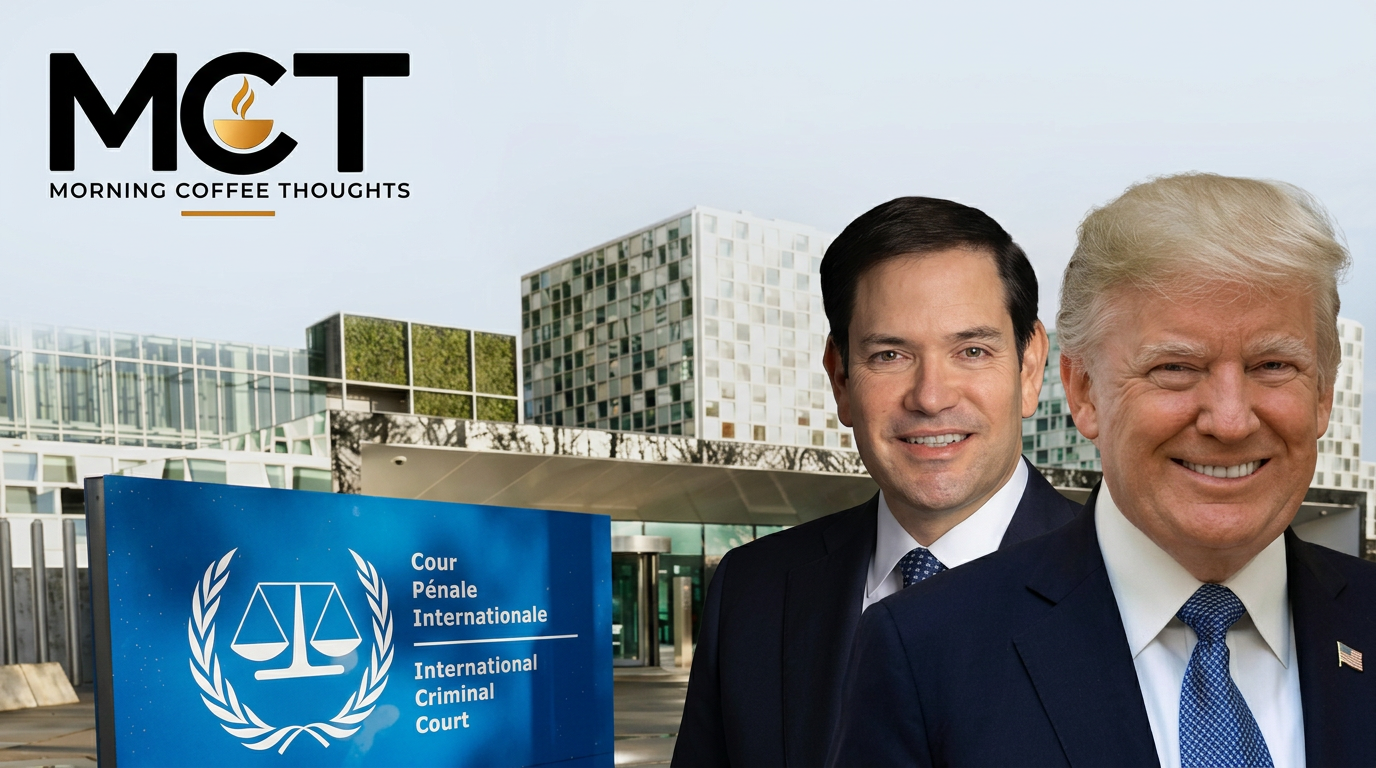
I was reading about Marco Rubio’s November 13 attack on the International Criminal Court when I came across this line:
“Stop quoting laws to men with swords.”
Rubio used that warning while accusing the ICC of trying to enforce rules Washington does not recognize.
The sword is supposed to settle the argument? The law should step aside because someone has the power to punish those enforcing it?
I wanted to understand what was behind this. Was the Trump administration simply defending Netanyahu? Was this another argument about American sovereignty? Why had a disagreement with the court become a campaign to dismantle it?
So I did some reading.
NETANYAHU—AND PROTECTION FOR TRUMP HIMSELF
The Netanyahu connection is right there in Trump’s own executive order.
On February 6, 2025, Trump accused the ICC of abusing its power by issuing what his administration called “baseless arrest warrants” against Israeli Prime Minister Benjamin Netanyahu and former defense minister Yoav Gallant. He promised “tangible and significant consequences.” His order authorized asset freezes and restrictions on entering the US against people involved in the ICC proceedings it covered.
Calling the warrants baseless does not make them so. And we Filipinos should recognize the strategy by now. To me, it is classic DDS messaging: dismiss the allegations as fabricated, call the investigation politically motivated, and attack the institution until people are talking about how unfairly the leader is being treated instead of the accusations. “Walang basehan” becomes the answer before anyone has even checked the evidence. Repeating it may rally supporters, but repetition is not a legal defense.
Then I came across a Reuters report published on December 10, 2025.
An administration official told Reuters that Washington wanted changes to the Rome Statute, the treaty that created the ICC, to make sure the court would not investigate Trump and his top officials. The administration threatened more sanctions if its demands were not met.
According to the official, they were worried that the court might investigate Trump and other senior officials after he leaves office in 2029. Washington also wanted the court to drop proceedings involving Israeli leaders and formally end the earlier investigation involving American troops in Afghanistan.
Saying an investigation has no legal basis is one thing. Asking for the rules to be changed so you cannot be investigated is another.
The first is a legal defense. The second seeks an exemption.
WE HAVE HEARD THIS KIND OF RESPONSE BEFORE
In April 2018, Rodrigo Duterte threatened to arrest ICC prosecutor Fatou Bensouda if she came to the Philippines to investigate his drug war.
“You cannot exercise any proceedings here without basis,” he said. “That is illegal and I will arrest you.” His threat followed his announcement that the Philippines would withdraw from the Rome Statute.
Imagine the message that sends to the families asking for an investigation. The prosecutor is investigating alleged killings, and the president’s response is to threaten her with detention.
Trump has different tools. His administration has imposed sanctions on ICC judges and prosecutors, using American financial and immigration powers to restrict assets, travel, and access to services.
The circumstances differ, but the pattern is familiar: reject the court’s authority, invoke sovereignty, then use state power against the people carrying out its work.
TRUMP HAS A CHEERLEADER IN THE DDS
Interestingly, Trump’s campaign against the ICC has found a willing supporter among the DDS. Greco Belgica, former chair of the Presidential Anti-Corruption Commission, is now cosplaying as Trump’s political adviser. He has urged Trump to dismantle the court before his term ends.
Peanut Gallery Media Network, where Belgica is an anchor, reported his open letter on November 10. He warned that Trump could face a fate similar to Duterte’s after leaving office and called for the “complete dismantling of the illegitimate, unaccountable authority claimed by the ICC.”
Belgica is telling Trump to act while he still has presidential power because he could face the court later. I don’t see a defense of justice in that advice. I see a leader being encouraged to get rid of a court before it might investigate him.
And where does that leave the Filipino families seeking justice through the ICC? Belgica is asking Trump to help destroy the same court they have turned to. Their chance to have the allegations heard should not be sacrificed to protect Duterte, Trump, or anyone else.
SOVEREIGNTY BELONGS TO OTHER COUNTRIES, TOO
The argument against the ICC often starts with a fact and ends with a leap.
The United States did not join the Rome Statute. Therefore, we are told, the ICC cannot investigate Americans.
But nationality is not the court’s only basis for jurisdiction. Under Article 12, where an alleged crime occurred can also give the court authority to act—even when the accused comes from a country that has not joined the treaty. The court still has to show that its jurisdiction applies.
Other countries have sovereignty, too. Their decisions to accept the court’s jurisdiction cannot simply be treated as meaningless whenever an American or a close American ally becomes the subject of an investigation. The ICC’s authority comes from a treaty accepted by participating countries. A prosecutor does not get to declare that the entire world falls under the court.
The Rome Statute also gives genuine national investigations and prosecutions priority. This is called complementarity. The ICC is a court of last resort, not a replacement for every country’s justice system. It deals with genocide, crimes against humanity, war crimes, and the crime of aggression—not every controversial policy or government decision.
Rubio has raised the prospect of American border agents being prosecuted for defending US borders. But, as the Lowy Institute’s analysis explains, allegations involving Americans acting on US territory face a basic problem: does the ICC have the authority to hear the case? In that scenario, the analysis points to a UN Security Council referral, which the United States could block with its veto. Americans operating abroad may fall under the ICC’s authority.
Putting those situations into the same frightening story may convince people. It does not explain the law accurately.
For Filipinos, the claim that rejecting the court automatically ends its authority should sound familiar. On April 22, 2026, the ICC Appeals Chamber confirmed jurisdiction in Duterte’s case over alleged crimes committed during the relevant period when the Philippines was a state party: November 1, 2011, through March 16, 2019. Withdrawal did not erase that jurisdiction.
WHY THREATEN TO DISMANTLE THE INSTITUTION?
By July 2026, Rubio was no longer speaking only about opposing individual investigations.
“Using all the tools at our government’s disposal, working beside every ally with whom we can make common cause, we will dismantle the ICC—brick by brick, if necessary,” he said.
The reported campaign included sanctions, travel restrictions, and efforts to get other countries to stop supporting the court. Reuters also reported that concern about possible future cases against Trump administration officials formed part of the campaign.
On October 9, 2026, the United States imposed sanctions on the ICC itself, following earlier sanctions against judges and prosecutors. The court condemned the move as an attempt to disrupt its operations and intimidate those working with it.
The administration calls this a defense of sovereignty. I see a government willing to weaken a court when it reaches people Washington wants to protect.
But the ICC is not an American agency that Trump can abolish by instruction. It exists through a treaty among countries. Washington can impose costs, obstruct cooperation, and pressure other governments. It cannot cancel that treaty on its own.
Other governments have pushed back. The Bureau of the Assembly of States Parties condemned the sanctions against the institution and reaffirmed support for the court’s independence and mandate.
Those statements need to be followed by continued cooperation. Otherwise, American pressure gets to decide how far the court can go.
A FLAWED COURT IS NOT AN ARGUMENT FOR AN OBEDIENT ONE
The ICC has weaknesses. Its delays, how its prosecutors handle cases, how it answers for its own failures, and its dependence on government cooperation all deserve criticism. Even some analysts who oppose the effort to destroy it raise these concerns.
We can ask for better investigations, fairer procedures, and stronger safeguards. None of that requires a court that knows which governments and officials it must never inconvenience.
An arrest warrant is not a conviction. Netanyahu is entitled to challenge the allegations and the court’s authority. Duterte is entitled to defend himself. Anyone accused deserves a fair process.
We should not presume guilt because we dislike a leader. Neither should friendship with Washington become a substitute for answering a case.
Governments can disagree with courts and challenge their decisions. Trump’s administration has gone further: punishing the people doing the work, sanctioning the court itself, threatening to dismantle it, and reportedly demanding protection from future investigations.
That is what I object to.
THESE ATTACKS CAN DO DAMAGE. THEY CANNOT PROVE INNOCENCE.
Sanctions can interfere with financial services, travel, and the day-to-day work of ICC officials. Sanctioning the court itself extends that pressure beyond the individuals already targeted.
We should not confuse the ability to obstruct a case with the ability to answer it.
Freezing an asset does not disprove an allegation. Restricting a judge’s travel does not settle a dispute over the court’s authority. Making a prosecutor’s work harder does not show that the person being investigated is innocent.
The damage would also extend beyond the people Trump wants protected. Weakening the court to obstruct one set of proceedings can make it harder to pursue others.
People seeking justice should not have to depend on whether their case happens to suit the foreign policy of a powerful country.
THE SWORD IS WHY THE LAW MATTERS
Governments and officials can hold enormous power over the people accusing them. They can control institutions, command armed forces, and punish those who investigate.
If possessing the sword means you get to decide when the law applies, what protection remains for those on the receiving end of that power?
We can demand that the ICC be competent, fair, and accountable. We can challenge its decisions and insist that it stay within its authority.
But demanding a better court is not the same as demanding one that leaves you and your allies alone.
If your commitment to justice disappears the moment an independent court reaches your friends—or might one day reach you—were you defending justice in the first place, or only your place above it?
SOURCES
- France 24https://www.france24.com/en/live-news/20261113-rubio-takes-swipe-at-international-law-attacks-icc
- White Househttps://www.whitehouse.gov/presidential-actions/2025/02/imposing-sanctions-on-the-international-criminal-court/
- Reutershttps://www.reuters.com/world/us/us-threatens-new-icc-sanctions-unless-court-pledges-not-prosecute-trump-2025-12-10/
- Philstarhttps://www.philstar.com/headlines/2018/04/14/1805768/duterte-threatens-icc-chief-arrest
- Reutershttps://www.reuters.com/article/world/duterte-to-withdraw-philippines-from-icc-after-outrageous-attacks-idUSKCN1GQ0M8/
- Harvard Law Schoolhttps://hls.harvard.edu/today/u-s-sanctions-against-the-international-criminal-court/
- International Criminal Court — Rome Statutehttps://www.icc-cpi.int/sites/default/files/Rome-Statute.pdf
- Just Securityhttps://www.justsecurity.org/153955/rubio-wants-help-dismantling-icc/
- International Criminal Court — Rome Statute, 2024 publicationhttps://www.icc-cpi.int/sites/default/files/2024-05/Rome-Statute-eng.pdf
- Lowy Institutehttps://www.lowyinstitute.org/the-interpreter/rubio-s-icc-broadside-misreads-the-court-s-own-limits
- International Criminal Court — Duterte jurisdiction rulinghttps://www.icc-cpi.int/news/icc-appeals-chamber-confirms-jurisdiction-duterte-case
- CNNhttps://www.cnn.com/2026/07/13/politics/rubio-dismantle-international-criminal-court
- Reutershttps://www.reuters.com/world/trump-administration-launches-effort-isolate-international-criminal-court-2026-07-13/
- International Criminal Court — Response to sanctions against the institutionhttps://www.icc-cpi.int/news/icc-strongly-rejects-us-sanctions-against-institution
- Voxhttps://www.vox.com/podcasts/497381/international-criminal-court-trump-rubio-dismantle-explained
- Assembly of States Partieshttps://www.icc-cpi.int/news/bureau-assembly-states-parties-regrets-sanctions-against-icc-institution
- Peanut Gallery Media Network — November 10, 2026https://peanutgallerynews.com/greco-belgica-appeals-trump-icc/