
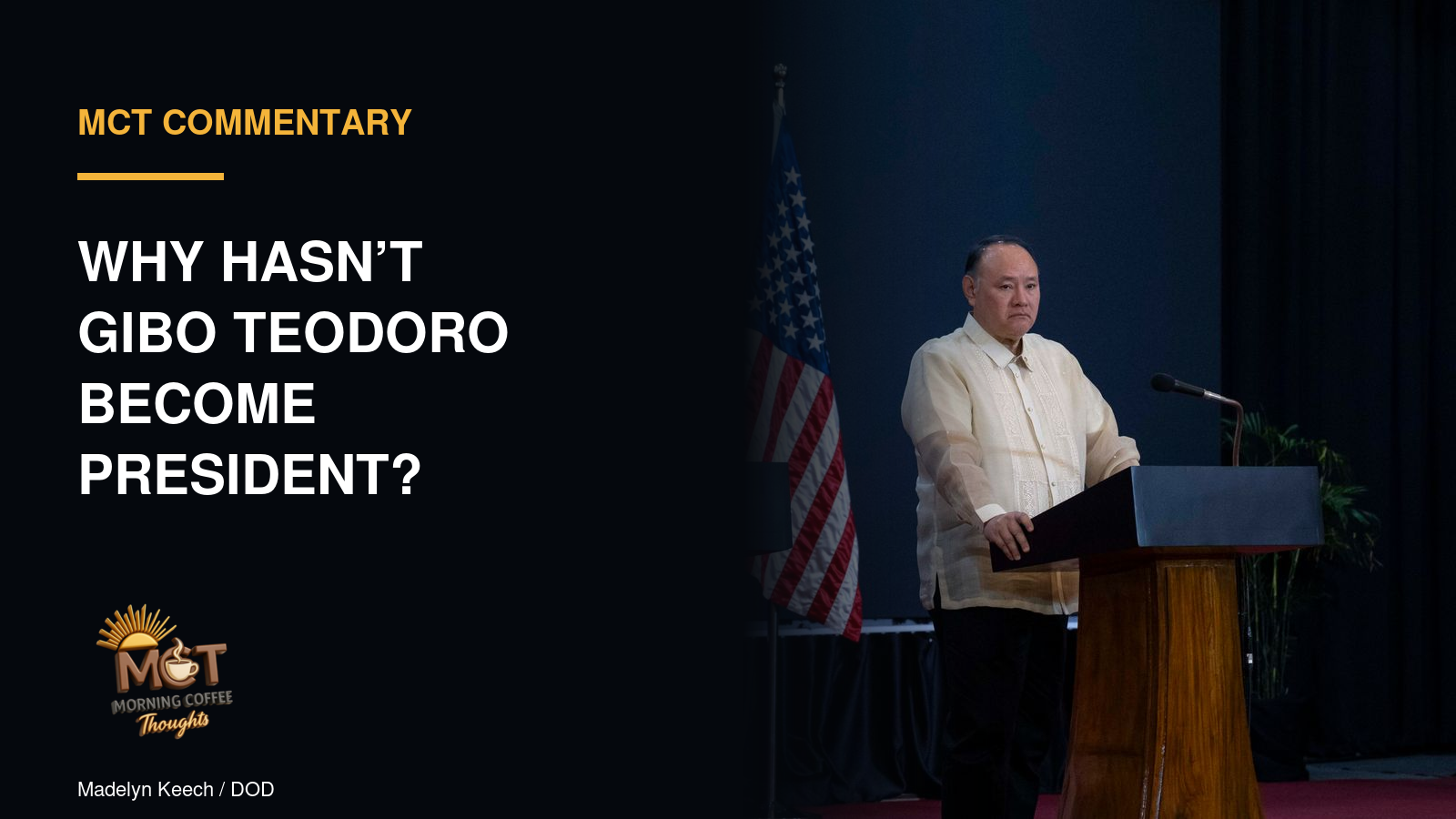
I have long been impressed by Gibo Teodoro. Yesterday, watching him respond to a note passed to him while he was speaking at the Seoul Defense Dialogue, I found myself impressed all over again.
The note challenged the arbitration ruling on the South China Sea, and Teodoro answered it openly before the audience. According to forum organizers quoted by Yonhap, it came from a Chinese military attaché and was delivered through a staff member. (Yonhap, Inquirer)
What made me go “wow” was his composure. To me, he looked cool, calm and collected even as he delivered a sharp rebuke.
I will be honest: I have never voted for the man. That admission belongs here, because I am also asking myself why someone I have long found impressive never became my choice on the ballot.
Watching him yesterday made me curious enough to look deeper. Why did his presidential bid fall short, and why has someone with his sharpness struggled to attract enough support from Filipino voters?
I wanted to understand what I might have overlooked. So I went back to his campaign, his political decisions and the record beyond the moments that made me admire him.
THE QUALIFICATIONS WERE THERE
Teodoro topped the 1989 Bar examinations, studied law at the University of the Philippines and earned a master’s degree in law at Harvard. He also served in Congress and as defense secretary under Gloria Macapagal-Arroyo. (PCIJ, official biography)
There is a reasonable basis for taking him seriously. His legal education and experience in government give a supporter something concrete to point to.
My own voting history, however, makes me pause before assuming those qualifications should have been enough. I could admire him and still choose someone else, so I cannot pretend the reasons behind other people’s votes must be simple.
An election puts a candidate’s decisions and political relationships before the public, too. That is where the picture of Teodoro becomes more complicated.
THE ADMINISTRATION HE REPRESENTED
Teodoro received 4,095,839 votes in the 2010 presidential election. He finished fourth behind Benigno Aquino III, Joseph Estrada and Manny Villar.
Aquino received 15,208,678 votes. Teodoro had millions of supporters, but the distance between their totals shows how much more support his campaign needed. (Final canvass report)
One obstacle was his association with Arroyo. He ran as the candidate of the governing Lakas-Kampi-CMD coalition while her presidency was receiving deeply unfavorable public assessments. (GMA News)
Pulse Asia’s March 2010 survey recorded 14 percent approval of Arroyo’s performance and 59 percent disapproval. Those numbers describe public opinion of her presidency, so they cannot tell us exactly how many votes that association cost Teodoro. (Pulse Asia)
Contemporary reporting does help explain the difficulty. Analysts interviewed by GMA connected Arroyo’s unpopularity and Teodoro’s weak survey standing with politicians leaving the governing party. (GMA News)
I can understand why an unhappy voter would hesitate over the administration’s candidate. Teodoro’s ability would not automatically settle questions about whose policies he would continue or how independent he would be.
That was a political burden his campaign had to address. A degree from Harvard could tell voters something about his education, but it could not answer those questions for him.
Aquino, meanwhile, campaigned on anti-corruption and transparency. Reporting from the period also described the public response to Corazon Aquino’s death as part of the circumstances that brought her son into the race. (Reuters, The Philippine Star)
A voter looking for a break from Arroyo had another candidate making that appeal. Whether Aquino later fulfilled the expectations placed on him is a separate assessment from understanding why someone might have chosen him in 2010.
Estrada and Villar also attracted more votes than Teodoro. His difficulty was broader than losing to Aquino, and an explanation based only on the eventual winner would leave part of the election unanswered. (Final canvass report)
THE PARTY WAS DIVIDED
It would be inaccurate to describe Teodoro as an outsider campaigning without powerful backing. He had a major political organization behind him, although keeping it together proved difficult.
Reuters reported senior party resignations and allies moving their support elsewhere. GMA’s examination of his campaign also described disputes with politicians who had previously backed him. (Reuters, GMA News)
Among them was House Speaker Prospero Nograles, who objected to Teodoro leaving the party chairmanship during the campaign. Teodoro maintained that he still had support and could win. (GMA News)
Those disagreements prevent me from seeing him simply as a candidate whose only problem was being attached to an unpopular president. His handling of the organization was also being questioned.
I would be careful about assigning blame from those accounts alone. A struggling campaign can lose allies, and losing allies can make the campaign weaker.
What is clear is that a party endorsement did not keep everyone working toward the same presidential result. Teodoro had to deal with doubts about the outgoing administration while facing disagreements inside the organization supporting him.
HIS OWN DECISIONS DESERVE A LOOK
There is another reason I cannot stop at his qualifications. His political record includes decisions people could object to even while acknowledging his intelligence.
In October 2003, Teodoro and Felix William Fuentebella filed an impeachment complaint against Chief Justice Hilario Davide Jr. The Supreme Court ruled that the second complaint was barred by the Constitution’s prohibition against initiating impeachment proceedings against the same official more than once within a year. (Supreme Court decision, via Lawphil, contemporary reporting)
The ruling concerned the constitutional limit on the proceedings. It should not be described as a judicial finding that Teodoro fabricated the allegations.
GMA returned to that controversy during the 2010 campaign. Teodoro defended his participation as having a basis, while Davide strongly criticized the move. (GMA News)
I cannot say how much that episode influenced the election result. It does show why a voter’s hesitation could come from a disagreement with Teodoro’s judgment, rather than a failure to recognize his ability.
That is a distinction I need to apply to my own admiration. Being impressed by an answer at a public forum should make me interested in how he has exercised power, including the decisions that are less flattering to him.
THE SENATE BID RAISES ANOTHER QUESTION
His return to electoral politics took a different route. In June 2021, Teodoro expressed willingness to become Sara Duterte’s running mate if she sought the presidency, and he filed to run for senator that October. (Inquirer, OneNews)
He was included in the Marcos–Duterte UniTeam Senate slate. The candidacy therefore had backing from national political figures with whom he had chosen to associate. (GMA News, The Philippine Star)
Teodoro received more than 12 million votes in the 2022 Senate election but finished fifteenth and did not win a seat. Again, he had considerable support that fell short of election. (COMELEC, The Freeman)
This is difficult to reconcile with an explanation built mainly around the absence of powerful allies. Endorsements were there, yet they did not produce enough votes for him.
We should still be careful about what an endorsement means. Inclusion in a slate does not tell us how much effort every member of that coalition put into electing each candidate.
Nor can his Senate total be treated as a presidential vote waiting to happen. People choosing several senators can support candidates whose political backgrounds differ, while the presidency asks them to select one person.
His willingness to run with Sara deserves attention in its own right. A voter assessing him is entitled to ask what that choice says about the people and policies he was prepared to support.
I can respect his sharpness and still ask that question. It would be unfair to judge other candidates by their alliances while treating his as an incidental detail.
WHAT HAS HE SAID ABOUT RUNNING AGAIN?
The question of a presidential push today also needs an answer from Teodoro himself. It is easy to discuss who should run without checking whether that person is prepared to pursue the office.
In a May 30, 2026 Reuters interview, Teodoro said he had no plans to run in 2028 and indicated that he should continue his existing work. ABS-CBN and Manila Bulletin reporting dated July 13 likewise described his stated focus on defense rather than political plans. (Reuters, ABS-CBN, Manila Bulletin)
Those were his positions at those times. They should not be turned into a permanent promise about what he will do in the future.
They do, however, belong near the center of this discussion. The years since 2010 cannot simply be described as one continuing presidential campaign that Filipinos have repeatedly declined to support.
His defense work gives people a reason to examine him again. Recent reporting documents his positions on China and military cooperation, although agreement with those positions does not establish willingness to elect him president. (Reuters)
A presidential campaign would have to explain how he would approach the wider responsibilities of the office. I would want to hear his plans for the problems people face at home, along with how he would pay for those plans and get them carried out.
Supporters could begin organizing before he makes a decision. But the difference between wanting someone to run and building an effective campaign would eventually require his participation.
THE LIMITS OF WHAT WE KNOW
Pulse Asia’s July 2026 report did not include Teodoro among the six named choices in its main presidential preference question. The table also recorded unaided mentions of other people without showing a Teodoro entry. (Pulse Asia, Table 2)
That leaves us without a preference score for a contest in which respondents were explicitly offered his name. His absence does not prove that nobody would vote for him, and it gives us no basis for claiming a large, hidden movement either.
I cannot turn my reaction to yesterday’s exchange into a national estimate. We would need surveys that test his candidacy and reliable information about the people willing to organize a campaign.
His previous election results help explain what happened then. The size of his support today remains a question that those old totals cannot answer.
WHAT I TAKE FROM ALL THIS
When I was in my twenties, I courted an Atenean. She was a combination of beauty, brains and guts, and we dated for a while, pero hindi naging kami.
I remember what she told me: “I find you very interesting. But interesting is not enough.”
Those words became a lifelong lesson. Years later, they help me explain how I feel about voting for Gibo Teodoro.
I find him very interesting, and I admire the sharpness and composure I saw yesterday. But choosing a president asks more of me than recognizing someone’s intelligence or enjoying the way he handles a difficult exchange.
I would need to be persuaded by his decisions, the people he chooses to work with, and what he intends to do with the power he is asking voters to give him. His record deserves the same attention I gave that moment in Seoul.
I have never voted for Gibo Teodoro. Whether that changes would depend on what I learn about him beyond the qualities that have long impressed me.
He is very interesting. But interesting, to me, is never enough.
SOURCES
- Yonhap, Seoul forum note incident.https://en.yna.co.kr/view/AEN20260908006551315
- Inquirer, Chinese note interrupts Teodoro at Seoul forum.https://www.inquirer.net/488031/chinese-note-interrupts-teodoro-at-seoul-forum/
- PCIJ, Teodoro’s education and background.https://pcij.org/2010/05/01/scary-brilliant-guy-brzero-social-love-life/
- Presidential Communications Office, Teodoro appointment and biography.https://pco.gov.ph/news_releases/pbbm-appoints-gilberto-teodoro-to-dnd-ted-herbosa-to-doh/
- The Philippine Star, 2010 final canvass report.https://www.philstar.com/headlines/2010/06/09/582310/canvass-over-its-noynoy-binay
- Pulse Asia, March 2010 general report.https://pulseasia.ph/wp-content/uploads/2025/05/2010-UB-March-2010-General-Report.pdf
- GMA News, Defections from Arroyo’s party.https://www.gmanetwork.com/news/topstories/nation/176529/sensing-defeat-in-2010-polls-allies-leave-arroyo-s-party/story/
- Reuters, Arroyo coalition disputes.https://www.reuters.com/article/world/party-woes-may-hurt-philippines-arroyos-ambitions-idUSTRE62U2BZ/
- Reuters, Aquino’s campaign and defense proposals.https://www.reuters.com/article/economy/aquino-vows-more-spending-for-philippines-defence-idUSSGE63L0BR/
- GMA News, Examination of Teodoro’s 2010 campaign and political decisions.https://www.gmanetwork.com/news/topstories/specialreports/190480/miscalculations-spell-doom-for-gibo-s-presidential-bid/story/
- Supreme Court, via Lawphil, Francisco Jr. v. House of Representatives, November 10, 2003.https://lawphil.net/judjuris/juri2003/nov2003/gr_160261_2003.html
- The Philippine Star, October 2003 Davide impeachment complaint.https://www.philstar.com/headlines/2003/10/24/225245/house-impeaches-davide
- Inquirer, Teodoro on a possible Sara Duterte presidential candidacy.https://newsinfo.inquirer.net/1442543/sara-duterte-did-not-say-she-is-certain-to-run-for-president-says-gibo-teodoro
- OneNews, Teodoro’s vice-presidential and Senate plans.https://www.onenews.ph/articles/teodoro-time-not-ripe-for-vice-presidential-run
- GMA News, Marcos–Duterte Senate slate announcement.https://www.gmanetwork.com/news/topstories/nation/818765/marcos-duterte-bares-six-in-uniteam-s-senate-slate-for-eleksyon-2022/story/
- The Philippine Star, Marcos–Duterte Senate slate.https://www.philstar.com/headlines/2022/01/20/2155185/ten-senatorial-bets-marcos-dutertes-senatorial-slate
- COMELEC, 2022 senatorial summary statement of votes.https://www.comelec.gov.ph/?r=2022NLE/ElectionResults_/SenatorialSummaryStatementofVotes
- The Freeman, Teodoro’s 2022 result and subsequent plans.https://www.philstar.com/the-freeman/cebu-news/2022/06/26/2190940/gibo-run-again-senator-2025
- Reuters, May 30, 2026 interview.https://www.reuters.com/world/china/philippines-remains-under-threat-china-despite-trump-xi-summit-minister-says-2026-05-30/
- ABS-CBN, Teodoro on defense work and a possible 2028 run.https://www.abs-cbn.com/news/nation/2026/7/13/-kung-uukol-bubukol-teodoro-says-focus-remains-on-defense-not-2028-presidential-race-2149
- Manila Bulletin, Teodoro’s stated focus on defense.https://mb.com.ph/2026/07/13/teodoro-shuns-political-plans-focused-on-job-as-defense-chief
- Reuters, September 7, 2026 security interview.https://www.reuters.com/world/china/philippines-teodoro-says-china-could-exploit-cuts-us-south-korean-exercises-cuts-2026-09-07/
- Pulse Asia, July 2026 report on the May 2028 elections.https://pulseasia.ph/wp-content/uploads/2026/07/MR2-UB2026-2-MR-on-the-May-2028-Elections-Final.pdf
The appearance of U.S. Department of War (DoW) visual information does not imply or constitute DoW endorsement.