
LATEST COMMENTARY
FIVE THINGS TO KNOW
MCT READER PULSE · MCT-PULSE-2026-017
MCT READER SURVEY
Gaano ka nagtitiwala na tama ang ginagawa ng Kongreso sa budget ng bayan?
This is an informal survey of people who choose to participate. It is not a scientific or nationally representative sample.
ABOUT ONLINE LENDING APPS: FIVE REASONS NOT TO BORROW IN A RUSH
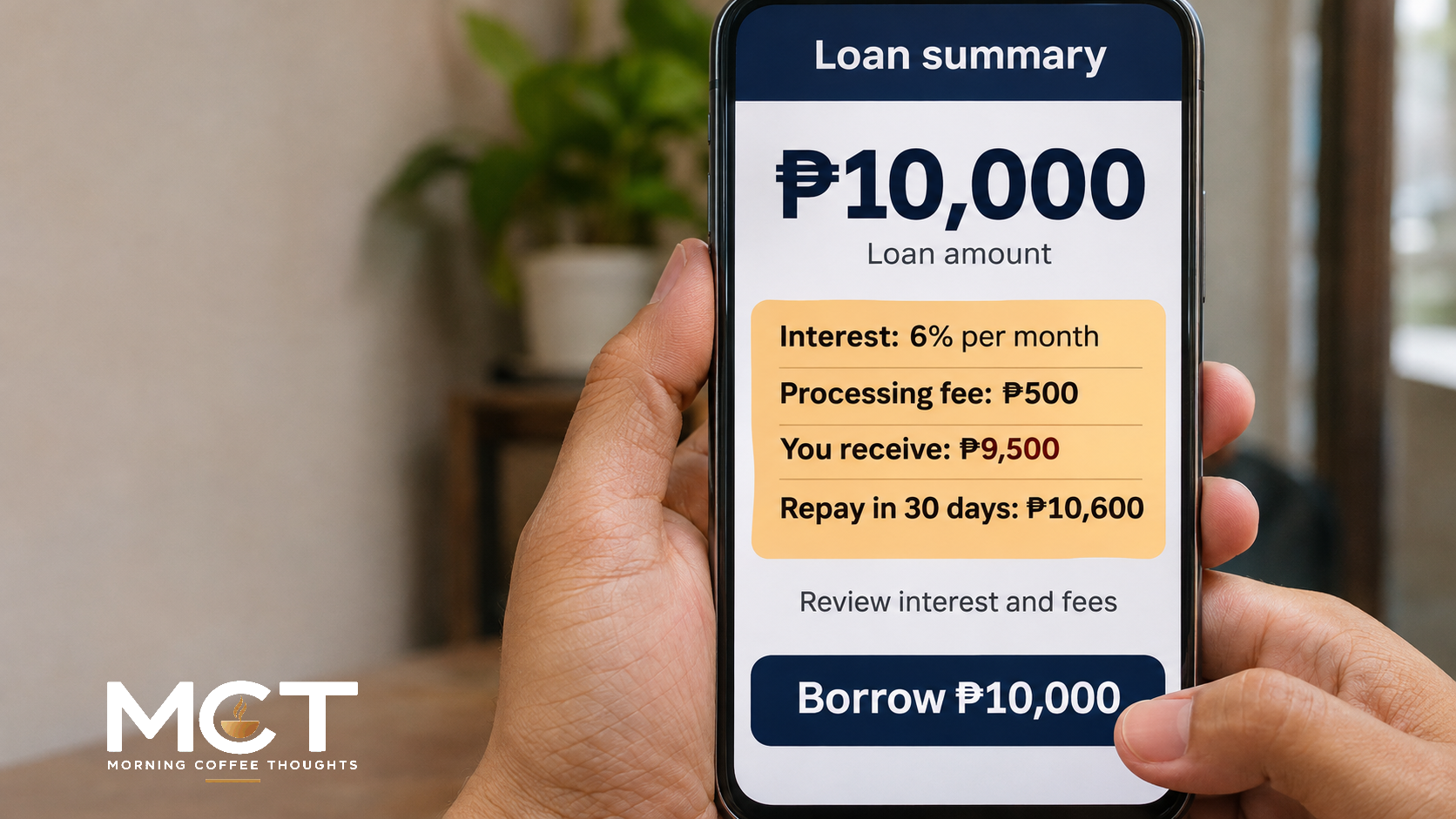
You need ₱5,000 today. An app offers to send the money before payday, but the offer shows less cash after fees. The loan comes due in a month, and the app wants access to your contacts. Before you tap Accept, check what the loan will cost and what the company is asking you to hand over.
1
CHECK HOW MUCH CASH YOU ACTUALLY GET
Suppose the app says you borrowed ₱5,000. It deducts a ₱200 processing fee, so ₱4,800 reaches your e-wallet. If you owe ₱5,300 in 30 days, you’re paying ₱500 to use ₱4,800 for a month. That’s about 10.4% of the cash you received, even though the interest alone was ₱300. This is an example, not a quote from a lender.
Before accepting, read and save the written disclosure. Look for the amount you’ll receive, every fee, the effective interest rate, what you’ll pay in total, and the due dates. Check which charges apply if you’re late. If you can’t find those numbers before accepting, walk away.
2
A LEGAL RATE CAN STILL BE EXPENSIVE
For unsecured, general-purpose loans of up to ₱10,000 and up to four months from lending or financing companies, the SEC caps the stated interest at 6% a month. The effective rate, which counts interest and other loan fees but excludes late penalties, cannot exceed 12% a month. Late or missed-payment penalties are capped at 5% a month on the unpaid amount already due. All interest, fees and penalties combined cannot exceed 100% of the amount borrowed. Those rules cover qualifying loans taken out, renewed or restructured from April 1, 2026. They don’t set one rate for every loan you can get on a phone.
Look at your next payday before you borrow. If repaying the app would leave you without rent or grocery money, ask the biller about installments first. If you have access to a salary advance, a cooperative or a bank loan, compare the total peso cost and the repayment dates. Taking out a second app loan to pay the first can leave you with another set of fees and another due date.
3
DON’T GIVE A LOAN APP YOUR WHOLE PHONEBOOK
Check the exact app name against the SEC’s list of recorded online lending platforms and match it to the company named in the contract. Check that the company has authority to lend. Being in an app store or showing an SEC registration number by itself isn’t enough.
During setup, check whether the app wants access to your phone’s entire contact list or asks you to enter selected references yourself. Those requests give it different amounts of information. Read what it will collect, why it needs it and whether you can provide individual names and numbers without opening your whole phonebook. Limited contact access may be allowed for specified, necessary purposes; unrestricted access is not something you have to accept without question.
Some apps may let you apply without whole-phonebook access but still require selected references. Refusing those details may stop you from completing the application. Do not count on being able to decline every contact request and still proceed. If the app blocks the next step, read its privacy notice and ask its official support whether there is a way to provide only the information needed. If it cannot explain the access it demands, do not continue.
A character reference helps verify your identity or the information in your application. Inform the person before listing them. Naming someone as a reference or emergency contact does not automatically make them responsible for your balance or authorize collection calls to them. A guarantor must separately agree to back the loan. Granting a phone permission does not give collectors permission to harass people in your contacts.
4
COLLECTION CAN REACH YOUR FAMILY, COWORKERS AND SOCIAL MEDIA
With abusive lending apps, collection can spread beyond your own phone. A collector may repeatedly call or send insulting messages, then use a copied contact list to reach relatives, coworkers or your employer. Those people may be told your name and unpaid balance, asked to pressure you, or falsely told they are responsible for your loan. You can end up explaining a private debt to people who had nothing to do with it.
The abuse can also move online. A borrower’s photo may be circulated with accusations about an unpaid loan, or personal details may be posted where other people can see and use them. Exposing someone’s private information, such as their phone number or home address, to invite harassment is commonly called doxing. A selfie or ID photo submitted to verify a loan application must never become material for humiliating the borrower.
Collectors may ask for repayment, but threats of violence, insults, false claims and public shaming are prohibited. They cannot use your phonebook to chase people who never agreed to guarantee the loan. Giving an app permission to access contacts does not authorize this abuse. A lending company remains responsible for its collection practices even when it hires an outside agency to make the calls.
Harassment does not automatically cancel a valid debt. Ask the lender for a written breakdown of the principal, interest, fees, penalties and payments already credited. Dispute charges you do not recognize through its official channel. Keep that repayment discussion separate from your complaint about the collector’s conduct. You can challenge abusive collection while asking how to settle the amount you actually owe.
5
SAVE THE EVIDENCE AND REPORT THE ABUSE
Before blocking a number or deleting the app, save the loan agreement, payment records, app name, developer and company details. Keep complete messages and call logs with the sender’s number or account, dates and times. For a public post, save its link and screenshots showing who posted it. Ask affected contacts to keep the messages they received and send you copies. This helps show what the collector actually said and who else was contacted.
Revoke unnecessary access to contacts, photos and other phone data. Removing permission or uninstalling the app cannot retrieve information the operator has already copied. Tell affected relatives or coworkers that their number may have been used for collection and ask them not to forward your personal details. After preserving evidence of a shaming post, report it through the platform’s privacy or harassment tools and request removal.
For a lending or financing company’s abusive collection or undisclosed charges, send a written complaint through its official channel and keep its reply or your unanswered request. If unresolved, file through the SEC iMessage portal. Attach the agreement, a timeline, evidence of the abuse and proof of your attempt to resolve it with the company. Name both the app and its operator. If the operator is unclear, include the app-store listing or website so the SEC can identify it.
For misuse of contacts, photos or other personal data, use the National Privacy Commission’s complaint form. Describe what information was accessed or exposed, who received it and the harm it caused; attach your supporting records. Follow the NPC’s current filing instructions, including notarizing the complaint and submitting it through one of its listed channels. A complaint about collection and a complaint about misuse of personal data can concern the same incident.
For threats or online scams, contact the PNP Anti-Cybercrime Group or the NBI Cybercrime Division with the same evidence. If someone threatens immediate physical harm, seek police help promptly instead of waiting for the lender to answer your complaint.
BOTTOM LINE
Before borrowing, check both the full repayment cost and the access the app wants to your phone. If collection turns abusive, preserve the evidence and report the conduct while clarifying the actual balance. If the lender is a bank or another BSP-supervised institution, raise the complaint with that institution first and escalate unresolved issues to the Bangko Sentral. The complaint portals and instructions are listed below.
SOURCES
- SEC Memorandum Circular No. 14, series of 2025, interest and fee ceilings effective April 1, 2026 https://www.sec.gov.ph/wp-content/uploads/2026/01/2026MC-No-14-S-of-2025-Recalibrated-Ceilings-on-Interest-Rates-and-Other-Fees-Charged-by-FLCs.pdf
- SEC Memorandum Circular No. 18, series of 2019, unfair debt collection https://www.sec.gov.ph/mc-2019/mc-no-18-s-2019-prohibition-on-unfair-debt-collection-practices-of-financing-companiesfc-and-lending-companieslc/
- National Privacy Commission Circular No. 2022-02, loan app privacy, references and guarantors https://privacy.gov.ph/wp-content/uploads/2023/05/NPC-Circular-No.-2022-%E2%80%93-02-Amending-20-01-Loan-Related-Transactions.pdf
- DICT, NPC and SEC joint advisory on online lending platforms, March 18, 2026 https://privacy.gov.ph/wp-content/uploads/2026/03/DICT-NPC-SEC-Public-Advisory-on-Online-Lending-Platforms.pdf
- SEC list of recorded online lending platforms https://www.sec.gov.ph/lending-companies-and-financing-companies-2/list-of-recorded-online-lending-platforms
- SEC lending and financing complaint instructions https://www.sec.gov.ph/lending-companies-and-financing-companies/complaints/
- SEC iMessage complaint portal https://imessage.sec.gov.ph/
- National Privacy Commission complaint instructions https://privacy.gov.ph/filing-a-complaint/
- Bangko Sentral consumer complaint channels https://www.bsp.gov.ph/Pages/InclusiveFinance/ConsumerAssistanceChannelsChatbot.aspx
- National Privacy Commission, complaints about lenders contacting borrowers’ phonebooks https://privacy.gov.ph/npc-conducts-hearings-on-48-online-lending-apps-after-over-400-harassment-complaints/
- National Privacy Commission, findings on misuse of contacts and online shaming in a lending-app case https://privacy.gov.ph/online-lending-firm-found-criminally-liable-for-violating-data-privacy-law/
GOOGLE PREFERRED SOURCES
FOLLOW MCT ON GOOGLE
Google’s Preferred Sources feature lets you choose publications you want Google to prioritize for you. Select “Add to Preferred Sources” to make MCT easier to find in Top Stories and other eligible Google results. This does not subscribe you to email.