
LATEST COMMENTARY
FIVE THINGS TO KNOW
MCT READER PULSE · MCT-PULSE-2026-017
MCT READER SURVEY
Gaano ka nagtitiwala na tama ang ginagawa ng Kongreso sa budget ng bayan?
This is an informal survey of people who choose to participate. It is not a scientific or nationally representative sample.
ABOUT UNPAID PERSONAL LOANS: WHAT TO DO WHEN SOMEONE WON’T PAY YOU BACK
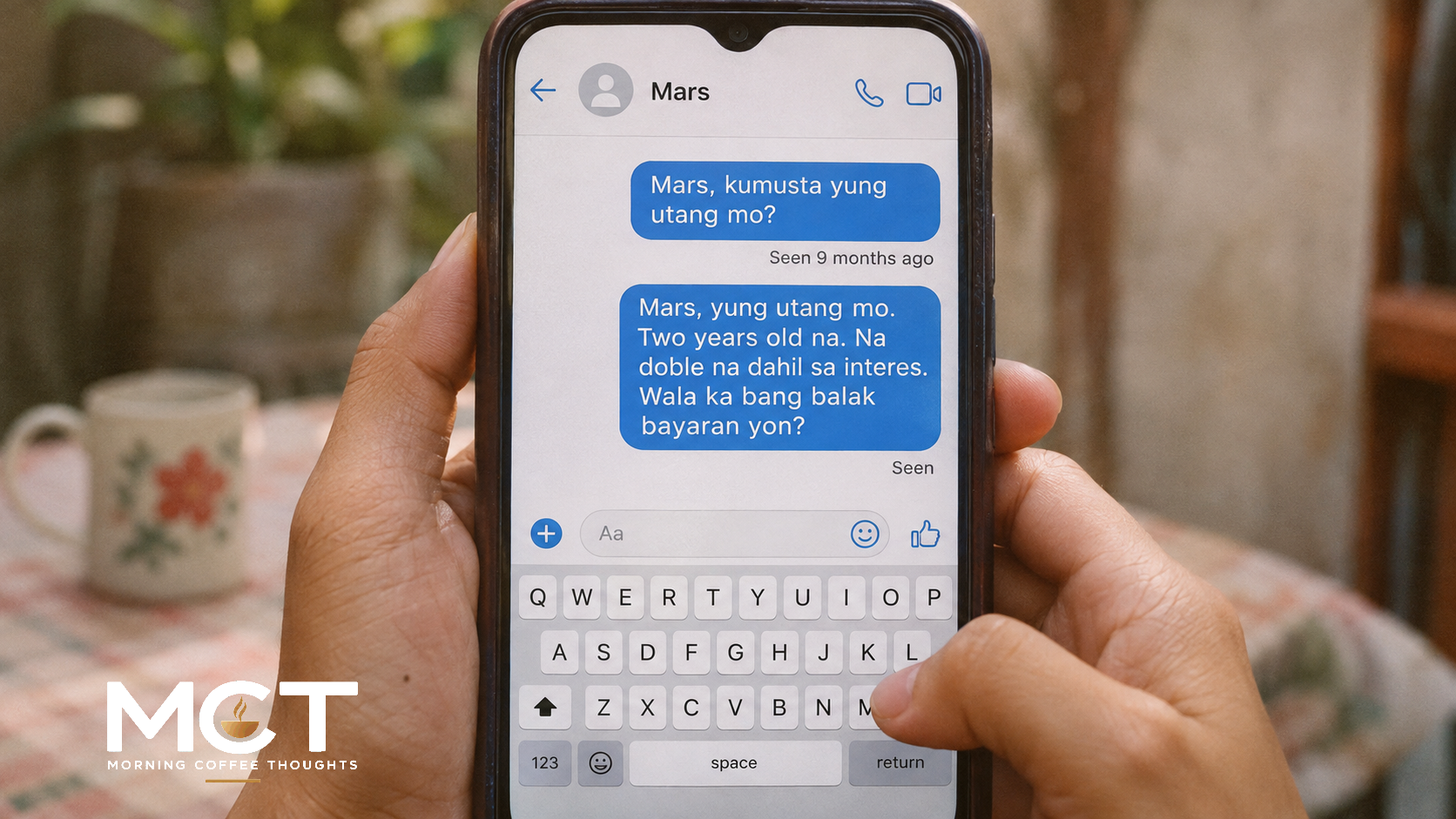
You lent someone money. The due date passed, and every follow-up gets another “next week.” Before you send another message, put together what you can prove: how much you lent, when it was due, and how much is still unpaid.
1
SAVE WHAT SHOWS IT WAS A LOAN
Keep the signed agreement or promissory note if you have one. Save bank or e-wallet receipts, the full message thread about the loan, and records of any partial payments. Write down the dates and compute the balance. A transfer receipt can show money changed hands; a message acknowledging the loan or promising repayment helps show why it was sent.
No signed agreement? You can still gather evidence. Keep the original messages and records, not just cropped screenshots. Be ready to explain who sent the messages and how you know.
2
ASK FOR PAYMENT IN WRITING
Once the loan is due, send a clear written demand. State the amount lent, what has already been paid, the remaining balance, and the date by which you’re asking them to pay. Keep a copy and proof it reached them, such as a signed acknowledgment or a courier’s delivery record. Don’t add a loan interest rate that wasn’t expressly agreed to in writing.
If you’re willing to accept installments, put the amounts and dates in an agreement both of you can keep. Record each payment. If the loan is already several years old, get legal advice promptly: deadlines for filing can depend on how the loan was agreed and what happened afterward.
3
CHECK IF YOU HAVE TO GO TO THE BARANGAY FIRST
If you and the borrower actually live in the same city or municipality and the dispute is covered by barangay conciliation, you generally have to try that process before going to court. If you live in different barangays within the same city or municipality, start with the barangay where the borrower actually lives. Different cities or municipalities generally mean this step isn’t required, with an exception if the barangays adjoin and both of you agree to use the process.
Bring your records. If there’s no settlement and the barangay process is required in your case, ask about getting the Certificate to File Action. If you do settle, get a signed copy and make sure it spells out the balance and payment dates.
4
IF THE LOAN IS STILL UNPAID, CHECK SMALL CLAIMS
An unpaid personal loan can qualify for small claims in a first-level court if the claim is ₱1 million or below, excluding interest and costs. Use the Supreme Court’s Statement of Claim form and attach your supporting records, any required affidavits, and the barangay certificate if applicable. Include the borrower’s correct address so the court can serve its papers. The Clerk of Court can tell you which forms and copies to submit and what filing fees apply. You may get legal advice beforehand; a lawyer generally cannot appear for you at the small-claims hearing. If your claim is above the cap, get advice on the right civil procedure instead of splitting the debt into separate cases.
If you win and the borrower still doesn’t pay, ask the same court about a Motion for Execution. That is the step for having the judgment enforced. A sheriff can act on property or funds the law allows the court to reach. If none can be found, a judgment may not get you paid right away.
5
COLLECT THE DEBT WITHOUT THREATS OR PUBLIC SHAMING
Someone can’t be jailed simply for failing to pay a debt. A missed payment alone doesn’t make it estafa. If you have evidence the borrower used a lie to get you to hand over the money in the first place, get legal advice about that separately. Keep your messages private and factual. Posting their photo, address or conversation online won’t collect the money and can create a separate dispute.
BOTTOM LINE
For barangay conciliation, ask the barangay hall for the Lupon Tagapamayapa. For court forms, fees and filing, look up the first-level court in the Supreme Court’s Court Locator and contact its Office of the Clerk of Court. The forms and locator are in the source list below.
SOURCES
- Civil Code of the Philippines, Articles 1144–1155, 1169, 1934 and 1956 https://lawphil.net/statutes/repacts/ra1949/ra_386_1949.html
- Rules on Electronic Evidence, Rules 3, 5 and 11 https://lawphil.net/courts/supreme/am/am_01-7-01_sc_2001.html
- Local Government Code, Sections 408, 409 and 412 https://lawphil.net/statutes/repacts/ra1991/ra_7160_1991.html
- Supreme Court, Small Claims rules and forms https://sc.judiciary.gov.ph/small-claims/
- Supreme Court, Trial Court Locator https://sc.judiciary.gov.ph/court-locator/
- Rules of Civil Procedure, Rule 39 on enforcing money judgments https://lawphil.net/courts/rules/pdf/am_19-10-20-sc_2019.pdf
- 1987 Philippine Constitution, Article III, Section 20 https://lawphil.net/consti/cons1987.html
- Supreme Court, G.R. No. 256798, on the elements of estafa by deceit https://lawphil.net/judjuris/juri2023/jul2023/gr_256798_2023.html
GOOGLE PREFERRED SOURCES
FOLLOW MCT ON GOOGLE
Google’s Preferred Sources feature lets you choose publications you want Google to prioritize for you. Select “Add to Preferred Sources” to make MCT easier to find in Top Stories and other eligible Google results. This does not subscribe you to email.