The impeachment court is taking a one-day break, while commuters face another day of transport protests. There are also developments affecting electricity bills, mobile internet service, and government borrowing.
Impeachment hearing canceled today; proceedings resume October 1
PISTON continues its strike as Manibela returns to the road
New electricity bill format will separate charges excluded from VAT
NTC says its weak-signal checks cover the whole country
Government raises an initial ₱84.9 billion through retail Treasury bonds
LATEST FIVE THINGS TO KNOWSeptember 30, 2026 · 8:35 PM6-minute read
ABOUT THE SUPREME COURT’S DECISION ON THE IMPEACHMENT VOTE THRESHOLD
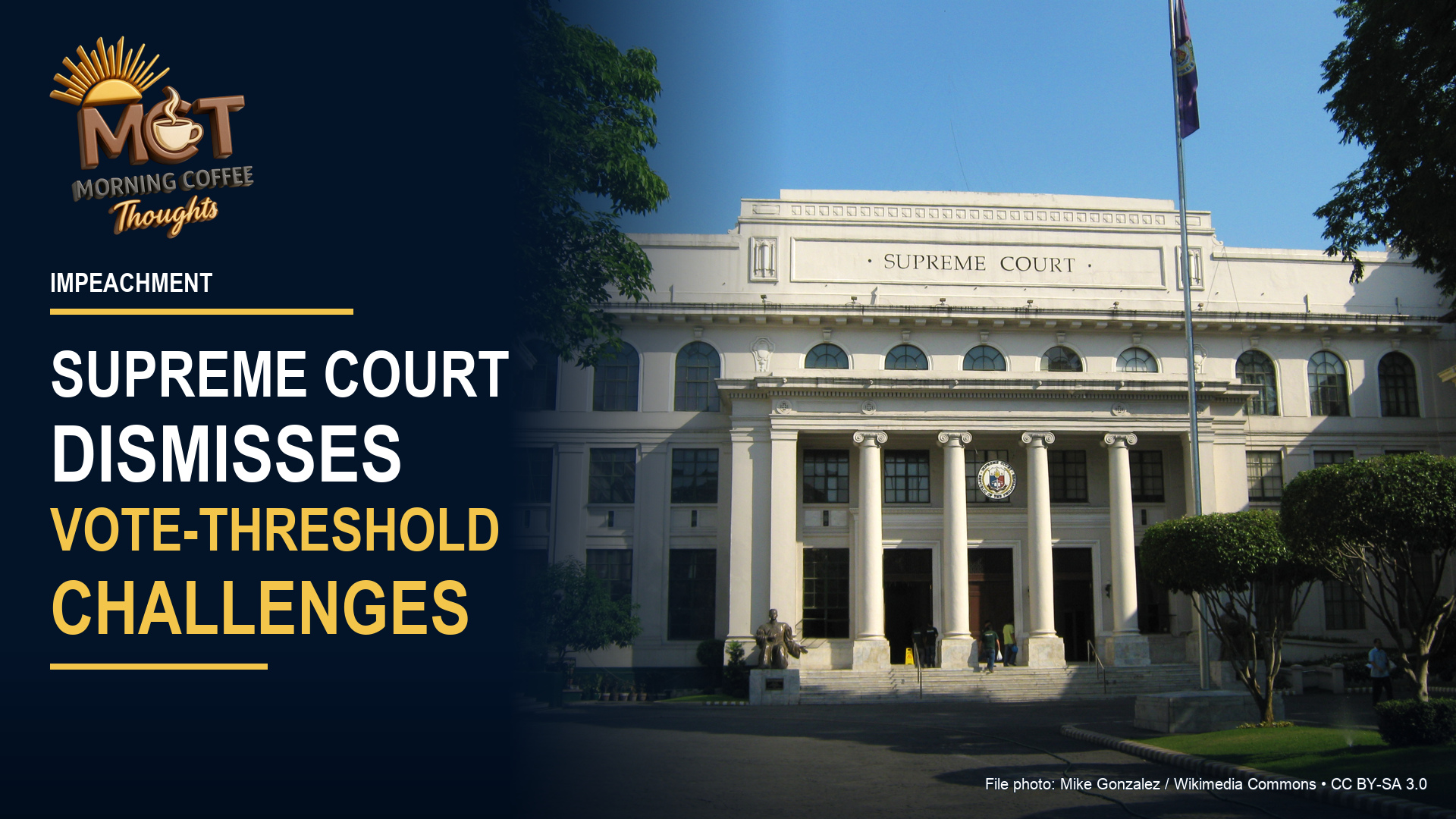
The Supreme Court dismissed three petitions on September 30 challenging how the Senate impeachment court would count the votes needed to convict Vice President Sara Duterte. The dismissal leaves the Senate’s September 23 ruling in place, but it needs to be read carefully. A case can be dismissed because it does not meet the requirements for the Court to hear it, without settling whether the challenged action is constitutional.
Davao City Mayor Sebastian “Baste” Duterte told the Senate impeachment court on September 29 that he had been unfamiliar with GenCorp Industries Inc. before it came up in the proceedings. He also said he did not know about Vice President Sara Duterte’s declared business interest in the company.
If you are planning a flight home or a family trip, check the full ticket price before paying. The Civil Aeronautics Board has approved a higher fuel-surcharge ceiling for October 1 to 15. The increase can add to your travel costs even when the advertised base fare looks affordable.
A Philippine fisheries vessel was damaged in a collision off Palawan. Manila and Beijing disagree about how it happened, while fishermen still need fuel.
Both chambers have backed longer terms, but the November 2026 election remains the law until Congress completes one final bill and the President acts on it.
Metro Manila households served by Maynilad and Manila Water will see slightly higher water charges beginning October 1. The announced increases are small for many residential customers, but the figures vary by concessionaire and consumption level. That makes it easy to misunderstand a notice expressed only in centavos per cubic meter.
Retired Sandiganbayan Presiding Justice Amparo Cabotaje-Tang explained the legal framework for Article II. Her testimony laid out the test; it did not prove the allegations against Vice President Sara Duterte.
Why the Constitution points to 16 votes, why the current absences created a real dispute, and why the Senate must settle the counting rule before judgment.
Defense Secretary Gilberto “Gibo” Teodoro Jr. was answering questions at the Seoul Defense Dialogue on September 8 when a man handed him a note. He read it aloud, challenged its rejection of the 2016 South China Sea ruling and objected to being interrupted that way.
An amicus curiae is someone who helps a court understand a legal question. The phrase means “friend of the court.” When more than one person takes that role, they are called amici curiae. They give advice. The court still makes the decision.
It can be raining outside while PAGASA warns about El Niño. That can sound confusing when the immediate problem is a wet road or a flooded field. The two warnings describe different periods: the weather happening now and the rainfall conditions that may develop over the coming months.
The Sandiganbayan has ordered the arrest of Zaldy Co, Martin Romualdez and two other accused in the plunder case filed on September 7. By Monday evening, authorities had served Romualdez's warrant and carried out booking procedures at Cardinal Santos Medical Center in San Juan. His arrest is a confirmed development; it does not establish that his three co-accused are also in custody.
The Office of the Ombudsman filed a plunder case against former House Speaker Martin Romualdez at the Sandiganbayan on September 7 over his alleged involvement in flood-control kickbacks. The accusations have now reached the court that will handle the criminal case. Romualdez denies wrongdoing and remains presumed innocent.
The increase was divided between March and September, so workers and payroll staff who remember only the first adjustment may apply the wrong rate after September 1.
Flood control is not only about pumps, canals and drainage. It also depends on where communities build, which lands remain open, and whether development decisions follow the same hazard information.
Orly Guteza has withdrawn his earlier accusation. Here is what a recantation changes, what it does not prove, and what the Ombudsman still needs to examine.
The Senate has approved stronger protections for patients who cannot immediately pay, but hospital debt does not disappear and the proposal is not yet law.
The fund can pay for useful local projects, but it is separate from the automatic tax share of local governments and still depends on national budget decisions.
Self-rated poverty and food poverty declined in June, but the figures also show how many Filipino families remain under pressure and why lower household budgets do not necessarily mean life became cheaper.
The Philippines has joined a technology partnership, but the proposed New Clark City hub still needs detailed agreements, investors, utilities, and safeguards.
CADENA could connect budgets, contracts, payments, and reported results in one public trail. The technology still cannot determine whether the information entered is true.
The French financing belongs to a nearly US$970-million package and supports the national budget after policy reforms, rather than a list of local marine projects.
What prosecutors filed, what they must prove, how Duterte’s conditional wording may affect the charge, and the unresolved question of whether the case can proceed while she remains vice president.
The election is still scheduled for November 2, 2026. A newly filed Senate bill would move it by two years, keep current officials in office longer, and change who can run for the Sangguniang Kabataan.
House Bill No. 9965 would bar children below 13 from having social media accounts, require parental consent for users aged 13 to 17, regulate platform algorithms, and impose fines reaching P50 million. It is still being deliberated in the House.
The proposal would add rights over automated decisions, six months’ notice for major workplace AI changes, deepfake rules, and environmental disclosure for AI infrastructure. It is not law yet.
The proposed benefit is not available yet. Congress still has to settle who qualifies, how claims will be verified, and how the program will be funded.
What the 6.2 percent national rate measures, why lower-income households recorded 8.2 percent inflation, and what the figures mean for an ordinary family budget.
What the auditor found in the OVP’s confidential-fund submissions, what those findings mean, and what prosecutors still have to connect to Sara Duterte personally.
Lithuania is offering technology, training, and experience in tracking organized propaganda campaigns, but no detailed Philippine program has been announced.
FIVE THINGS TO KNOWSeptember 30, 2026 · 8:35 PM6-minute read
ABOUT THE SUPREME COURT’S DECISION ON THE IMPEACHMENT VOTE THRESHOLD
The Supreme Court dismissed three petitions on September 30 challenging how the Senate impeachment court would count the votes needed to convict Vice President Sara Duterte. The dismissal leaves the Senate’s September 23 ruling in place, but it needs to be read carefully. A case can be dismissed because it does not meet the requirements for the Court to hear it, without settling whether the challenged action is constitutional.
Here are five things to know about what happened and how it affects the trial.
1
The Court dismissed the petitions on procedural grounds
The petitions were filed separately by Victor Rodriguez, Berteni Cataluña Causing, and Ernesto Francisco Jr. According to the Supreme Court’s announcement, the grounds for dismissal included lack of standing and prematurity.
In plain language, standing concerns whether the person bringing the case has a sufficient legal interest to ask the Court to act. Prematurity concerns whether the dispute has reached the stage where the Court can properly decide it. These requirements help determine whether a case can be heard before the Court addresses the constitutional arguments.
The announcement identifies those grounds without providing a detailed explanation of how each applied to every petition.
WHAT TO WATCH
The written resolutions and any further explanation of how the procedural grounds applied to each petition.
2
The argument is about which senators count toward the two-thirds requirement
The Constitution requires the concurrence of two-thirds of all members of the Senate to convict in an impeachment case. Using a membership of 24, that means 16 votes.
On September 23, the Senate impeachment court interpreted the membership used in that calculation to include only senators who are legally and actually able to participate when the vote takes place. That interpretation could produce a lower required number.
The petitioners challenged this reading. Their position was that senators remain members even when detained, temporarily absent, or medically unable to attend. They argued that those circumstances should not reduce the membership used to calculate the required votes.
WHAT TO WATCH
How the impeachment court determines which senators qualify for inclusion when judgment is taken, and the reasons it gives for any exclusion.
3
The Supreme Court did not set a fixed 14-vote threshold
Fourteen is one possible result of the Senate’s method of counting. It is not a number established by the Supreme Court’s September 30 announcement.
For example, two-thirds of 21 is 14. If 22 senators are counted, at least 15 votes would be needed because votes cannot be split into fractions. If all 24 are counted, the requirement remains 16.
These are examples of the arithmetic. They do not establish how many senators will ultimately be counted. The Senate’s stated rule concerns their ability to participate at the time of the vote. It should not be reduced to a claim that anyone who misses a hearing automatically disappears from the calculation.
WHAT TO WATCH
The actual membership count adopted for the final vote. Any report giving a required number should explain how that number was reached.
4
The Court’s announcement does not declare the Senate’s interpretation constitutional
The petitioners sought to have the September 23 ruling overturned and asked for orders that would stop its implementation or a final conviction vote while their challenges were pending. Their petitions were dismissed, leaving the Senate’s interpretation in place.
The Court’s announcement reports a procedural dismissal and does not announce a ruling on whether the Senate’s interpretation is constitutional. Describing the outcome as a Supreme Court declaration that the Senate’s interpretation is constitutional would go beyond what the announcement says.
The immediate effect is clear: these petitions did not overturn the Senate’s ruling. Whether the constitutional argument could be heard through a later legal challenge would depend on that case and whether it meets the Court’s requirements.
WHAT TO WATCH
Whether any further challenge is filed, what it asks the Court to decide, and whether the Court agrees to hear it.
5
The threshold can affect the outcome, but this decision does not decide Duterte’s guilt
The required number of votes determines whether a conviction carries. A change in that number can affect the result even when the votes cast by individual senators stay the same.
As a simple example, 15 votes for conviction would fall short of a 16-vote requirement. Those same 15 votes would meet a 15-vote requirement. This is why the disagreement over which senators count has drawn so much attention.
Still, the Supreme Court’s dismissal does not establish that the impeachment charges have been proven. It also does not tell us how any senator will vote on those charges. The senators’ eventual judgment remains a separate decision.
WHAT TO WATCH
Each senator’s vote and explanation when judgment comes, alongside the impeachment court’s official calculation of the votes required.
BOTTOM LINE
The Supreme Court dismissed the challenges to the Senate’s voting formula on September 30, leaving that formula in place. Its announcement cited procedural grounds, including lack of standing and prematurity.
For readers following the trial, the next questions are how many senators will be counted when judgment is taken, why they are included or excluded, and whether the votes for conviction reach the resulting threshold. The claim that the Supreme Court has already declared 14 votes sufficient goes beyond what it announced.
Google’s Preferred Sources feature lets you choose publications you want Google to prioritize for you. Select “Add to Preferred Sources” to make MCT easier to find in Top Stories and other eligible Google results. This does not subscribe you to email.
Morning Coffee Thoughts is reader-supported. Contributions help pay for research tools, hosting, and the work required to verify and explain each development.
Choose the monthly support amount you are comfortable with.