FIVE THINGS TO KNOW…

Short explainers published throughout the day.

7:21 AM6-minute read

ABOUT THE NOTE HANDED TO GIBO TEODORO IN SEOUL

Defense Secretary Gilberto “Gibo” Teodoro Jr. was answering questions at the Seoul Defense Dialogue on September 8 when a man handed him a note. He read it aloud, challenged its rejection of the 2016 South China Sea ruling and objected to being interrupted that way.

Read the explainer →
9:55 AM8-minute read

ABOUT EL NIÑO AND PREPARING FOR LESS RAIN

It can be raining outside while PAGASA warns about El Niño. That can sound confusing when the immediate problem is a wet road or a flooded field. The two warnings describe different periods: the weather happening now and the rainfall conditions that may develop over the coming months.

Read the explainer →
5:30 AM8-minute read

ABOUT THE NEW ARREST WARRANTS AGAINST ZALDY CO, MARTIN ROMUALDEZ AND TWO OTHERS

The Sandiganbayan has ordered the arrest of Zaldy Co, Martin Romualdez and two other accused in the plunder case filed on September 7. By Monday evening, authorities had served Romualdez's warrant and carried out booking procedures at Cardinal Santos Medical Center in San Juan. His arrest is a confirmed development; it does not establish that his three co-accused are also in custody.

Read the explainer →
3:15 PM8-minute read

ABOUT THE PLUNDER CASE AGAINST MARTIN ROMUALDEZ

The Office of the Ombudsman filed a plunder case against former House Speaker Martin Romualdez at the Sandiganbayan on September 7 over his alleged involvement in flood-control kickbacks. The accusations have now reached the court that will handle the criminal case. Romualdez denies wrongdoing and remains presumed innocent.

Read the explainer →
1:18 PM7-minute read

ABOUT THE NEW SWS POVERTY NUMBERS

Self-rated poverty and food poverty declined in June, but the figures also show how many Filipino families remain under pressure and why lower household budgets do not necessarily mean life became cheaper.

Read the explainer →
2:02 PM11-minute read

ABOUT THE CHILDREN'S SOCIAL MEDIA SAFETY ACT

House Bill No. 9965 would bar children below 13 from having social media accounts, require parental consent for users aged 13 to 17, regulate platform algorithms, and impose fines reaching P50 million. It is still being deliberated in the House.

Read the explainer →
12:02 PM7-minute read

ABOUT THE SEALED BIR BOX

Marcos authorized the BIR to comply with the Senate subpoena. That did not open the records to the public or prove the unexplained-wealth allegation.

Read the explainer →

MCT READER PULSE · MCT-PULSE-2026-008

MCT READER SURVEY

Senator-judges who are absent from the impeachment trial—including those on medical leave, in hiding, or detained—should still be allowed to cast a vote. Do you agree?Ang mga senator-judge na wala sa impeachment trial—kabilang ang naka-medical leave, nagtatago, o nakadetine—ay dapat payagan pa ring bumoto. Sang-ayon ka ba?

Senator-judge Erwin Tulfo asked the impeachment court to clarify who may validly vote and how absent members affect the constitutional two-thirds requirement. He cited one senator on medical leave abroad, one in hiding, and two in detention. The court had not resolved those questions when this survey opened. This survey asks for your view; it does not state what the Constitution or the impeachment rules require.

Background: Senate impeachment records, INQUIRER.net, and MindaNews.

This is an informal survey of verified MCT readers who choose to participate. It is not nationally representative.

Open the shareable survey page →
View previous survey results →
Checking your reader session…

September 10, 2026 · 1:49 AM7-minute read

ABOUT WHETHER THE IMPEACHMENT VOTE THRESHOLD CAN CHANGE

Why the Constitution points to 16 votes, why the current absences created a real dispute, and why the Senate must settle the counting rule before judgment.

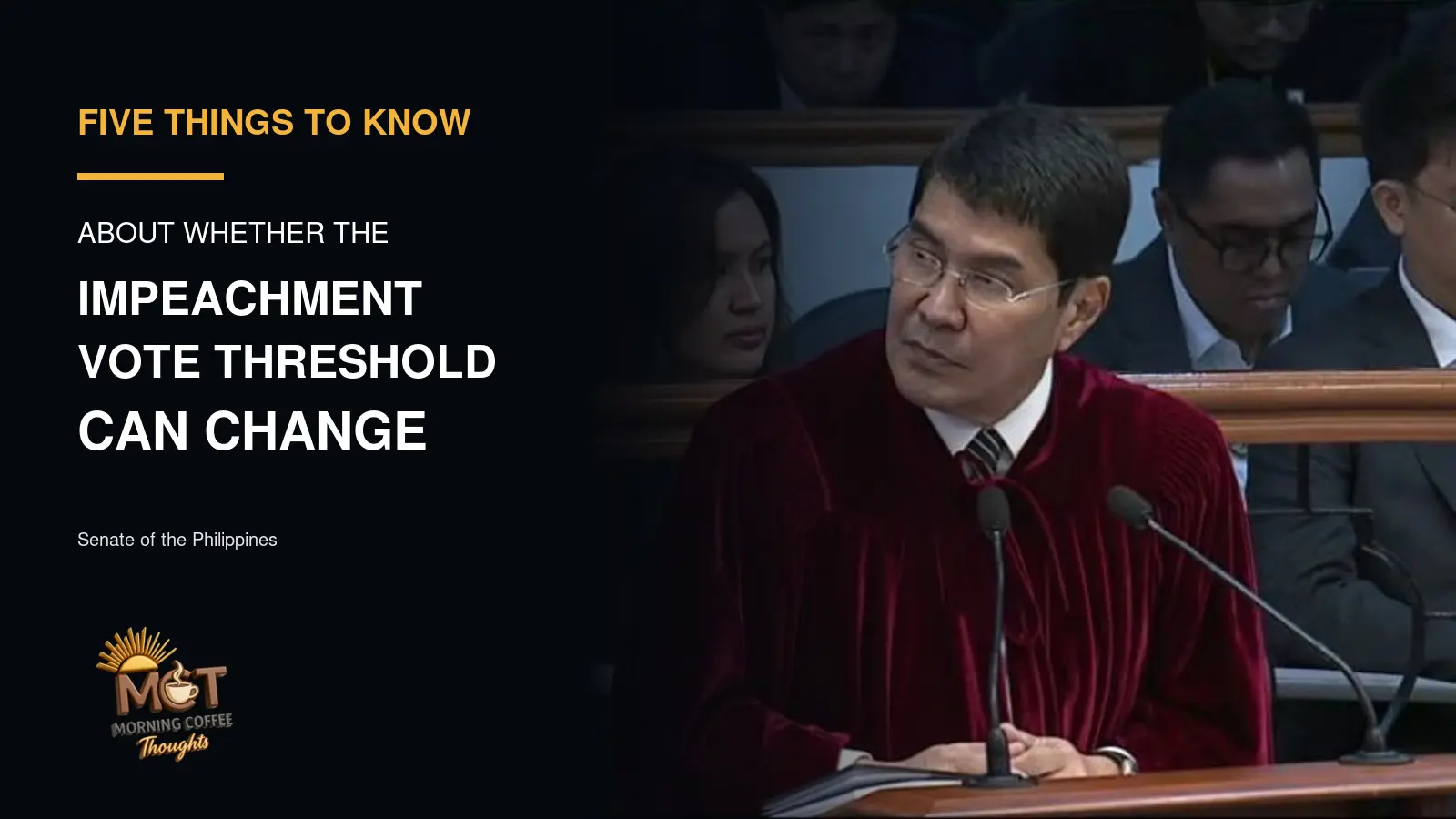
Senator-judge Erwin Tulfo speaking during the Senate impeachment hearing on September 8, 2026.
Photo: Senate of the Philippines

The Constitution says Vice President Sara Duterte cannot be convicted unless two-thirds of all Senate members vote for conviction. In a full 24-member Senate, that means 16 votes. The dispute is whether the number must remain 16 when some senator-judges cannot take part.

That is no longer a theoretical question. Jinggoy Estrada and Rodante Marcoleta are detained, Ronald dela Rosa is in hiding, and Loren Legarda is on medical leave abroad. Senator-judge Erwin Tulfo has asked the impeachment court to reconsider its fixed-16 ruling. The Senate plans to hear independent legal experts on September 16, hear both sides on September 23, and vote on the issue afterward.

This is not a vote on Duterte's guilt. It is a decision about how the final vote will be counted. Here are the five points that should guide it.

1

THE CONSTITUTION POINTS TO 16, BUT IT DOES NOT ANSWER EVERY PRESENT-DAY FACT

Article XI says no person may be convicted in an impeachment trial without the concurrence of “two-thirds of all the Members of the Senate.” The Senate's impeachment rules use the same phrase. If all 24 seats are counted, the required number is 16. Presiding officer Francis Escudero adopted that reading when the trial opened on July 6.

The argument for 16 is easy to understand. The Constitution did not say two-thirds of those present or two-thirds of those voting. It said all members. That higher barrier protects an elected official from removal by a temporary majority or a thinly attended session. Retired Supreme Court justice and 1987 Constitution framer Adolfo Azcuna has said senators should remain in the count while they remain members, whether or not they can participate.

The harder question is what happens when a senator still holds office but is legally or practically unable to sit as a judge. The text does not explain whether detention, continued hiding while an arrest warrant is outstanding or prolonged medical leave changes the base. That gap is why serious lawyers can begin with the same constitutional sentence and reach different answers.

WHAT TO WATCH

Listen for a rule that defines who remains part of “all the Members.” A bare announcement of 16 or a lower number will not be enough. The Senate must explain how its rule treats detention, hiding, illness and any later return to the trial.

2

THE SUPREME COURT CASE MOST OFTEN CITED IS USEFUL, BUT IT IS NOT A DIRECT ANSWER

Tulfo relied on Avelino v. Cuenco, a 1949 Supreme Court case about whether the Senate had a quorum. A quorum is the minimum number of members needed for a body to conduct business. The Court treated a senator who was outside the country and beyond the Senate's reach differently when calculating whether enough senators were present.

That case supports a practical idea: a legislative body should not become unable to act because a member cannot be compelled to attend. But Avelino concerned a quorum under the 1935 Constitution. It did not interpret the two-thirds vote for an impeachment conviction under the 1987 Constitution. Using it here requires an analogy, and the Senate must explain how far that analogy can go.

This is where the two dangers meet. A fixed 16 can allow empty seats to work like votes against conviction. A shifting number can allow political actors to manipulate the result by sidelining senators. The Senate cannot solve one danger by pretending the other does not exist. Any rule it adopts must work in Duterte's trial and when future political alliances are reversed.

WHAT TO WATCH

Check whether the invited experts treat Avelino as controlling law or only as guidance. They should also explain why a quorum rule can or cannot be carried into the Constitution's separate language for an impeachment conviction.

3

RESPECTED LAWYERS ARE DIVIDED, AND NONE OF THEIR OPINIONS IS YET THE RULING

Former Supreme Court justice Antonio Carpio has said the number can fall below 16 depending on how many senators are legally able to participate. San Beda Graduate School of Law dean Ranhilio Aquino has argued that the constitutional formula assumes the senators being counted heard the evidence, joined the deliberations and can vote. Former Senate president Franklin Drilon has called the number an open question that must be settled before a verdict creates a constitutional crisis.

On the other side, Azcuna starts with continued Senate membership and keeps the base at 24 unless a member loses that status. UP law professor Michael Tiu Jr. and UST political science chair Dennis Coronacion have also defended the plain reading of “all the Members.” Their concern is that reducing the denominator could weaken a constitutional safeguard and make removal easier to engineer.

These are informed positions, not judgments of the Supreme Court. The Senate's invited amici curiae, or friends of the court, will advise the senator-judges. They will not decide the issue for them. The names of the experts also need official confirmation before their views can be treated as part of the proceeding.

WHAT TO WATCH

Look for a written opinion or clearly recorded reasoning from each expert. The most useful advice will address the constitutional words and the risk of manipulation. Choosing a number that helps one side today is not enough.

4

DUTERTE-ALIGNED SENATORS HAVE A LEGAL ARGUMENT, AND THEIR POSITION ALSO HELPS THE DEFENSE

Senator Robin Padilla, a public Duterte supporter, has insisted that the Constitution requires 16 votes. Senator Pia Cayetano, who spoke for minority leader Alan Peter Cayetano during the debate, challenged Tulfo's use of Avelino. She said the current minority never accepted that case as the Senate's settled rule during the chamber's earlier leadership fight. Their stated objections concern constitutional text, consistency and the danger of changing the rule during an ongoing trial.

Those objections should be answered on their merits. Calling them Duterte allies does not make their legal argument wrong. The fixed threshold is also supported by senators and legal figures who should not simply be folded into a Duterte bloc.

Still, the practical effect cannot be ignored. With four of 24 senators currently unavailable, a fixed 16 would require 16 of the remaining 20, or 80 percent, to convict. If only 20 were legally counted, two-thirds would require 14. Keeping the base at 24 therefore gives the defense a larger cushion. That is an effect of the rule, not proof of anyone's private motive.

WHAT TO WATCH

Separate each senator's public legal reason from the political result it produces. Ask whether the same senator would defend the same formula if the absent members belonged to the opposite camp and the accused were a political rival.

5

THE SENATE MUST SETTLE THE RULE NOW, BUT IT MUST NOT INVENT A NUMBER FOR A DESIRED VERDICT

The Senate has the sole power to try and decide impeachment cases. That gives the impeachment court the first responsibility to interpret its voting rule. The Supreme Court can review constitutional violations or grave abuse of discretion when a proper case reaches it, but it does not ordinarily issue advance legal advice simply because senators would prefer someone else to carry the burden.

The present Senate cannot postpone the question until the final tally. If the vote lands between 14 and 15 for conviction, the threshold could determine whether Duterte is acquitted or removed and disqualified from public office. A rule announced only after the numbers are known would immediately look designed for the result, whichever side wins.

MCT's view is straightforward: the Senate must resolve the denominator before judgment, explain it in public and apply a neutral rule to every senator. It must decide whether a member who cannot hear evidence or cast a lawful vote remains part of the constitutional count. That does not mean the Senate must lower the number. It means silence is no longer a defensible option.

WHAT TO WATCH

On September 23, look for a recorded vote on the threshold, the exact number adopted and the legal test behind it. Also watch whether either side asks the Supreme Court to review the ruling through an actual case.

BOTTOM LINE

Sixteen remains the operative threshold unless the impeachment court overturns its earlier ruling. There is a credible legal case for keeping it and a credible challenge based on senators who cannot take part. What the Senate cannot do is allow absence to decide the trial without explaining why, or lower the number simply because one side wants an easier path to victory.

The cleanest course is to decide the rule before the verdict, give reasons that can survive a change in political fortunes and let every senator be judged by the same standard. In this trial, the way the Senate counts may become as consequential as the votes themselves.

GOOGLE PREFERRED SOURCES

FOLLOW MCT ON GOOGLE

Google’s Preferred Sources feature lets you choose publications you want Google to prioritize for you. Select “Add to Preferred Sources” to make MCT easier to find in Top Stories and other eligible Google results. This does not subscribe you to email.

← Back to MCT home

LATEST COMMENTARY

View all commentary →

SUPPORT MCT

HELP KEEP INDEPENDENT POLITICAL WRITING GOING.

Morning Coffee Thoughts is reader-supported. Contributions help pay for research tools, hosting, and the work required to verify and explain each development.

Choose the monthly support amount you are comfortable with.Continue through PayPal
Send support through GCash or Maya0969 314 4839