
LATEST COMMENTARY
FIVE THINGS TO KNOW
MCT READER PULSE · MCT-PULSE-2026-017
MCT READER SURVEY
Gaano ka nagtitiwala na tama ang ginagawa ng Kongreso sa budget ng bayan?
This is an informal survey of people who choose to participate. It is not a scientific or nationally representative sample.
ABOUT WHAT BANK SECRECY PROTECTS IN AN IMPEACHMENT TRIAL
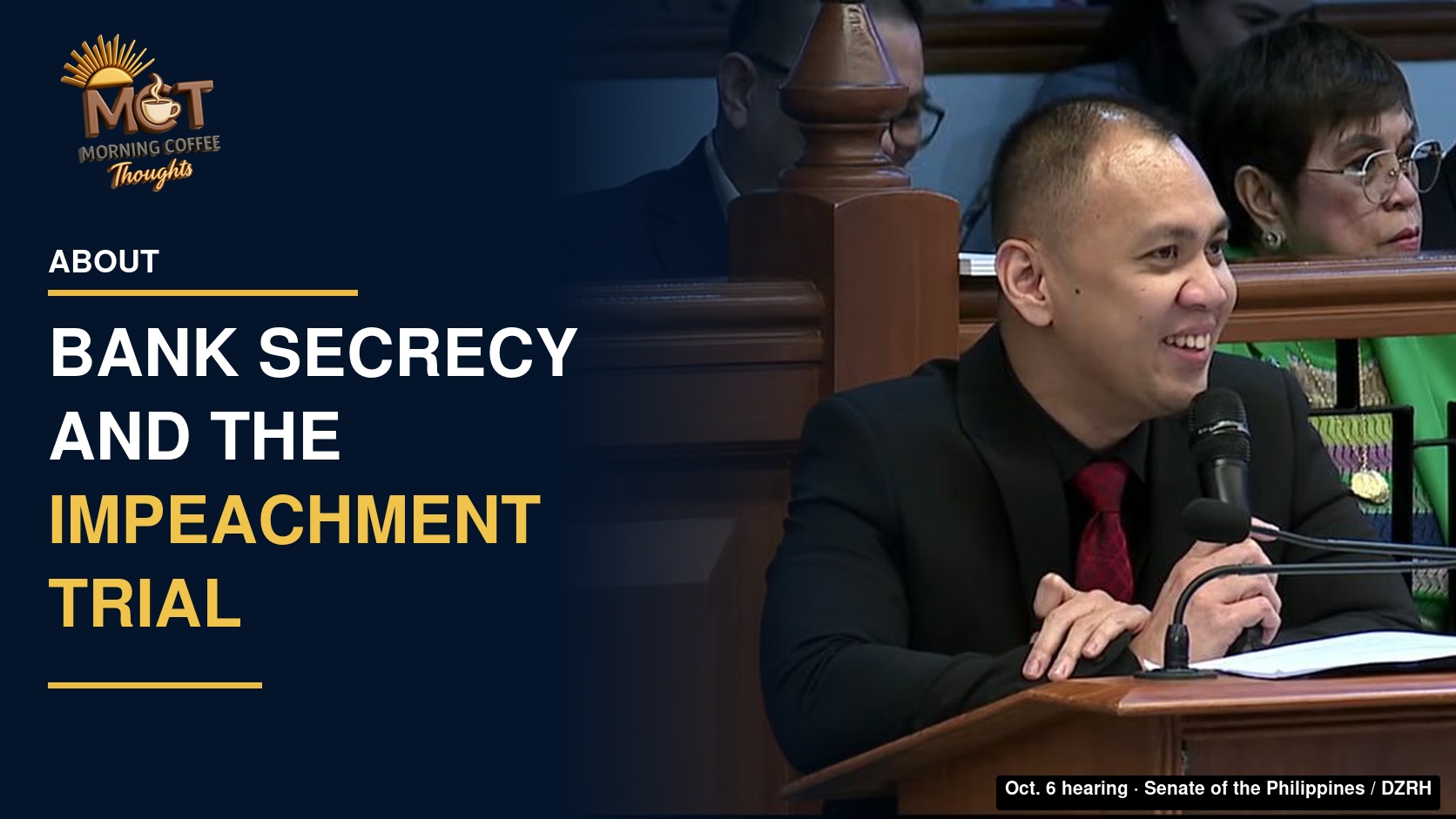
The arguments over bank records in Sara Duterte’s impeachment trial involve several protections. The privacy of a peso deposit, the protection of a foreign-currency deposit, and the confidentiality of a report sent to the AMLC come from different rules. Understanding those differences helps explain what the court has allowed and what remains in dispute.
1
The ordinary bank-secrecy law expressly includes an impeachment exception
Republic Act No. 1405 generally protects bank deposits from examination or inquiry, but Section 2 expressly lists impeachment among its exceptions.
WHAT TO WATCH
That gives an impeachment court a legal basis to examine deposits covered by that law. The scope of a request, the records sought, and how the information is handled still matter. An exception does not make every bank document open to everyone.
2
Foreign-currency deposits have a different legal starting point
Foreign-currency deposits are protected under Republic Act No. 6426, as amended. Its secrecy provision does not contain the same express impeachment exception found in the ordinary bank-secrecy law. The Supreme Court has recognized this distinction.
WHAT TO WATCH
Other laws, including the Anti-Money Laundering Act, allow access in specified circumstances. That means the legal basis for obtaining or using a foreign-currency record must be identified. It is unsafe to assume that every dollar account can automatically be opened simply because an impeachment trial is underway.
3
A bank’s report to the AMLC carries separate confidentiality protections
Banks must submit certain transaction reports to the Anti-Money Laundering Council. The law also protects the confidentiality of those reports. A report sent to the AMLC does not become an unrestricted public document.
WHAT TO WATCH
At the October 5 hearing, the impeachment court interpreted the confidentiality protections as allowing the AMLC to carry out its lawful functions and respond to properly limited subpoenas with safeguards. The ruling concerns the use of evidence in the proceedings; it is not general permission to publish confidential bank records.
4
Allowing testimony about foreign-currency reports does not erase every protection on dollar deposits
The court also ruled on October 5 that covered and suspicious transaction reports already submitted to the AMLC do not acquire absolute confidentiality simply because they contain foreign-currency information.
WHAT TO WATCH
That distinction matters. Hearing testimony about reports the AMLC already holds is a different legal question from ordering unrestricted access to someone’s dollar accounts. The ruling should be described according to the records it addresses.
5
Access to a record and proof of an allegation are separate questions
A court can allow a document or testimony without accepting every conclusion drawn from it. The meaning of the record, whether it is complete, and how it relates to a charge remain open to challenge.
Keep three measurements separate: transactions show money moving during a period; balances show money in an account on a particular date; and a SALN declares assets, liabilities, and net worth under the applicable requirements.
WHAT TO WATCH
A transaction total cannot simply be treated as year-end wealth. Balances added across several year-ends can also count money that remained in the accounts more than once. A fair comparison needs matching dates, account ownership, and the relevant declaration.
BOTTOM LINE
Bank privacy laws contain exceptions and procedures that can allow evidence to be heard. The trial must still determine what that evidence proves.
GOOGLE PREFERRED SOURCES
FOLLOW MCT ON GOOGLE
Google’s Preferred Sources feature lets you choose publications you want Google to prioritize for you. Select “Add to Preferred Sources” to make MCT easier to find in Top Stories and other eligible Google results. This does not subscribe you to email.