
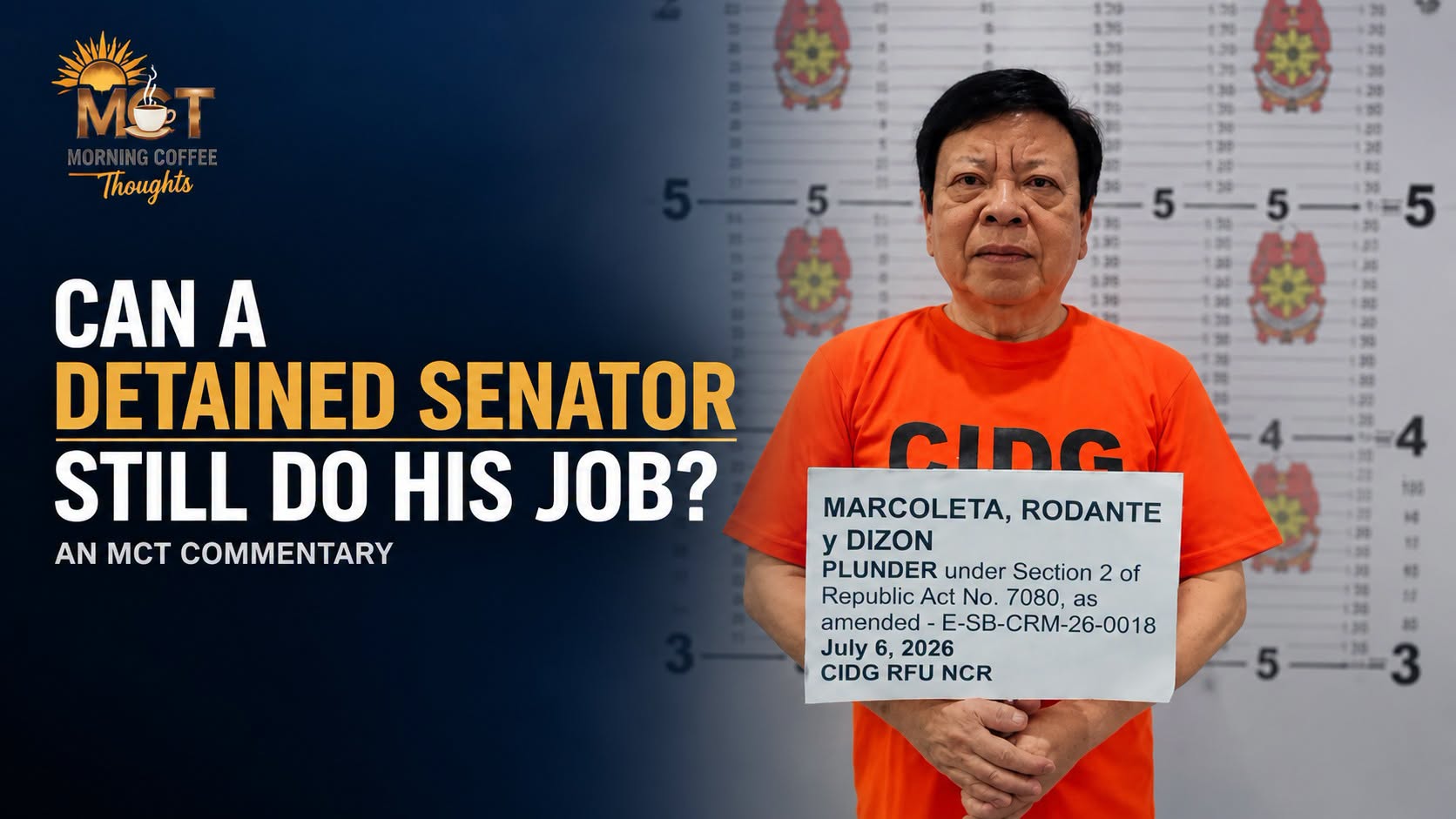
While having coffee, I was doing some readings about Senators Rodante Marcoleta and Jinggoy Estrada and their possible participation in the impeachment proceedings. Napunta ako sa isang simple question: kapag nakakulong ang isang elected public official, senator in this case, can he still do his job?
Let me share with you what I found because there are several legal questions involved here, and they are easy to mix together. Detention, remaining in office, participating in Senate proceedings, and preventive suspension are related, but they are not the same thing.
WHAT HAPPENS WHEN AN ELECTED OFFICIAL IS DETAINED?
Detention does not automatically remove someone from elected office. But remaining a senator does not mean a detained person can continue performing the job as though he were not in jail.
There is already Supreme Court jurisprudence on this. In People v. Jalosjos, Congressman Romeo Jalosjos wanted to leave confinement so he could attend congressional sessions and committee meetings, but the Supreme Court refused.
Then there was Antonio Trillanes IV v. Pimentel. Trillanes had already been elected senator while he remained detained over the Oakwood mutiny case, and he wanted to attend Senate sessions, committee hearings, investigations, caucuses, meetings and other official activities.
The courts refused that request as well, and the Supreme Court upheld the denial. The principle was that being elected does not give a detained official a continuing right to leave lawful custody whenever public duties call.
That distinction is important. An official may still occupy the office, but his liberty remains subject to the conditions of detention and the authority of the court.
THEN THERE WAS LEILA DE LIMA
De Lima adds an important nuance because her case shows that detention does not necessarily mean a senator can do absolutely nothing. While detained, she continued filing bills and resolutions and performing legislative work that could be done from inside the PNP Custodial Center.
But when Senate rules later allowed teleconferencing during the pandemic, De Lima asked the Muntinlupa Regional Trial Court to let her participate remotely in Senate sessions. The court denied the request, concluding that allowing her to participate by teleconference would, in practical terms, still allow her to take part in formal Senate proceedings while under detention.
De Lima challenged that reasoning. Her position was that Trillanes and Jalosjos restricted physical liberty, but did not necessarily prohibit work that could be done entirely from inside detention. That was her legal argument, however, and the trial court still denied her request.
This gives us a useful distinction. A detained senator may still be able to perform certain legislative tasks that do not require release from custody or formal participation in a Senate proceeding, but attending a session, voting, or joining formal proceedings remotely is another question.
The Senate itself had debated the issue. Senator Kiko Pangilinan supported allowing De Lima to participate through teleconference, while then Senate President Tito Sotto opposed it and pointed out that detained Senators Bong Revilla, Juan Ponce Enrile and Jinggoy Estrada had not been allowed similar participation during an earlier Congress.
So even Zoom is not automatically a way around detention. The question is not only whether the senator physically leaves the detention facility, but whether the arrangement allows the detained official to formally exercise functions that ordinarily come with the office.
AND THIS IS NO LONGER JUST AN OLD CASE
This brings us to Jinggoy Estrada, because his present situation gives us a much more recent example.
Estrada asked the Sandiganbayan to allow him to attend Vice President Sara Duterte's impeachment trial as a senator-judge. The Sandiganbayan denied that request in July.
According to reports on the ruling, Estrada argued that participation in an impeachment trial was a constitutional duty. The Sandiganbayan nevertheless concluded that the importance of that duty did not by itself justify allowing him to repeatedly leave detention to participate in proceedings expected to extend over a considerable period.
That distinction is important because a one-day medical furlough or appearance is very different from an arrangement that effectively allows a detainee to regularly resume a major function of his public office.
The Sandiganbayan relied on the same general line of jurisprudence involving Jalosjos and Trillanes. So in Estrada's case, we no longer have to speculate about whether the court might allow physical participation in the impeachment trial. He asked, and the request was denied.
CAN THE SENATE ASK THE SANDIGANBAYAN?
Yes.
Senator Alan Peter Cayetano has raised the possibility of the impeachment court coordinating with the Sandiganbayan regarding the participation of detained senators. Senate President Win Gatchalian has also said that because Marcoleta and Estrada are under Sandiganbayan jurisdiction, permission to attend Senate proceedings would have to come from the court.
The Senate can therefore express that it wants or needs the participation of a detained member. But that request does not transfer control of the detainee from the court to the Senate.
Senator Ping Lacson has argued that the cleaner procedure would be for the detained senators and their lawyers to make the request themselves rather than have the Senate intervene directly. His concern was that Senate intervention could be perceived as pressure on the Sandiganbayan.
So, yes, the Senate can ask. The Sandiganbayan can also say no.
In Estrada's case, it already did.
WHAT ABOUT ZOOM?
This was another question I had. If the problem is physically leaving jail, why not allow the senator to participate through Zoom?
That can certainly be requested, but I found no rule giving a detained senator an automatic right to participate remotely in Senate proceedings. De Lima's experience is particularly relevant because she specifically asked to participate through teleconferencing without leaving detention, and the trial court still denied her request.
So remote participation does not automatically solve the legal problem. The issue remains whether the detained official can formally exercise Senate functions under the conditions of judicial custody.
JINGGOY HAS ANOTHER PROBLEM
Estrada's situation also has another layer because detention is not his only legal restriction.
The Sandiganbayan ordered him preventively suspended from the Senate for 90 days in connection with a graft case. Preventive suspension and detention are separate legal concepts, and they should not be treated as though they mean the same thing.
A detained official may continue to hold the office but face severe practical and legal restrictions on how its functions can be exercised. A preventively suspended official, however, is subject to a specific court order temporarily barring him from exercising the office during the period of suspension.
Preventive suspension is also not a declaration of guilt. It is an interim legal measure while the criminal case proceeds.
MARCOLETA IS DIFFERENT
Marcoleta is also detained, but his position should not simply be copied from Estrada's.
The public reporting I reviewed shows that the issue of Marcoleta's possible preventive suspension has been raised before the Sandiganbayan. I have not found a subsequent public ruling showing that a comparable 90-day suspension has already been imposed on him.
His immediate obstacle is therefore detention and the Sandiganbayan's control over his custody.
We have also seen that the court is capable of granting limited permission when it considers the request appropriate. Earlier this month, the Sandiganbayan granted Marcoleta a one-day medical furlough, which shows that a detained official may request a specific temporary accommodation and the court may approve it under conditions.
Marcoleta, however, said on September 17 that he would not seek furlough merely to participate in the vote concerning the impeachment conviction threshold. So before we even reach the question of whether the Sandiganbayan would grant such a request, Marcoleta is presently saying he does not intend to make one.
WHAT DID I LEARN FROM ALL THIS?
The easiest mistake here is to treat everything as one question.
"Senator pa rin ba siya?"
Yes. Detention by itself does not necessarily remove him from office.
"Can he still do some work?"
Yes. De Lima's case shows that some legislative work can continue from detention.
"Can he therefore participate normally in formal Senate proceedings?"
There is no automatic right to do so.
"Can the Senate ask the Sandiganbayan to allow participation?"
Yes.
"Does the Sandiganbayan have to agree?"
No.
"Has physical participation actually been tested?"
Yes. Estrada asked to attend the impeachment trial, and the Sandiganbayan denied the request.
"Has remote participation been tested before?"
Yes. De Lima asked to participate in Senate sessions through teleconferencing, and the trial court denied that request too.
That is why the argument that Marcoleta and Estrada remain senators, therefore they must be allowed to vote as senator-judges, is incomplete. Their continued membership in the Senate is only one part of the legal picture.
The law also has to deal with detention, judicial custody, preventive suspension where applicable, and the specific kind of official participation being requested. Those questions do not disappear simply because the detained official still holds the title.
After reading Jalosjos, Trillanes, De Lima and the current Estrada situation, the picture is much clearer to me.
An elected official may remain in office while detained, and some work may still continue from inside detention. Formal participation in legislative proceedings, however, is another matter, and the official's electoral mandate does not by itself override judicial custody.
The title may remain.
Whether the official can fully exercise it is a separate legal question.
SOURCES
- Supreme Court E-Library, People of the Philippines v. Romeo G. Jalosjos, G.R. Nos. 132875-76, February 3, 2000https://elibrary.judiciary.gov.ph/thebookshelf/showdocs/1/51198
- Supreme Court E-Library, Antonio F. Trillanes IV v. Hon. Oscar Pimentel Sr., G.R. No. 179817, June 27, 2008https://elibrary.judiciary.gov.ph/thebookshelf/showdocs/1/45453
- Senate of the Philippines, De Lima dismayed over court's denial of her motion to join Senate online sessions, June 19, 2020https://legacy.senate.gov.ph/press_release/2020/0619_delima2.asp
- Senate of the Philippines, De Lima appeals Muntinlupa court's decision over her motion to join Senate online sessions, June 26, 2020https://legacy.senate.gov.ph/press_release/2020/0626_delima2.asp
- Senate of the Philippines, Statement of Sen. Francis Pangilinan on Sen. Leila de Lima's participation in teleconferencing Senate sessions, May 5, 2020https://legacy.senate.gov.ph/press_release/2020/0505_pangilinan1.asp
- Senate of the Philippines, Sotto: On De Lima, May 1, 2020https://legacy.senate.gov.ph/press_release/2020/0501_sotto1.asp
- Philippine Star, Marcoleta says no furlough bid for impeachment threshold vote, September 17, 2026https://www.philstar.com/headlines/2026/09/17/2556948/marcoleta-says-no-furlough-bid-impeachment-threshold-vote
- Philippine News Agency, Marcoleta won't bid for furlough to vote on impeachment threshold, September 17, 2026https://www.pna.gov.ph/articles/1284312
- Philippine Star, Marcoleta gets medical furlough, posts bail, September 4, 2026https://www.philstar.com/nation/2026/09/04/2553865/marcoleta-gets-medical-furlough-posts-bail