FIVE THINGS TO KNOW…

Short explainers published throughout the day.

7:21 AM6-minute read

ABOUT THE NOTE HANDED TO GIBO TEODORO IN SEOUL

Defense Secretary Gilberto “Gibo” Teodoro Jr. was answering questions at the Seoul Defense Dialogue on September 8 when a man handed him a note. He read it aloud, challenged its rejection of the 2016 South China Sea ruling and objected to being interrupted that way.

Read the explainer →
9:55 AM8-minute read

ABOUT EL NIÑO AND PREPARING FOR LESS RAIN

It can be raining outside while PAGASA warns about El Niño. That can sound confusing when the immediate problem is a wet road or a flooded field. The two warnings describe different periods: the weather happening now and the rainfall conditions that may develop over the coming months.

Read the explainer →
5:30 AM8-minute read

ABOUT THE NEW ARREST WARRANTS AGAINST ZALDY CO, MARTIN ROMUALDEZ AND TWO OTHERS

The Sandiganbayan has ordered the arrest of Zaldy Co, Martin Romualdez and two other accused in the plunder case filed on September 7. By Monday evening, authorities had served Romualdez's warrant and carried out booking procedures at Cardinal Santos Medical Center in San Juan. His arrest is a confirmed development; it does not establish that his three co-accused are also in custody.

Read the explainer →
3:15 PM8-minute read

ABOUT THE PLUNDER CASE AGAINST MARTIN ROMUALDEZ

The Office of the Ombudsman filed a plunder case against former House Speaker Martin Romualdez at the Sandiganbayan on September 7 over his alleged involvement in flood-control kickbacks. The accusations have now reached the court that will handle the criminal case. Romualdez denies wrongdoing and remains presumed innocent.

Read the explainer →
1:18 PM7-minute read

ABOUT THE NEW SWS POVERTY NUMBERS

Self-rated poverty and food poverty declined in June, but the figures also show how many Filipino families remain under pressure and why lower household budgets do not necessarily mean life became cheaper.

Read the explainer →
2:02 PM11-minute read

ABOUT THE CHILDREN'S SOCIAL MEDIA SAFETY ACT

House Bill No. 9965 would bar children below 13 from having social media accounts, require parental consent for users aged 13 to 17, regulate platform algorithms, and impose fines reaching P50 million. It is still being deliberated in the House.

Read the explainer →
12:02 PM7-minute read

ABOUT THE SEALED BIR BOX

Marcos authorized the BIR to comply with the Senate subpoena. That did not open the records to the public or prove the unexplained-wealth allegation.

Read the explainer →

MCT READER PULSE · MCT-PULSE-2026-008

MCT READER SURVEY

Senator-judges who are absent from the impeachment trial—including those on medical leave, in hiding, or detained—should still be allowed to cast a vote. Do you agree?Ang mga senator-judge na wala sa impeachment trial—kabilang ang naka-medical leave, nagtatago, o nakadetine—ay dapat payagan pa ring bumoto. Sang-ayon ka ba?

Senator-judge Erwin Tulfo asked the impeachment court to clarify who may validly vote and how absent members affect the constitutional two-thirds requirement. He cited one senator on medical leave abroad, one in hiding, and two in detention. The court had not resolved those questions when this survey opened. This survey asks for your view; it does not state what the Constitution or the impeachment rules require.

Background: Senate impeachment records, INQUIRER.net, and MindaNews.

This is an informal survey of verified MCT readers who choose to participate. It is not nationally representative.

Open the shareable survey page →
View previous survey results →
Checking your reader session…

September 10, 2026 · 9:02 AM8-minute read

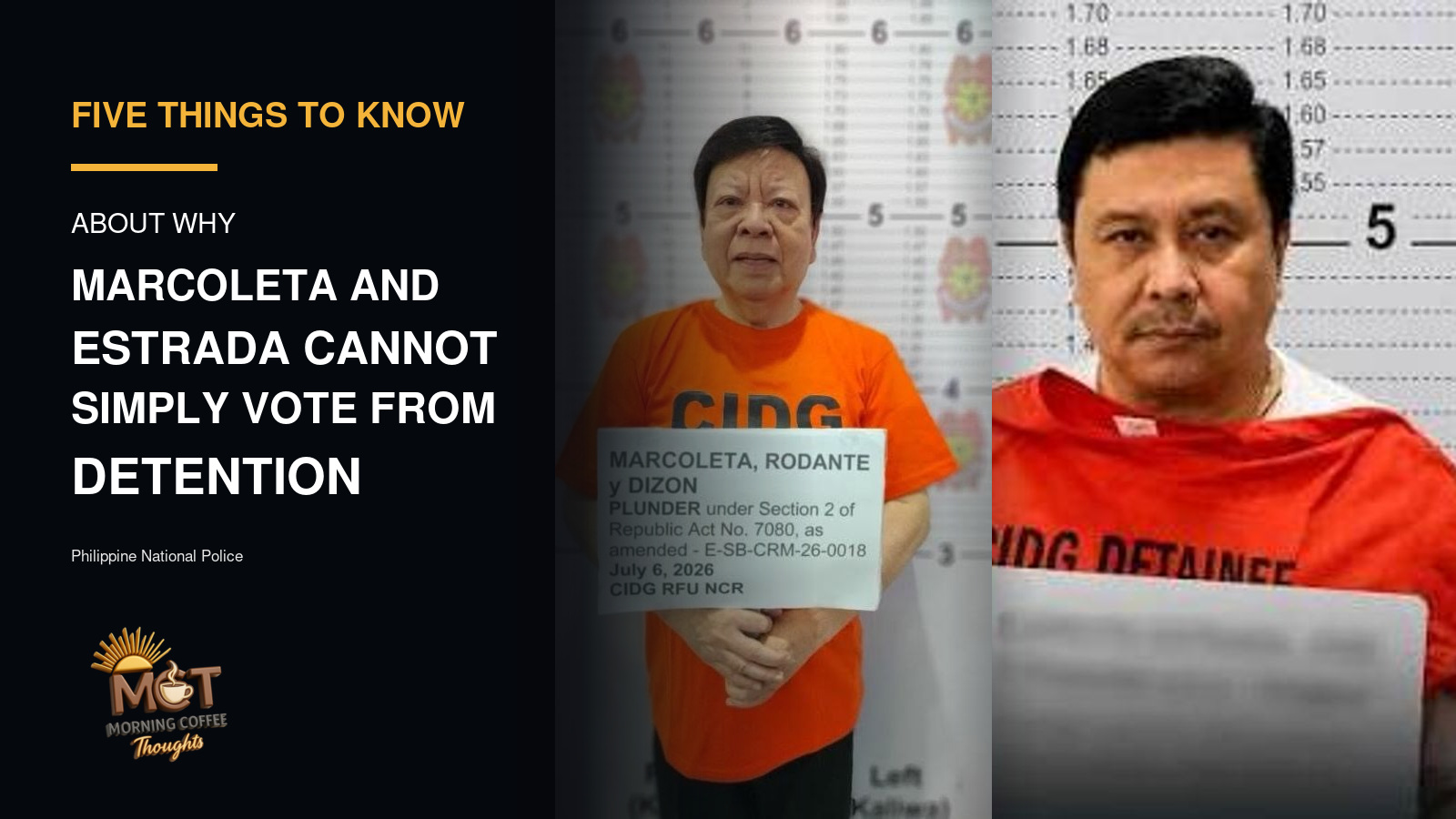
ABOUT WHY MARCOLETA AND ESTRADA CANNOT SIMPLY VOTE FROM DETENTION

Why holding a Senate seat does not cancel court custody, preventive suspension, or the need for judicial permission to join an impeachment vote.

Senators Rodante Marcoleta and Jinggoy Estrada in Philippine National Police custody photographs.
Photo: Philippine National Police

Senators Rodante Marcoleta and Jinggoy Estrada still hold seats in the Senate, but that does not mean they can exercise every power of those seats while detained. The distinction matters now because both want to take part in the impeachment trial of Vice President Sara Duterte.

Marcoleta says he can vote because he has not been preventively suspended. Estrada has also maintained that he remains a senator-judge. Their allies argue that excluding them would deny their constituents representation and leave the impeachment court incomplete.

But neither a Senate title nor a political demand opens a jail door. Both men are under the custody of the Sandiganbayan in separate plunder cases. Existing law, court rules and Supreme Court decisions place real limits on what a detained official may do. Those limits do not declare either senator guilty. They simply answer who controls their movement and whether public office can be performed from detention.

Here are the five things that matter.

1

WINNING A SENATE SEAT DOES NOT CANCEL THE LEGAL EFFECTS OF DETENTION

The clearest starting point is the Supreme Court's 2008 decision in Trillanes v. Pimentel. Antonio Trillanes IV had been elected to the Senate while detained and asked to attend sessions, hold meetings and perform legislative work. The Court rejected the request. Election to public office did not give him a special right to leave detention or turn his place of confinement into a Senate office.

That ruling followed an earlier decision, People v. Maceda, which said a detention prisoner cannot practice a profession, run a business or hold elective or appointive office while confined. The reason is practical as much as legal. Detention places a person under the custody of the court and restricts physical movement. The court, not the detainee and not the Senate, decides when that person may leave.

This does not erase Marcoleta's or Estrada's election. It does not declare their seats vacant, end their terms or establish guilt. It means that holding the title of senator is different from being free to perform the office. A detained senator cannot create an exception by sending a letter from jail and calling it a vote.

WHAT TO WATCH

Watch for any new order from the Sandiganbayan or the Supreme Court granting either senator authority to attend and participate. Without such an order, the existing custody restrictions remain the controlling fact.

2

THE PLUNDER LAW MAKES PREVENTIVE SUSPENSION A LEGAL CONSEQUENCE, NOT A POLITICAL FAVOR

Section 5 of the Anti-Plunder Law says a public officer facing criminal prosecution under a valid Information for plunder shall be suspended from office. An Information is the formal charge filed in court after prosecutors determine that a criminal case should proceed. The Sandiganbayan's internal rules provide the process: after arraignment, the accused is given time to explain why preventive suspension should not be imposed, and the court then acts on the matter.

Preventive suspension is not a finding of guilt. Its purpose is to stop an accused official from using the powers of office while the case is being tried. If the official is acquitted, the law provides for reinstatement and the benefits that were withheld, subject to the conditions stated in the law.

Estrada was placed under a 90-day preventive suspension effective June 22. Marcoleta has argued that no preventive-suspension order has been issued against him. That difference must be stated accurately. But it does not give Marcoleta an automatic right to vote. Even without a final suspension order, he remains detained in a non-bailable plunder case unless the Sandiganbayan grants bail or specific leave.

WHAT TO WATCH

The Sandiganbayan must separately resolve Marcoleta's preventive-suspension issue and his petition for bail. Those rulings may change his legal position. Until then, the absence of a suspension order is not the same as permission to perform Senate duties from jail.

3

ESTRADA ALREADY ASKED TO ATTEND, AND THE SANDIGANBAYAN SAID NO

Estrada's case removes much of the guesswork. He asked the Sandiganbayan to let him leave detention and attend Duterte's impeachment trial. The court denied the request for lack of merit. It said the importance of the proceeding, by itself, was not an emergency or a compelling reason for temporary leave.

That order matters because it applies the general rule to this exact situation. Estrada did not merely ask to attend an ordinary committee hearing. He invoked his duty as a senator-judge in an impeachment trial, and the court still refused. The Senate cannot treat that denial as if it never happened. Estrada has challenged the ruling before the Supreme Court, but the filing of an appeal does not quietly replace the order being challenged with the result he wants.

The same basic point applies to Marcoleta. Senate President Sherwin Gatchalian has said each detained senator must seek permission from the Sandiganbayan. That is not the Senate surrendering its impeachment power. It is the Senate recognizing that the judiciary has custody of the accused. The impeachment court controls its proceedings, but it does not control the gates of a detention facility.

WHAT TO WATCH

Watch whether the Supreme Court acts on Estrada's challenge and whether Marcoleta files his own request to attend. A favorable court order could open a lawful route. Political statements and letters cannot do that on their own.

4

THE SENATE'S IMPEACHMENT POWER DOES NOT OVERRIDE A COURT'S CUSTODY ORDER

The Constitution gives the Senate the sole power to try and decide impeachment cases. That means the Senate sets the trial's procedure, receives evidence and reaches judgment. It does not mean the impeachment court may release a criminal accused from Sandiganbayan custody or ignore a valid suspension order.

The two institutions control different things. The Senate decides how its impeachment trial will operate. The Sandiganbayan decides whether a detainee before it may leave confinement. If the Senate wants Marcoleta or Estrada physically present, the lawful route is a request to the court followed by an order granting leave. If either senator wants to participate remotely, the Senate would still need a valid rule allowing it and a court order consistent with his detention. The ordinary Senate rule on remote sessions is for force majeure or a national emergency. It is not a general work-from-jail provision.

This separation protects everyone. A Senate majority should not be able to pull an ally out of detention by declaring legislative necessity. A court should not decide the merits of an impeachment case. Each body must stay within its authority.

WHAT TO WATCH

Look for the exact legal document behind any claimed participation. Is it a Sandiganbayan order, a Supreme Court ruling or a properly adopted Senate rule? If it is only a letter, request or political declaration, it has not removed the legal barrier.

5

THE PUSH TO LET THEM VOTE IS POLITICALLY USEFUL TO DUTERTE, BUT THAT DOES NOT MAKE IT LAWFUL

The loudest public campaign for Marcoleta and Estrada to participate has come from Marcoleta himself and senators aligned with the Dutertes. Their position is easy to understand politically. Both detained senators are expected to be important votes in Sara Duterte's trial. Their absence can affect the balance inside the impeachment court and intensify the separate fight over how many votes are needed to convict.

Political usefulness, however, is not legal authority. Alan Peter Cayetano has urged the impeachment court to help both men participate, yet even that proposal recognizes the need for Sandiganbayan permission. The argument that their constituents deserve representation also has limits. Voters choose officials subject to the same laws that bind everyone else. An election does not create immunity from detention, and a claim of representation cannot cancel a court order.

This issue must also be kept separate from the conviction threshold. Whether detained senators remain part of “all the Members of the Senate” when calculating two-thirds is a disputed constitutional question. Whether they may cast a vote from detention without court authorization is much clearer. They cannot. Treating those questions as identical only creates confusion that helps the side seeking their votes.

WHAT TO WATCH

Watch whether supporters produce a controlling court ruling that authorizes a detained senator to perform impeachment duties. If the argument remains limited to fairness, political representation or the needs of one side, it has not answered the existing law.

BOTTOM LINE

Marcoleta and Estrada are presumed innocent, and neither man's detention is a conviction. They may challenge the charges, seek bail and ask the courts for permission to attend the impeachment trial. What they cannot do is turn continued Senate membership into an automatic power to vote from detention.

The Sandiganbayan has custody. Estrada's request to attend has already been denied. Marcoleta has no verified order allowing him to participate, and his claim that he has not been suspended does not remove the restrictions of detention. Until a competent court changes those conditions, the Senate should not accept a letter, remote instruction or political demand as a lawful senator-judge vote. There is room to debate the impeachment threshold. There should be far less confusion about who controls these two detainees and what they may legally do while confined.

GOOGLE PREFERRED SOURCES

FOLLOW MCT ON GOOGLE

Google’s Preferred Sources feature lets you choose publications you want Google to prioritize for you. Select “Add to Preferred Sources” to make MCT easier to find in Top Stories and other eligible Google results. This does not subscribe you to email.

← Back to MCT home

LATEST COMMENTARY

View all commentary →

SUPPORT MCT

HELP KEEP INDEPENDENT POLITICAL WRITING GOING.

Morning Coffee Thoughts is reader-supported. Contributions help pay for research tools, hosting, and the work required to verify and explain each development.

Choose the monthly support amount you are comfortable with.Continue through PayPal
Send support through GCash or Maya0969 314 4839