
A company can report sales without all that money becoming a shareholder’s income. A company can earn a profit without distributing dividends. And a missing financial statement cannot tell us whether a dividend was paid.
Those points became important on Day 27 of Vice President Sara Duterte’s impeachment trial.
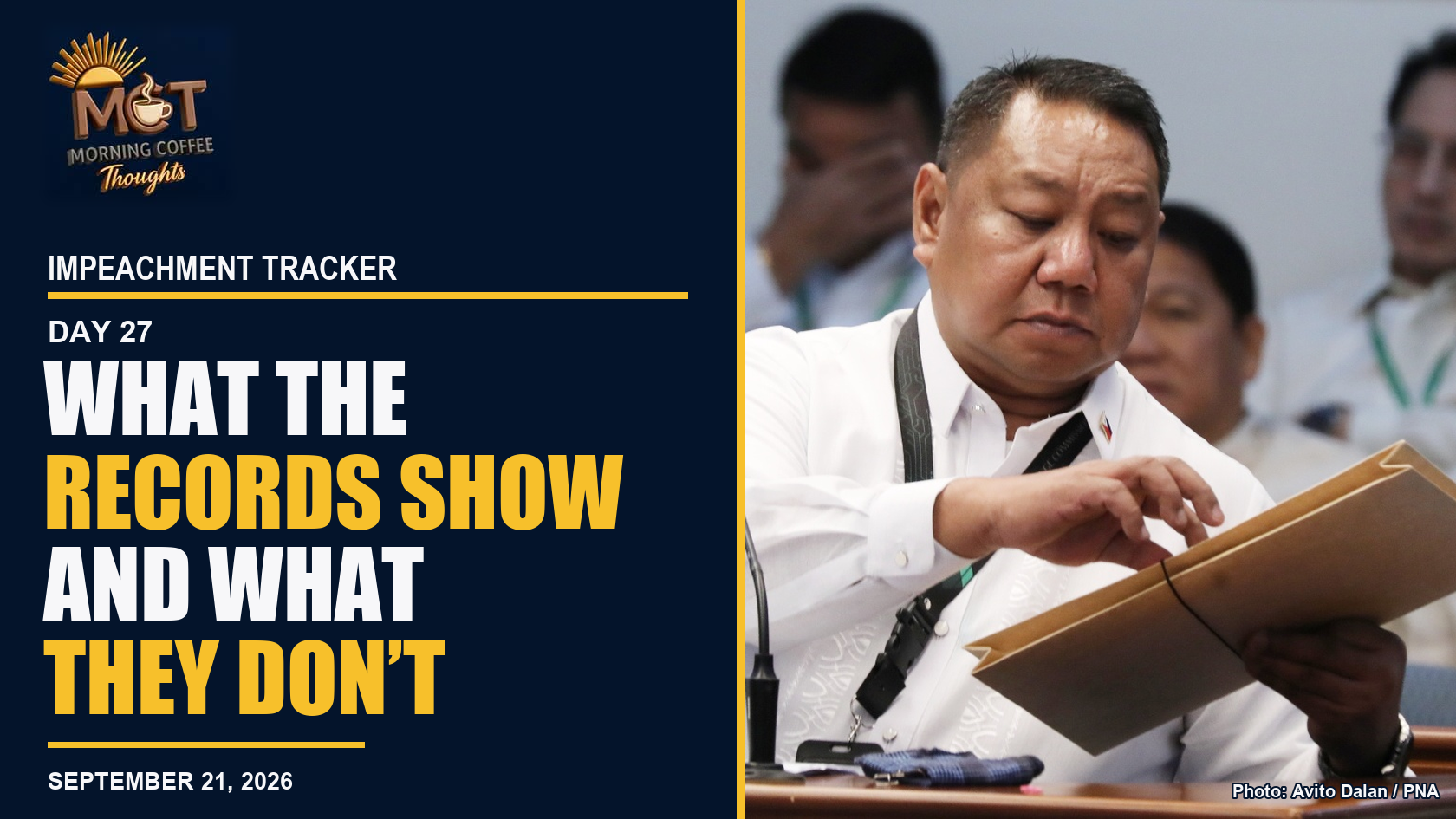
The prosecution presented Securities and Exchange Commission official Gerardo Fernando del Rosario to discuss corporate records connected to the Vice President and her husband, Manases Carpio. The questions involved their reported shareholdings, corporate positions, and whether income from these businesses could help explain the growth of their declared wealth.
Some answers strengthened the questions facing the Vice President. Others exposed gaps in the presentation. Several required correction before the hearing could move forward.
These are my notes on the exchanges worth keeping.
WHY THE WITNESS LINEUP CHANGED
The prosecution dispensed with its planned Civil Service Commission witness, Ariel Ronquillo, saying earlier testimony had sufficiently covered the points it intended to raise.
The PhilGEPS witness was also deferred while the requested documents were being assembled.
That left Del Rosario, director of the SEC’s Company Registration and Monitoring Department, to explain the corporate filings under Article II.
His testimony could establish what companies had reported to the SEC. Whether those entries proved the prosecution’s allegations was another question.
THE LABEL ON THE PAGE WAS A PROBLEM
An early dispute concerned a summary headed as the Vice President’s shareholdings even though it also contained company-wide financial information.
The defense objected that viewers could mistake corporate totals for amounts personally belonging to Duterte.
The prosecution answered that the table had separate columns for the company and the individual shareholder. Presiding officer Francis Escudero initially allowed the first page on that basis.
But the defense then pointed to a financial-statement page carrying the same heading.
Senator Francis Pangilinan asked that summaries be furnished ahead of their presentation, giving the court and opposing counsel time to examine them. Escudero directed the parties to do so.
Senator Alan Peter Cayetano raised the public-facing problem: people watching the hearing could see the heading and draw a conclusion that an oral clarification would not necessarily undo.
Escudero ordered the heading removed; he did not rule in that exchange that the figures themselves were false.
For me, this was a necessary intervention. A financial table already asks a lot of an ordinary reader. Its heading should help explain the numbers, not leave the reader assigning a corporation’s money to one person.
THE CORPORATE ROLES DESERVE SCRUTINY
Del Rosario discussed filings listing Duterte as a 20-percent shareholder of Metro City Chow Foods Corporation and as a director and compensation-committee member, including during her vice presidency.
Those entries prompted questions about the constitutional restrictions on the Vice President’s participation in business.
There was an important correction here, too.
When Del Rosario described the restriction in terms of business interests, Escudero pointed out that the provision read into the record referred to participation in business. Del Rosario acknowledged the imprecision in his explanation.
That exchange did not settle whether Duterte’s reported roles violated the Constitution.
Later, Senator Sherwin Gatchalian pursued the issue more directly. Did membership in the compensation committee indicate participation in management?
Del Rosario answered affirmatively, while explaining that he was relying on the position reported by the corporate secretary. He also said the SEC had not investigated the suggested constitutional violation and left that judgment to the Senate.
Both parts of that answer belong in the notes.
The reported role raised a substantive question about participation. The witness’s reliance on corporate filings also defined the limits of his answer.
SOME OWNERSHIP QUESTIONS REMAINED OPEN
The hearing also examined Gencorp Industries.
Del Rosario said Duterte’s name did not appear in the incorporation and shareholder records being discussed. The prosecution explored corporate shareholders, common individuals across companies, and possible nominee or trust arrangements.
It elicited entries placing Jaime T. Cruz in both Gencorp and Metro City Chow. But when counsel pursued the characterization of an interlocking director, the defense objected and Escudero sustained the objection.
That ruling did not erase the corporate entries already discussed. Nor did those entries, by themselves, establish the Vice President’s ultimate ownership.
Senator Joel Villanueva asked how a business interest declared in a SALN could be reconciled with the absence of the person’s name from the corporate records.
Del Rosario discussed possible arrangements, but said he had no document establishing the proposed trust agreement.
Asked about beneficial-ownership information, he said his department did not have access to those forms.
That answer cannot be shortened to “the SEC has no record.” He was explaining what his department could access, not establishing that the information existed nowhere.
CARPIO’S RECORDS AND THE DIRECTION OF THE MONEY
The presentation also covered Cale88 Foods Corporation.
The summary listed Carpio with an initial 40-percent ownership interest, later 47.5 percent, and as chairman and president in earlier entries. The 2025 row stated that he no longer appeared as a director or stockholder.
The disappearance of a name from a filing does not, on its own, explain how an ownership interest was transferred or the terms of that transaction.
The examination then turned to advances from stockholders.
Here, the direction of the money was important. Del Rosario explained that these were funds advanced by shareholders to the company. The company owed the advancing shareholders.
They were not automatically payments from the company to Carpio. Nor did his ownership percentage establish that the entire balance came from him.
NO INFORMATION IS NOT THE SAME AS NO DIVIDENDS
The most consequential correction came during the prosecution’s presentation of dividends across several companies.
For some companies, Del Rosario said the filings examined contained no declaration of dividends.
For others, he said no financial statements had been filed with the SEC and he lacked the information needed to determine whether dividends had been declared.
The defense objected when the presentation treated the second situation as though it established the first.
Escudero sustained that objection and directed counsel to reflect the witness’s actual answer.
The prosecution denied misrepresentation. It said it stopped showing the disputed illustration after the clarification and maintained that its earlier examples were supported by the companies’ filings.
The defense then sought to strike the illustration and related questions. Escudero declined that request, explaining that the illustration had not been submitted in evidence and that his clarification addressed the testimony.
Those were two separate rulings.
The later refusal to strike the illustration did not turn missing information into proof of zero dividends.
HONTIVEROS ASKED ABOUT WEALTH. AQUINO ASKED ABOUT OTHER INCOME.
Senator Risa Hontiveros examined whether the companies’ financial position and the absence of dividends could explain an increase in personal assets.
Del Rosario explained that a company may retain profits rather than distribute them. No dividend does not automatically mean the company lost money.
But Hontiveros also obtained a direct answer: dividends a shareholder had not received could not explain an addition to that shareholder’s assets.
She then asked about divestment. Del Rosario pointed to changes in filings, including one dating to 2019, but said he did not hold the underlying documents transferring ownership.
Those answers did not establish a complete account of divestment during the vice presidency.
Senator Bam Aquino pursued another possible income channel: salaries and other compensation.
Could someone receive money as an employee or officer even if the company did not distribute dividends?
The witness acknowledged that possibility for someone holding an appropriate role.
Aquino then asked for the records that could establish whether Duterte or Carpio actually received such income. The prosecution said it had not found employment information in the SEC records presented that day and would call Bureau of Internal Revenue representatives concerning tax returns.
A possible salary is not a proven salary. But the absence of dividends is also not enough to rule out every other form of income.
THE TULFOS’ QUESTIONS
Senator Raffy Tulfo argued that Duterte should have been advised to divest and questioned the defense about the advice it would have given her.
The defense declined to answer the hypothetical question.
Later, Tulfo asked whether compensation from a prohibited business role would be ill-gotten. Escudero intervened because the question invited a legal conclusion the prosecution needed to establish.
Senator Erwin Tulfo focused on why the SEC did not remind officials about possible restrictions when their names appeared in corporate records.
Del Rosario described the absence of a directive to his office and suggested informational materials within the registration process. He agreed to bring the recommendation to the Commission.
That was a proposed follow-up, not a new policy already in force.
WHAT THE COURT LEFT FOR THE NEXT HEARING
Before adjournment, Escudero also ruled on the defense’s earlier language. He directed changes to references to misrepresentation and conditioning the public’s mind.
That addressed the wording in the record. It did not establish that every challenged presentation was accurate.
The defense’s cross-examination of Del Rosario was left for the next sitting. The PhilGEPS witness was also scheduled for September 22.
Sebastian Duterte’s September 23 subpoena was recalled. The court arranged a September 28–30 witness sequence involving him and representatives from PhilHealth Region XI and the PNP Firearms and Explosives Office.
The trial adjourned until 10 a.m. on September 22.
My takeaway from Day 27 is that there are serious questions in these records, particularly about continuing corporate roles. Those questions deserve answers grounded in documents.
The same care is required when the presentation overreaches. A missing filing cannot become a zero. A hypothetical salary cannot become an actual receipt. A reported committee position cannot simply be left out because the witness qualified his answer.
The notes need to preserve what the testimony supports—and stop where the evidence stops.