
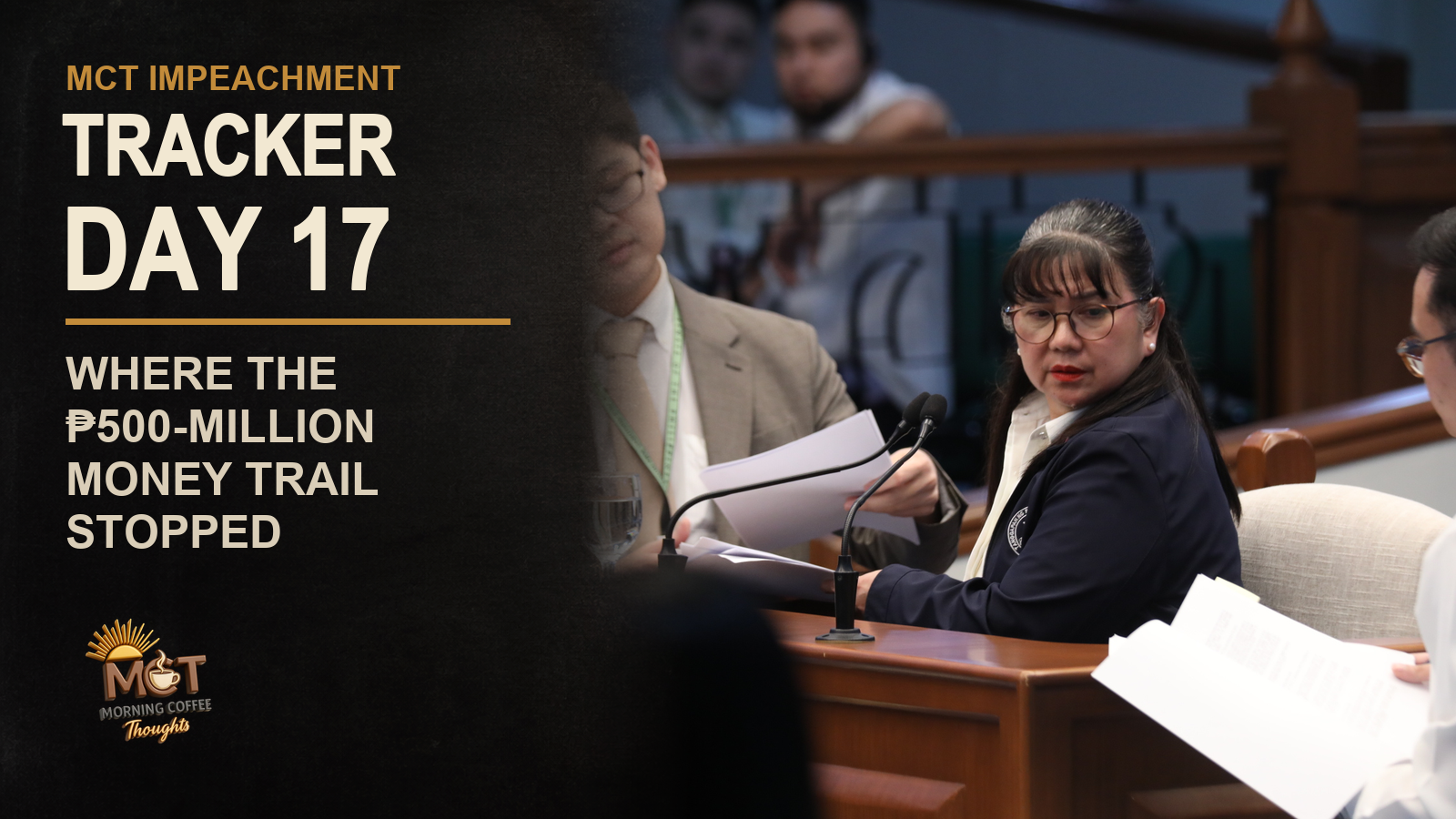
The Senate impeachment court convened at 10:04 a.m. Senator-judge Joel Villanueva led the opening prayer. At 10:08 a.m., the court declared a quorum with 17 senator-judges present.
The court continued hearing Article I, which accuses Vice President Sara Duterte of systematic misappropriation and irregular liquidation of ₱612.5 million in confidential funds: ₱500 million from the Office of the Vice President and ₱112.5 million from the Department of Education during her tenure as education secretary.
These remain allegations being tried. The Senate has not yet decided Duterte’s guilt or innocence.
GINA ACOSTA RETURNS TO THE WITNESS STAND
Former OVP special disbursing officer Gina Acosta returned for her second day of testimony. She had been declared a hostile witness for the prosecution.
“Hostile witness” is a courtroom classification that allowed prosecutors to ask her leading questions. It did not mean the court had already found her dishonest.
Acosta completed direct examination, cross-examination, redirect and recross before answering questions from the senator-judges. She was excused after completing her testimony.
HOW THE ₱500 MILLION MOVED
Acosta testified that the OVP received four confidential-fund allocations of ₱125 million each: one in December 2022 and three more in 2023.
According to Acosta, Duterte instructed her to release the first ₱125 million to Col. Raymund Dante Lachica because he was the designated security officer who supposedly knew how to implement the OVP’s confidential activities.
When asked whether she also released the ₱375 million in 2023 to Lachica for the same reasons, Acosta answered yes.
Acosta therefore testified that the entire ₱500 million was ultimately released to Lachica.
For the December 2022 withdrawal, Acosta said the cash consisted of 125 sealed bundles worth ₱1 million each. The money was transferred from bank boxes into four traveling bags and transported to the OVP office.
Acosta said she suggested using four bags based only on her estimate. Duterte reportedly agreed to the arrangement.
Acosta also said she and Lachica were the only people inside the room when the cash was handed over, although Lachica had companions waiting outside.
THE ₱80-MILLION AND ₱45-MILLION RELEASES
One important detail emerged during Senator Lito Lapid’s questioning.
At least one of the 2023 ₱125-million allocations was not released to Lachica all at once. Acosta said she initially released ₱80 million and kept the remaining ₱45 million in the OVP vault.
The balance was later released after Lachica submitted a fund utilization report and an object of expenditure.
This does not change Acosta’s testimony that Lachica ultimately received the full ₱500 million. It shows that one allocation was released in two stages.
WHO WAS ACCOUNTABLE?
Acosta was the OVP’s designated and bonded special disbursing officer. Lachica was not bonded.
Acosta acknowledged that Lachica was not the accountable disbursing officer. She nevertheless maintained that she remained accountable for the money and considered her release of the cash to Lachica to be the act of “disbursement.”
Lachica, she said, merely implemented the confidential activities on the ground.
The prosecution and previous COA witnesses have argued that the arrangement violated the rules governing confidential funds because the designated SDO is supposed to make the disbursements and maintain the transaction records.
The defense’s position is that Acosta remained accountable, that the physical turnover was already her disbursement and that the Joint Circular did not expressly prohibit her from relying on documents submitted by the designated security officer.
The impeachment court has not yet issued a final ruling on that legal dispute.
THE RECEIPTS WERE RETURNED
Acosta said Lachica signed acknowledgment receipts whenever he received the money. However, after Acosta completed the liquidation process, Lachica took those receipts back.
This reportedly happened for the December 2022 allocation and all three 2023 allocations. Acosta therefore no longer possessed the receipts directly documenting Lachica’s receipt of the ₱500 million.
Separate acknowledgment receipts bearing the names of alleged recipients were retained and submitted to the Commission on Audit.
Acosta repeatedly acknowledged that she did not personally witness Lachica give money to those recipients. She was not present during the reported transactions and relied on the utilization reports, acknowledgment receipts and other papers Lachica provided.
That does not prove that no payments occurred. It establishes that Acosta could not verify them through her own observation.
₱16 MILLION FOR SAFE HOUSES
The prosecution presented an accomplishment report covering December 21 to 31, 2022.
The report listed ₱16 million for the rental of safe houses and related incidental expenses.
When asked whether she personally verified those expenses, Acosta again pointed to Lachica and the documents he submitted.
₱75 MILLION WITHOUT OFFICIAL RECEIPTS
Acosta confirmed that ₱75 million reportedly spent on supplies and medical and food assistance was supported by acknowledgment receipts rather than official receipts or sales invoices.
Some supporting documents were reportedly missing names, signatures or dates.
The absence of official receipts establishes a documentation problem. By itself, it does not prove that the money was stolen or that nothing was purchased.
THE NAMES ON THE ACKNOWLEDGMENT RECEIPTS
The prosecution presented acknowledgment receipts carrying several unusual names and corresponding payments:
- Antonio Pagong: ₱100,000 for the purchase of information
- Timon Andrew Pusa: ₱100,000 for vehicle rental connected with confidential activities
- Don Piang: ₱250,000 for vehicle rental
- May Pamana: ₱150,000 for the purchase of information
- Shane Ngitngit: ₱150,000 for the purchase or rental of supplies, materials and equipment
- Xuniso P. Belat: ₱100,000 for the purchase of information
Acosta said the people were real but the names were aliases. She could not provide their true identities because she said only Lachica knew who they were.
Senator Bam Aquino later asked whether the OVP had conducted an internal investigation after these names became publicly controversial.
Acosta said no such investigation or verification had been conducted. She also acknowledged that the OVP did not maintain a master list connecting the aliases to verified identities.
The hearing therefore did not establish that the recipients were imaginary. It established that Acosta could not identify or independently verify them.
CERTIFICATIONS BASED ON LACHICA’S PAPERS
Acosta confirmed that she signed liquidation documents and that Duterte signed reports covering the fourth quarter of 2022 and the first three quarters of 2023.
Acosta said her certification concerned the dates, amounts and entries appearing in the papers. She testified that the information supporting both her certification and Duterte’s certification came from documents submitted by Lachica.
This placed the same unanswered question before the court: how could the people signing the liquidation reports verify that the activities and payments described in the documents had actually occurred?
Acosta’s answer remained that she trusted Lachica because Duterte had designated him as the OVP security officer.
THE DAVAO PROCEDURE
The prosecution questioned Acosta about her earlier work as special disbursing officer for Davao City while Duterte was mayor.
Acosta agreed that the same basic procedure had been followed: confidential funds were released in cash to a security officer, the security officer submitted utilization documents and the receipt acknowledging his receipt of the money was later returned to him.
The defense objected because the Davao City funds were not included in the impeachment charge.
The court allowed the questioning only to examine an alleged pattern or practice. It did not turn Davao City’s confidential funds into a separate impeachment charge.
THE TREE-PLANTING ARGUMENT
The prosecution presented a post showing Duterte participating in an OVP tree-planting activity in Nunungan, Lanao del Norte, on August 13, 2026.
Acosta confirmed that the OVP had no confidential-fund allocation in 2026. Prosecutor Amando Ligutan argued that this showed the OVP could conduct a tree-planting activity safely without confidential funds.
The defense objected that the 2026 activity was outside the impeachment charges. Acosta said she could not draw the prosecution’s conclusion.
The exchange established that the OVP held a 2026 tree-planting activity despite having no confidential-fund allocation. Whether that proves earlier confidential spending for similar activities was unnecessary or improper remains an argument from the prosecution, not a finding of the court.
THE WORD “SCAM” IS STRICKEN
Near the end of direct examination, Ligutan asked whether the confidential-fund arrangement could be considered a “scam” or blatant deception involving public money.
The defense objected that the question was argumentative and impertinent.
Presiding officer Francis Escudero agreed and ordered the word “scam” stricken from the record because it had come from the prosecutor, not from Acosta.
The court did not call the arrangement a scam.
THE DEFENSE’S CROSS-EXAMINATION
During cross-examination, defense lawyer Lindon Bacquel emphasized that Acosta recalled receiving no audit observation memorandum or notice of suspension concerning Davao City confidential funds while she served there.
The defense also highlighted the March 31, 2026 notice of disallowance covering the OVP’s ₱375 million in confidential funds for the first three quarters of 2023.
Bacquel pointed out that it was issued more than two years after the liquidation and during the period of House impeachment proceedings.
Acosta could not recall whether the COA notice and House hearings actually overlapped.
The absence of similar COA notices during Acosta’s Davao tenure does not prove that every transaction there was proper. The timing of the 2023 notice also does not, by itself, prove political motivation.
A separate COA disallowance covering ₱73.287 million from the December 2022 confidential funds had been affirmed by the COA Commission Proper on April 10, 2026. The OVP filed a motion for reconsideration that remained pending.
A notice of disallowance is an audit action. It is not a criminal conviction or an impeachment verdict.
The defense ended its cross-examination at 1:05 p.m.
REDIRECT AND THE MEETING WITH A DEFENSE LAWYER
During redirect, the prosecution accused Acosta of having “selective memory.”
Prosecutors noted that she had difficulty recalling details when they asked about Davao City confidential funds but could answer the defense’s questions about the absence of COA notices.
Acosta explained that what she could not remember were the specific amounts, not everything that happened during her Davao service.
The prosecution also questioned Acosta about meeting defense lawyer Lindon Bacquel before her testimony.
Acosta admitted speaking with Bacquel while she was in Davao visiting her seriously ill husband. She said she asked only about how the Senate proceedings would work and that Bacquel did not disclose the questions he would ask.
The prosecution later raised the possibility that Acosta had been coached because of her repetitive answers.
No evidence presented during Day 17 established that coaching had occurred.
THE SENATOR-JUDGES QUESTION ACOSTA
After the lawyers completed their examination, the senator-judges questioned Acosta about the accountability and verification gaps in her testimony.
Kiko Pangilinan and Win Gatchalian pressed Acosta on how she could remain accountable after turning the cash over to an unbonded officer.
When Gatchalian asked what safeguard prevented the money from being pocketed, Acosta pointed to the liquidation documents submitted to COA. She admitted that she had not raised the accountability problem directly with Duterte.
Erwin Tulfo questioned documents covering ₱122 million in reported medicine purchases and ₱112 million in supplies. He asked how medicines could be classified as rewards connected with informants.
Acosta said she could not personally confirm that ₱122 million had actually been spent on medicines because she relied on Lachica’s documents.
Raffy Tulfo questioned why names such as Pagong, Pusa and Belat did not prompt stronger verification.
After Acosta described herself as having average intelligence, Tulfo called her “stupid in the name of blind loyalty.”
That was Tulfo’s personal assessment, not a ruling of the court.
Risa Hontiveros presented an acknowledgment receipt bearing the name “Clarisse Hontiveros,” dated February 24, 2023. That was Hontiveros’ birthday.
Acosta said she had not noticed the coincidence and did not know the person’s true identity.
Imee Marcos asked whether Acosta had ever seen Duterte touch, claim or receive any part of the confidential funds. Acosta answered no.
That answer established only what Acosta personally saw. It did not establish that Duterte received money. Acosta’s limited personal observation was also insufficient to rule out other possible routes of benefit that she did not witness.
Marcos then asked about Acosta’s seriously ill husband. Acosta became emotional, and the court allowed her time to compose herself.
Lito Lapid asked about the remaining ₱45 million from one ₱125-million allocation and about acknowledgment receipts bearing the names Diane Maple Lapid and John A. Lapid.
Acosta said the ₱45 million had remained in the vault before being released to Lachica, and that only Lachica could explain the identities behind the Lapid names.
Bam Aquino asked why the OVP had not conducted an internal investigation into the aliases or established a master list connecting them to verified identities.
Panfilo Lacson stressed that purchases of supplies, even for confidential activities, ordinarily require official receipts or sales invoices signed by real people rather than aliases.
This was Lacson’s reading of the documentation rules, not yet a ruling by the impeachment court.
Tito Sotto questioned how reported activities could have been conducted in 132 locations over 11 days when Acosta said her disbursing authority could not be delegated.
Acosta again answered that Lachica implemented the activities.
Sotto referred to the OVP’s lack of regional offices. The OVP did operate satellite offices, so this should not be interpreted as proof that it had no field presence anywhere in the country.
Escudero later observed that even Lachica was not “Superman” and could not personally distribute money to several people in different locations on the same day.
He suggested that other people must have handled some of the distributions.
That was an inference. Acosta did not identify any additional distributors, and no such person was established through her testimony.
FAJARDA’S REPORTED STROKE
Near the close of the hearing, Escudero announced that former DepEd special disbursing officer Edward Fajarda had asked to be excused from the August 24 to 26 trial dates after reportedly suffering a stroke.
According to the letter and medical certificate submitted to the court, Fajarda had been placed in intensive care for observation and later transferred to a regular hospital room.
The court did not immediately accept the medical claim. Escudero ordered the Senate Medical and Dental Bureau to examine Fajarda, coordinate with his physicians and report whether he was medically unable to testify.
The prosecution tentatively reserved September 7 for his testimony.
THREE MILITARY WITNESSES SUBPOENAED
Because Fajarda was unavailable, the prosecution requested subpoenas for retired Col. Manaros Boransing II, Col. Magtangol Panopio and Maj. Gen. Adonis Bajao concerning DepEd’s 2023 confidential funds.
The defense objected that it would have only one day to prepare.
Escudero allowed the subpoenas but said the defense’s cross-examination would most likely occur the following week, giving it additional preparation time.
The issuance of subpoenas did not establish what the military officers would say in the Senate or whether their earlier statements would survive cross-examination.
The court subsequently adjourned. Public reports confirm the adjournment but do not provide a sufficiently reliable exact time.
The 3:30 p.m. appearing on one live-update page was the page’s final update time, not a verified adjournment time.
WHAT DAY 17 ESTABLISHED
Acosta’s testimony established her account of how the ₱500 million left her custody.
She said Duterte instructed her to release the money to Lachica, who was unbonded but designated to implement the confidential activities.
Acosta remained the bonded and accountable SDO. She signed liquidation documents based on papers supplied by Lachica even though she did not personally witness the final payments, confirm the reported purchases or verify the identities behind the aliases.
Day 17 did not prove that Duterte personally pocketed the money. It did not prove that all the recipients were imaginary, and it did not prove that every reported activity was fabricated.
Acosta’s lack of personal knowledge also does not prove Duterte’s innocence.
What remains is an incomplete money trail. Once the cash reached Lachica, Acosta could no longer independently explain who physically distributed it, who ultimately received it or how the purchases and operations described in the liquidation documents were verified.
An impeachment trial is not a criminal trial. Senators are nevertheless being asked to decide whether the fund system described under oath constitutes an impeachable abuse of public trust.
They cannot make that assessment responsibly without examining where the money actually went.
This is why Lachica’s testimony, along with the records he can produce or cannot produce, will be central.