
These are my notes from the September 14 impeachment hearing. If I missed anything critical or described anything inaccurately, please let me know. I will be happy to verify and correct it.
I went back through the hearing expecting to follow money. Instead, the Senate spent much of Day 24 learning the rules for following it.
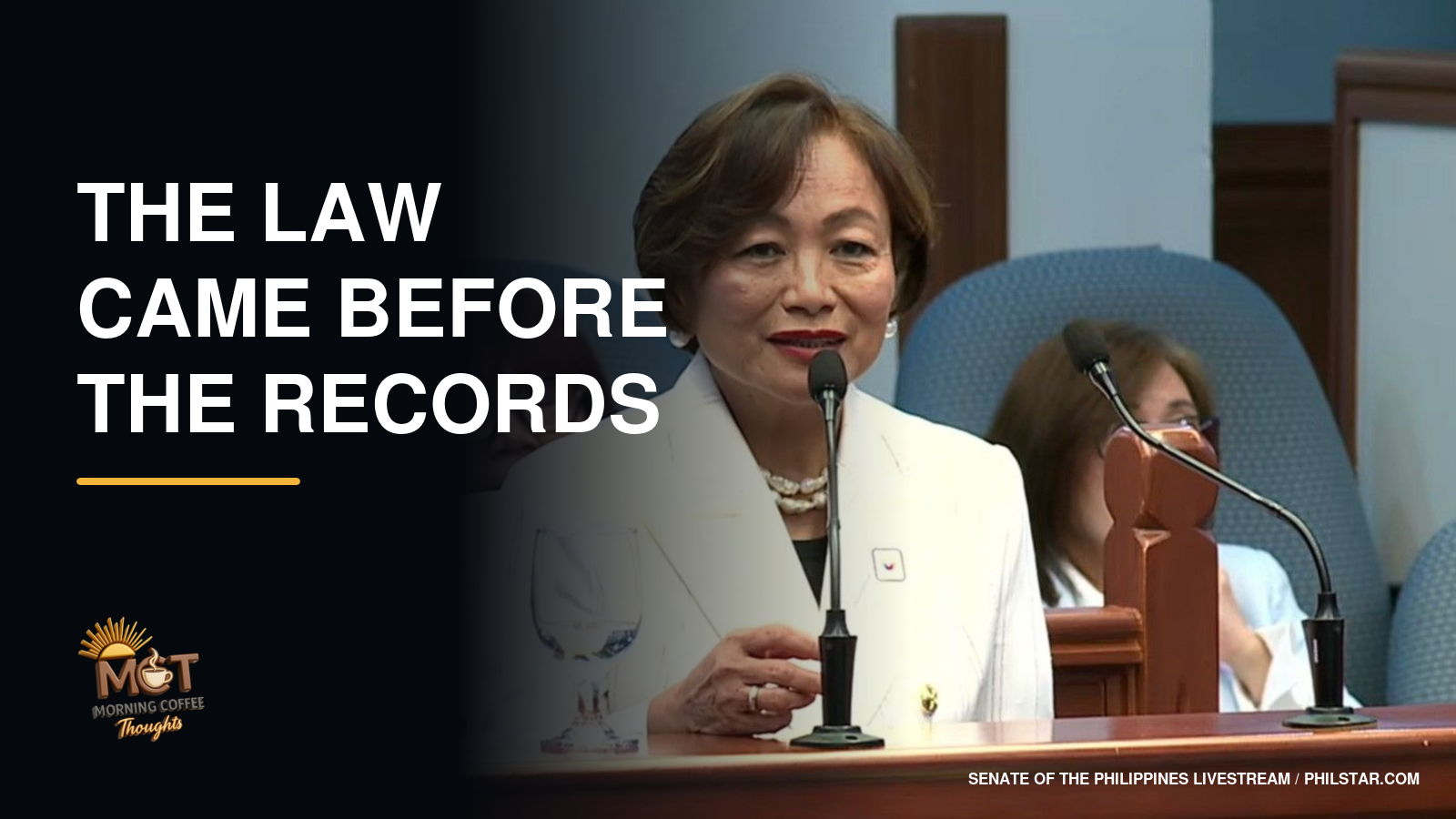
That was the prosecution's choice. Before showing the SALNs, bank records, tax documents and corporate filings behind Article II, it called retired Sandiganbayan Presiding Justice Amparo Cabotaje-Tang to explain how the law looks at unexplained wealth, hidden ownership, business interests and omissions from a public official's wealth declaration.
It sounded like a lecture at times. The questions eventually exposed why the lecture was necessary, where it was incomplete and how easily a large number can be mistaken for a verdict.
The prosecution brought a legal framework. The documents still have to do the proving.
1. THE DOCUMENTS HAVE NOT DONE THE PROVING YET
Yesterday opened Article II, the part of the impeachment case accusing Vice President Sara Duterte of accumulating wealth that cannot be reconciled with her lawful income, filing incomplete or untruthful Statements of Assets, Liabilities and Net Worth from 2022 to 2024, and failing to divest or continuing to participate in business while in office.
Justice Tang did not authenticate a Duterte bank account. She did not identify an undeclared property. She did not compare Sara Duterte's salary with a particular acquisition. She had no personal knowledge of whether Duterte's SALNs were accurate or whether any of her assets were unlawfully acquired.
The Senate allowed her to testify because she could explain the rules that may later be applied to those records. Presiding Officer Francis Escudero made the limit clear: her opinion would not bind the impeachment court and would not be conclusive. The defense could challenge her, and it did.
So the fair description of yesterday is simple. The prosecution supplied its legal map. It has yet to walk the Senate through the transactions, connect them to actual ownership, compare them with lawful income and prove the allegations written in Article II.
That limit protects the fairness of the trial. Duterte's supporters cannot dismiss the inquiry before the records are examined, and her critics cannot treat a legal lecture as evidence of guilt.
2. ₱6.77 BILLION IS A HEADLINE. IT IS NOT YET AN ANSWER.
The number hanging over Article II is approximately ₱6.7 billion to ₱6.77 billion in aggregate transactions linked by the prosecution to accounts involving Duterte and her husband, lawyer Manases Carpio.
Aggregate transactions are the total movements recorded across accounts. They are not automatically the amount somebody earned, owned or kept. The same money can be counted more than once as it moves from one account to another. A deposit can represent income, a loan, a transfer, money held for another person or something unlawful. The number alone cannot tell us which.
This is where both camps will have to do serious work.
The prosecution must show whose money it was, where it came from, when it was acquired, who controlled or benefited from it, and what part cannot be explained by lawful income. If it relies on property or accounts under another person's name, it must prove the connection instead of asking the Senate to assume it.
The prosecution carries the burden of proving its case. If properly authenticated records reveal a serious discrepancy, however, calling the case political will not explain it. The defense can answer with records showing a lawful source, a spouse's separate ownership or the legitimate purpose of money that temporarily passed through an account.
₱6.77 billion commands attention. Evidence must give the number meaning.
3. THE SALN IS A PHOTOGRAPH TAKEN ON DECEMBER 31
One exchange helped me understand why bank records can show far more movement than a SALN.
Senators asked what happens when millions or billions enter a public official's account and are withdrawn before the end of the year. Justice Tang initially had to correct herself on the date. The SALN filed by April 30 reports the official's financial position as of December 31 of the previous year.
If money entered an account in October and left in November, it would no longer be sitting there as a year-end asset. That does not automatically make the transaction unlawful. It also does not erase the transaction from the bank trail or prevent the Anti-Money Laundering Council from examining it.
That answer gave us one of the clearest ways to understand the coming evidence. A SALN is a photograph taken on December 31. Bank records are closer to a moving picture.
The prosecution will be looking for moments in that moving picture that reveal ownership, control, income or benefits not reflected in the official photograph. The defense can show that a transaction had a lawful explanation or that money passing through an account was never the account holder's property.
Neither document should be read alone. A missing year-end balance does not prove concealment. A clean-looking year-end declaration also cannot answer every question about what happened during the rest of the year.
4. ONE OMISSION MAY BE A MISTAKE. REPETITION CHANGES THE QUESTION.
Justice Tang was careful on one point that deserves the same care from the public: an omission from a SALN does not automatically prove unexplained wealth.
The official must be given a chance to explain. A property may have been lawfully acquired. A filer may have made an honest error. A spouse may have owned an asset under a valid property arrangement. An official may even have been genuinely unaware of a spouse's account. The surrounding evidence decides whether an omission was innocent, negligent or deliberate.
The question becomes harder when the same property or financial interest disappears from declaration after declaration. Repetition can support an inference that somebody was trying to conceal it. It still needs proof, but the honest-mistake explanation becomes harder to sustain each year the same omission returns.
This is why the coming comparison must be exact. Which asset was allegedly missing? Who acquired it? When? How much did it cost? What lawful income was available? Was it held jointly, separately or through a company? Did it remain undeclared across several years? What explanation did Duterte provide?
Without those details, "false SALN" is an accusation. With authenticated records and a fair opportunity to answer them, the Senate can decide whether it was a mistake, a reporting violation, intentional concealment or no violation at all.
5. THE BUSINESS QUESTION IS STRICT, BUT YESTERDAY DID NOT SETTLE EVERY EDGE
The Constitution places unusually strict restrictions on the President and Vice President. During their tenure, they may not directly or indirectly participate in business, and they must strictly avoid conflicts of interest.
Justice Tang took a broad view. When Escudero asked whether the prohibition reached ownership of even a sari-sari store, she said yes. The discussion also reached corporate shares and divestment. Yet another exchange acknowledged that an official may receive dividends from shares.
That left an important question unfinished. When is a stockholding a passive investment, and when does ownership, control, influence or benefit become prohibited participation in business? The documents showing corporate positions, voting rights, beneficial ownership and actual conduct may answer more than a general statement can.
There is also a deadline detail that should be reported accurately. Republic Act No. 6713 says that when a conflict of interest arises, an official must resign from a position in a private business enterprise within 30 days of assuming office and divest shareholdings or interests within 60 days. Several reports compressed those separate requirements into a single 30-day divestment rule.
The constitutional restriction may impose a stricter standard on the country's two highest executive officials. The Senate still has to decide how that restriction applies to Duterte's actual interests and conduct. A legal principle cannot identify beneficial ownership by itself. The SEC records, company documents and testimony about who exercised control will have to make that connection.
6. THE DEFENSE FOUND A LIMIT, THEN TURNED TO POLITICAL LABELS
Defense lawyer Mark Vinluan had a legitimate point to establish: Justice Tang did not know the facts of Sara Duterte's finances. She was explaining law, and the senator-judges must decide the law for themselves. The defense also preserved its objection that she was an inadequately disclosed surprise witness and that it had not received enough material to prepare.
Then the cross-examination moved into political territory.
Was Tang disappointed that former president Rodrigo Duterte had not appointed her to the Supreme Court after several applications? Was she anti-Duterte? Did she like Sara Duterte? Was she a Kakampink? Was she close to Chel Diokno? Had she been promised anything for appearing?
Cross-examination is allowed to test bias. A witness's political connection, personal interest or hostility can affect credibility. Asking the question is not improper merely because it sounds uncomfortable.
But the questions have to lead somewhere.
Tang denied being anti-Duterte or politically affiliated. She said she was not close to Diokno and recalled that they had appeared on opposing sides in earlier litigation. When asked whether she was receiving or had been promised anything, she answered, "My testimony is not for sale."
That became the line people remembered. I was left asking whether the defense uncovered bias or simply gave the witness her strongest moment. Calling somebody a Kakampink does not rebut a statute, correct a SALN or explain a bank transfer.
7. THE MOST USEFUL WORDS WERE "I STAND CORRECTED"
"My testimony is not for sale" was the dramatic answer. I underlined a quieter one.
When the relevant SALN date was clarified, Justice Tang said, "I stand corrected."
That did not destroy her expertise. It demonstrated why the defense had to be allowed to question her and why the senator-judges cannot outsource their judgment to an expert witness. A credible proceeding leaves room for correction in public.
The same discipline should apply to everybody watching. A viral clip may omit the qualification that followed an answer. A prosecution statement may describe allegations as strongly as the rules permit. A defense statement may emphasize unfairness while leaving the financial discrepancy unanswered. A headline may turn transaction volume into apparent wealth.
We should be willing to correct our own first impressions when the full record says something more precise.
WHAT COMES NEXT
At the end of yesterday's hearing, the prosecution was preparing to move from legal concepts to documents. The scheduled witnesses included an Ombudsman records officer expected to identify and authenticate Duterte's SALNs and an SEC official expected to authenticate corporate records.
Authentication is only the beginning. It tells the court that a record is what the witness says it is. The next questions are harder: What does the record show? What does it omit? How does it compare with lawful income and other filings? Who owned or controlled the companies and accounts? What explanation does the defense offer? Does the full evidence support an innocent error, lawful wealth, a disclosure violation or deliberate concealment?
WHAT DAY 24 LEFT US WITH
Day 24 did not establish that Sara Duterte had unexplained wealth. It established the legal framework the prosecution wants the Senate to use when the financial records arrive.
Justice Tang explained how lawful income, year-end SALNs, beneficial ownership, repeated omissions and business interests may fit together. The defense established that she had no personal knowledge of Duterte's finances and that her opinions do not bind the senator-judges. The political questions on cross-examination produced the day's most memorable exchange, but they did not resolve a single financial discrepancy.
The large figure also remains only a starting point. The approximately ₱6.77 billion cited by the prosecution refers to aggregate transactions, not a finding that Duterte earned, owned, kept or stole that amount. The prosecution must trace the money, prove ownership or control, compare the assets with lawful income and establish what was omitted. The defense must be allowed to explain every challenged record.
Day 24 gave the prosecution its vocabulary. The records now have to carry the accusation.
SOURCES
- Senate of the Philippines, Impeachment Documents, Case No. 004-2026https://senate.gov.ph/services/impeachment-documents
- House of Representatives, Committee Report No. 261 and Articles of Impeachmenthttps://docs.congress.hrep.online/legisdocs/first_20/CR00261.pdf
- House of Representatives, Article II witness and documentary planhttps://www.congress.gov.ph/media/press-releases/10161
- Day 24 full-hearing video timeline, UNTV-origin mirrorhttps://zolotube.com/watch?v=S4ucrT8aiEY
- 1987 Constitutionhttps://lawphil.net/consti/cons1987.html
- Republic Act No. 6713, Code of Conduct and Ethical Standards for Public Officials and Employeeshttps://lawphil.net/statutes/repacts/ra1989/ra_6713_1989.html
- Republic Act No. 3019, Anti-Graft and Corrupt Practices Acthttps://lawphil.net/statutes/repacts/ra1960/ra_3019_1960.html
- Supreme Court, Civil Liberties Union v. Executive Secretaryhttps://lawphil.net/judjuris/juri1991/feb1991/gr_83896_1991.html
- Supreme Court, Republic v. Rabusahttps://lawphil.net/judjuris/juri2022/aug2022/gr_208183_2022.html
- Supreme Court, Heirs of Ligot v. Republichttps://elibrary.judiciary.gov.ph/thebookshelf/showdocs/1/69940
- Philstar, Day 24 hearing recaphttps://qa.philstar.com/headlines/2026/09/14/2556237/sara-duterte-trial-recap-sept-14-law-lecture-unexplained-wealth-politics-cross
- BusinessMirror, Article II testimony and next witnesseshttps://businessmirror.com.ph/2026/09/14/prosecutors-press-constitutional-ban-on-vp-engaging-in-business/
- Journal Online, the six guideposts presented by the prosecutionhttps://journalnews.com.ph/impeachment-day-24-recap-retired-justice-lays-down-at-least-6-guideposts-for-vp-sara-unexplained-wealth-evidence/