
AUGUST 17, 2026
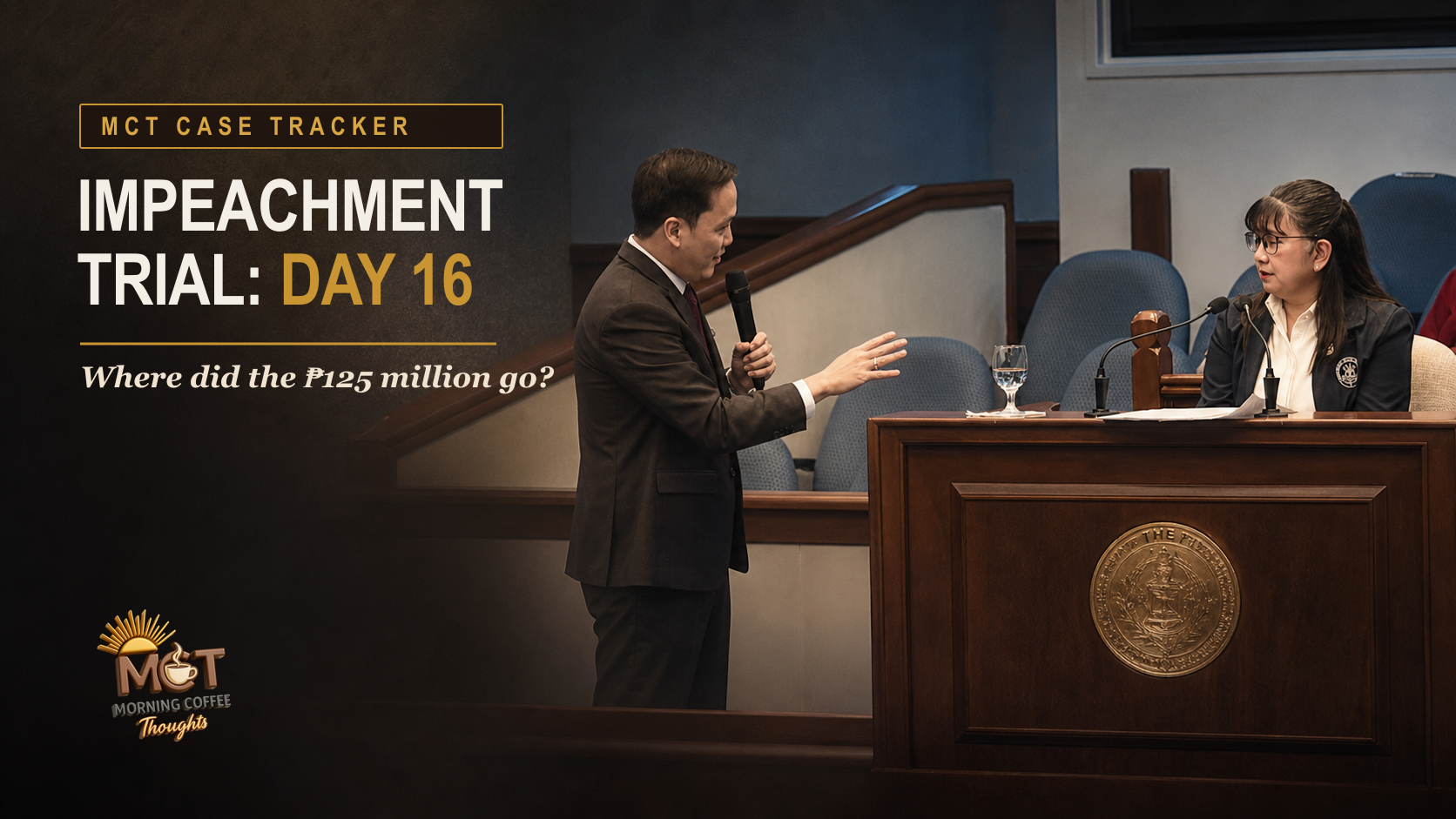
These are my personal notes from the August 17 impeachment hearing.
They are not the official Senate minutes or a stenographic transcript. I am keeping them as a working record so I can track what each witness actually said, what the lawyers argued, what had already been established in previous hearings, where different witnesses corroborate or contradict each other, and what remains unanswered.
The main witness was Gina Acosta, former Special Disbursing Officer of the Office of the Vice President.
The hearing centered on the ₱125 million in OVP confidential funds that Acosta personally withdrew in cash on December 20, 2022, and what happened to that money after it left LandBank.
The most important testimony of the day was not that the ₱125 million existed or that Acosta withdrew it. Those facts had already been established.
What became clearer was the next part of the chain.
According to Acosta, Vice President Sara Duterte personally instructed her to release the ₱125 million to Col. Raymund Dante Lachica.
That gives me this working trail:
LandBank → Gina Acosta → Col. Raymund Dante Lachica → still to be fully established
And according to Acosta, the instruction moving the money from her to Lachica came from Sara Duterte herself.
That is where Day 16 became important.
For taxpayers, the practical issue is whether the government can show, through authorized officers and verifiable records, who controlled ₱125 million, what operations it paid for and who accepted responsibility when that chain changed.
WHO IS GINA ACOSTA?
Acosta's role went beyond picking up money for the OVP.
She was the Special Disbursing Officer, or SDO.
That means she was an accountable officer entrusted with government funds.
She was responsible for the cash advance placed under her name and for ensuring that the money was safeguarded, disbursed and liquidated according to government rules.
That makes her role central to the confidential-fund story.
She was also not new to this kind of work.
Acosta had previously served as a Special Disbursing Officer handling confidential funds in Davao City while Sara Duterte was mayor, before eventually performing the same type of function at the Office of the Vice President.
That history is relevant because it means Acosta was not an inexperienced employee encountering confidential funds for the first time.
She already had experience handling this kind of government money.
That becomes important when evaluating later explanations about what she understood her responsibilities to be.
ACOSTA IS DECLARED A HOSTILE WITNESS
The prosecution asked that Acosta be declared a hostile witness.
The impeachment court granted the request.
That allowed prosecutor Atty. Amando Virgil Ligutan to ask leading questions even though Acosta had technically been called as a prosecution witness.
Presiding Officer Francis Escudero reminded Ligutan of an important distinction:
Leading questions were allowed.
Misleading questions were not.
That became relevant because Ligutan's examination was aggressive and often attempted to pin Acosta down on responsibilities, instructions and the governing confidential-fund rules.
For my notes, the hostile-witness designation should not itself be treated as proof that Acosta was lying.
It was a procedural ruling that gave the prosecution greater latitude in questioning her.
THE LANGUAGE ISSUE
One of the first controversies surrounding Acosta was language.
She asked to answer in Bisaya and appeared uncomfortable answering some questions in Tagalog or English.
An interpreter was made available.
The problem eventually drew the attention of Senator-Judge Erwin Tulfo.
Tulfo said he had reviewed Acosta's earlier testimony before the House, particularly exchanges during the congressional investigation involving Rep. Gerville Luistro.
His point was that Acosta had previously answered questions in Tagalog and English.
He questioned why she appeared to have much greater difficulty doing that during the impeachment hearing.
Tulfo openly challenged the inconsistency and eventually said:
“Tama na po itong panloloko sa atin.”
That was Tulfo's accusation.
It is not something I should convert into a factual finding that Acosta was deliberately pretending not to understand.
But the contradiction is legitimate credibility material.
She had previously demonstrated an ability to answer in Tagalog and English.
During the impeachment proceeding, she requested to use Bisaya and at times appeared to have difficulty with the other languages.
Tulfo confronted her with the earlier transcript.
For my purposes, that stays in the credibility file.
It does not prove anything about where the confidential funds went.
THE DECEMBER 20, 2022 WITHDRAWAL
The questioning eventually turned to the actual ₱125-million withdrawal.
The check was encashed at the LandBank Shaw Boulevard branch on December 20, 2022.
The transaction occurred at around 2:00 in the afternoon.
The time and place fix the December 20 movement of the cash more precisely.
Previous testimony had already established that Acosta personally encashed the check.
So the real question on Day 16 was no longer whether the money left LandBank.
It did.
The question was:
What happened after it became physical cash?
FOUR DUFFEL BAGS
Acosta testified that the ₱125 million was placed in four duffel bags.
She described the bags being moved from the bank.
According to her recollection, LandBank security guards helped by dragging the four duffel bags toward the vehicle.
She was uncertain whether a trolley had been used.
That is more specific than simply saying somebody helped carry the bags.
The physical volume of ₱125 million became part of the prosecution's presentation because this was not money that could simply be slipped into an envelope or briefcase.
It required several large bags.
THE AI-GENERATED IMAGE OF THE CASH
One of the more unusual procedural moments was the prosecution's use of an AI-generated image depicting what ₱125 million in cash inside duffel bags might look like.
The prosecution was using the image as a visual aid or simulation to help illustrate the physical scale of the amount.
The defense objected.
The defense's point was that the image did not necessarily represent the actual dimensions, quantity or arrangement of the real cash withdrawn by Acosta.
Escudero allowed its use after the prosecution clarified that it was merely a simulation or demonstrative illustration, not actual photographic evidence of the December 20 transaction.
That distinction is important.
The AI-generated image proves nothing about how the real money looked.
It was a courtroom visual aid.
Nothing more.
THE LANDBANK-GUARD DISCREPANCY
Acosta's recollection that LandBank guards dragged or helped move the bags creates a possible conflict with earlier evidence regarding LandBank procedure.
The earlier LandBank position was that once the cash was released, bank personnel were not supposed to assume responsibility for helping transport it to the client's vehicle.
So I now have two accounts that do not fit neatly together:
Acosta remembers LandBank guards helping move the four duffel bags.
The earlier LandBank evidence suggests that should not have been part of their procedure.
I am not resolving that contradiction yet.
It could be a minor difference in memory.
Or it could become useful later when Acosta's reliability is assessed.
For now, it stays marked:
I am marking this discrepancy as unresolved.
WHY WAS LACHICA INVOLVED?
The prosecution then moved to what happened after the cash left the bank.
Acosta said she contacted Col. Raymund Dante Lachica.
Lachica was associated with the Vice Presidential Security and Protection Group.
That raises a fundamental question.
Acosta was the Special Disbursing Officer.
Lachica was a security officer.
Why was a security officer taking control of money that had been formally entrusted to an accountable disbursing officer?
That is one of the most important distinctions in this whole confidential-fund case.
A security officer may participate in a confidential activity.
That does not automatically make him the accountable officer authorized to receive and disburse the cash advance.
Those are two different functions.
ACOSTA'S EXPLANATION OF LACHICA'S ROLE
Acosta's explanation was essentially that Lachica knew how to implement confidential activities.
She had previously described implementation as something effectively left to him.
The idea appears to have been:
Acosta handled the financial side.
Lachica handled the operational side.
But that explanation immediately creates another problem.
If Acosta withdrew ₱125 million and then turned the money over to Lachica to distribute or use at his discretion, was she still exercising control over the cash advance?
Or had she effectively transferred responsibility for the money to someone who was not the designated SDO?
That distinction became central.
WHO ORDERED THE HANDOVER?
This produced the most important testimony of the day.
Acosta testified that Vice President Sara Duterte instructed her to release the ₱125 million to Col. Lachica.
This is the part I want to preserve carefully.
Acosta did not describe the transfer as something she independently decided to do.
She attributed the instruction directly to Duterte.
So the sequence becomes:
The government releases ₱125 million.
Acosta encashes the check.
The money becomes physical cash placed in four duffel bags.
Acosta contacts Lachica.
Acosta releases the money to Lachica.
Acosta says Sara Duterte instructed her to do it.
That is the major Day 16 evidentiary development.
ACOSTA HAD SAID THIS BEFORE
Acosta had already given substantially the same account during the House investigation.
She had previously said that she turned the money over to Lachica with Duterte's authority or approval.
She had also said that she trusted Lachica because Duterte trusted him.
So the August 17 testimony did not reveal this allegation to the public for the first time.
The difference is institutional.
Acosta was now saying it before the Senate sitting as an impeachment court.
That means the testimony was now being formally placed before the senator-judges who will ultimately decide Duterte's impeachment case.
THE JOINT CIRCULAR BECOMES CRITICAL
The prosecution then turned to the rules governing confidential funds.
This is where the legal and accounting problem becomes much sharper.
The relevant Joint Circular requires cash advances for confidential and intelligence funds to be drawn by duly designated and bonded Special Disbursing Officers.
The circular also provides that:
under no circumstance may the cash advance be transferred from one accountable officer to another.
Acosta was the designated and bonded SDO. Lachica was not the SDO named for the cash advance.
The quoted provision does not, by itself, settle every role a security officer may perform in a confidential operation. The prosecution's compliance argument rests on the actual handover, the limits of Lachica's authority and Acosta's own acknowledgment that the circular contains no provision authorizing release or disbursement to a security officer simply because he is a security officer.
ACOSTA'S IMPORTANT ADMISSION
During questioning, Acosta acknowledged an important point:
There is no provision in Joint Circular No. 2015-01 authorizing the release or disbursement of confidential funds to a security officer simply because he is a security officer.
That admission may actually be as important as her statement that Duterte instructed her to hand over the money.
Because now we have two propositions coming from Acosta herself:
Sara Duterte instructed her to release the ₱125 million to Lachica.
And:
The Joint Circular contains no provision authorizing that type of release to a security officer.
That creates a much more direct compliance problem.
THE ₱125-MILLION PROGRAM ITSELF HAD ANOTHER PROBLEM
Acosta also acknowledged another deficiency.
The ₱125-million confidential-fund allocation was lodged under a broad “Good Governance Program.”
But the allocation did not contain detailed activities identifying precisely what operations were supposed to be funded.
That becomes important because confidential funds are not exempt from planning simply because the activities themselves are secret.
There still has to be a legitimate government purpose and an accountable relationship between the fund, the authorized activity and the eventual liquidation.
If the planning document merely contains a broad label without detailed activities, that raises another accountability problem before the money is even spent.
COA'S “BREAK IN THE CHAIN OF ACCOUNTABILITY”
This also connects directly to testimony already given by COA state auditor Xylene del Campo.
Her earlier testimony described what happened when Lachica became involved as a break in the chain of accountability.
That framing now makes much more sense when placed beside Acosta's testimony.
The chain should normally be straightforward:
Cash advance → designated bonded SDO → authorized expenditures → liquidation
But what happened here, according to Acosta, was:
Cash advance → Acosta → Lachica
And Lachica was not the designated SDO.
That is the break.
ACOSTA'S RESPONSIBILITY AS THE ACCOUNTABLE OFFICER
This leaves a very basic problem.
If Acosta was the accountable officer, what exactly did she do after turning the money over to Lachica?
Did she decide who should receive payments?
Did she know who the confidential informants were?
Did she personally meet them?
Did she see the payments take place?
Did she know how much each person received?
Did she verify whether the supposed intelligence or confidential operations actually happened?
Did she witness the signing of acknowledgment receipts?
Did she know whether the names appearing on those receipts represented real people?
If not, what exactly was she certifying when the money was later liquidated?
These questions go directly to the integrity of the paper trail.
THE WORD “DISCRETION”
The idea that implementation was left to Lachica's discretion is especially important.
If Lachica merely helped transport money under Acosta's direction, that would be one thing.
If Acosta handed him ₱125 million and allowed him to decide how, where and to whom it would be distributed, that is something entirely different.
One is physical assistance.
The other is operational control.
And if operational control moved from the bonded SDO to a security officer, the prosecution has a much stronger argument that the chain of accountability was broken.
DID ACOSTA KNOW THE FINAL RECIPIENTS?
This remains unresolved.
If Acosta did not personally distribute the cash, then who did?
If Lachica distributed it, who received it?
Were the supposed recipients real?
Were the acknowledgment receipts signed by actual people?
Were the confidential operations genuinely conducted?
And who checked any of this before the documents were submitted for liquidation?
The OVP had also previously submitted more than 1,200 deficient acknowledgment receipts connected to confidential-fund expenditures.
The presence of paperwork left a harder question:
Was there paperwork?
The question becomes:
Did the paperwork accurately document real transactions involving real people and real confidential operations?
THE DECEMBER 2022 COA DISALLOWANCE
The December 2022 ₱125-million transaction also has to be kept separate from later 2023 findings.
For the December 21–31, 2022 confidential-fund expenses, COA disallowed ₱73.287 million out of the ₱125 million. The Commission Proper upheld that amount on April 10, 2026, while a later motion for reconsideration was reported pending.
That figure is important.
It is not correct simply to say COA questioned the entire ₱125 million.
The disallowance covered ₱73.287 million, not the entire ₱125 million.
Of that amount, roughly ₱69.8 million was recorded as “rewards,” while approximately ₱3.5 million involved office equipment such as tables, chairs, computers and printers.
The breakdown identifies the exact categories COA questioned.
THE 2023 CONFIDENTIAL-FUND CASE IS SEPARATE
The three ₱125-million withdrawals in 2023 total ₱375 million.
Those transactions produced their own separate COA problems.
Those findings should not be merged casually with the December 2022 disallowance.
The 2022 and 2023 transactions involve different periods, different audit findings and different stages of review or appeal.
So in my notes:
December 2022 = one audit problem.
2023 = separate audit problems.
And neither should automatically be described as if COA had simply disallowed one undifferentiated ₱500-million block.
THE ₱500 MILLION MUST ALSO NOT BE CONFUSED WITH ₱612.5 MILLION
Another number that appears elsewhere in the impeachment case is ₱612.5 million.
That refers to the broader confidential-fund controversy involving both the OVP and DepEd.
It should not be confused with the ₱500 million representing the four ₱125-million OVP withdrawals handled by Acosta.
The numbers refer to different scopes.
Keeping them separate is necessary if these notes are going to remain useful later.
HOW ACOSTA'S TESTIMONY CONNECTS TO MADRIAGA
The connection to Ramil Madriaga is becoming more interesting.
Madriaga previously described four bags of cash and alleged that the money was subsequently divided and moved through people connected to Lachica.
Acosta now independently confirms several upstream details:
There was a ₱125-million cash withdrawal.
The money was placed into four duffel bags.
Lachica became involved.
Acosta released the money to him.
And Acosta says Sara Duterte instructed her to release it.
That gives partial corroboration to the beginning of Madriaga's story.
But it does not prove his entire account.
THERE IS ALSO A POSSIBLE ACOSTA–MADRIAGA CONTRADICTION
This is something I want to watch carefully.
Madriaga has alleged that the money or portions of it were brought to DepEd premises as part of the downstream distribution.
Acosta's account appears to place the OVP vehicles going directly toward the Office of the Vice President, not DepEd.
That may become important.
If they are talking about the same money movement and the same point in time, then the two versions may conflict.
But I do not want to force a contradiction prematurely.
They could be describing different legs of the movement.
So for now:
Acosta: bank → OVP vehicle → OVP direction
Madriaga: later alleged movement involving DepEd premises
The exact timeline needs to be compared carefully before declaring one of them wrong.
WHAT THE LANDBANK EVIDENCE GIVES US
The LandBank evidence establishes the beginning of the trail.
The check existed.
Acosta encashed it.
The money was physically released.
A very large amount of cash was involved.
The bank records and testimony make it difficult to dispute that the transaction occurred.
Acosta then takes the story one step farther.
She tells us what happened after the cash was under OVP control.
So:
LandBank tells us how the money left the bank.
Acosta tells us how the money left her control.
The unresolved problem is still:
What happened after Lachica obtained it?
THE DOCUMENTS I NEED TO KEEP TRACK OF
For Article I, the documentary trail is becoming as important as the witnesses.
The records I need to track include:
- Treasury checks; - LandBank encashment records; - Acosta's SDO designation; - fidelity-bond records; - cash-advance documents; - financial plans; - the “Good Governance Program” documentation; - liquidation reports; - acknowledgment receipts; - confidential-fund accomplishment reports; - Joint Circular No. 2015-01; - COA Notices of Disallowance and audit findings; - Acosta's 2024 House testimony; - records identifying supposed recipients; - and documents supposedly connecting payments to actual confidential operations.
I want to keep testimonial evidence and documentary evidence separate.
Because eventually the question becomes:
Does the paper trail confirm what the witnesses say happened?
THE DEFENSE OBJECTIONS
The defense objected at several points during Ligutan's questioning.
The objections form part of the record because Acosta had been declared hostile and Ligutan was using leading questions.
For my notes, the most important rule is this:
A lawyer's question is not evidence.
If Ligutan says something in a question, that does not make the proposition true.
The evidence is Acosta's answer.
The same applies to the defense.
For future detailed note-taking, I need to preserve important sequences as:
Question → objection → ruling → answer
That prevents me from accidentally converting lawyer argument into sworn testimony.
THE NDRRMC ALERT INTERRUPTION
At one point, phones inside the chamber simultaneously sounded an NDRRMC emergency alert.
The proceedings were briefly interrupted.
Escudero instructed those inside the chamber to silence their phones before the examination continued.
It has no evidentiary significance.
But since these are also functioning as minutes of the hearing, I am keeping it here.
WHAT ACOSTA ACTUALLY ESTABLISHED ON DAY 16
For my own purposes, these are the propositions I am comfortable attributing directly to Acosta:
1. She was the OVP Special Disbursing Officer.
2. She had previous experience as an SDO handling confidential funds in Davao City.
3. She personally encashed the ₱125-million OVP confidential-fund check on December 20, 2022.
4. The money was released as physical cash.
5. The money was placed into four duffel bags.
6. She contacted Col. Raymund Dante Lachica.
7. She released the money to Lachica.
8. She identified Sara Duterte as the person who instructed her to release the money to Lachica.
9. She acknowledged that Joint Circular No. 2015-01 does not contain a provision expressly authorizing confidential-fund cash to be turned over to a security officer.
10. She acknowledged that the ₱125-million allocation under the Good Governance Program did not contain detailed activities identifying exactly what would be funded.
Those are the Acosta points I consider most important from Day 16.
WHAT ACOSTA DID NOT ESTABLISH
Acosta did not establish that Sara Duterte personally pocketed the ₱125 million.
She did not establish that Lachica stole it.
She did not prove Madriaga's entire account.
She did not establish the identity of every final recipient.
She did not establish that every acknowledgment receipt was fictitious.
She did not establish that every claimed confidential operation was fake.
She did not prove that the entire ₱125 million was stolen.
She did not establish that every confidential-fund withdrawal followed exactly the same route.
And she did not establish what ultimately happened to every peso after the money entered Lachica's control.
Those questions remain open.
CREDIBILITY ISSUES I AM TRACKING
I now have several credibility issues surrounding Acosta.
LANGUAGE
Why was there such difficulty answering in Tagalog or English during the impeachment proceeding when previous House testimony showed her answering in those languages?
Not proof of dishonesty.
But something worth tracking.
LANDBANK GUARDS
Her recollection that bank security personnel dragged or helped move the bags may conflict with earlier testimony or LandBank procedure.
Still unresolved.
HER OWN SDO RESPONSIBILITY
She was the accountable officer.
Yet her explanation suggests that Lachica exercised significant control over implementation and possibly over the cash itself.
That creates a legitimate question about what she actually knew regarding the expenditures she later had responsibility for liquidating.
KNOWLEDGE OF RECIPIENTS
If she did not personally distribute the money or know the recipients, the credibility and reliability of the eventual liquidation documents become even more important.
WHAT THE PROSECUTION GAINED
The prosecution gained a clearer line toward personal responsibility.
Before Acosta, the prosecution could already establish:
The money was released.
The money was withdrawn.
After Acosta, the prosecution can now point to sworn testimony saying:
Sara Duterte personally instructed the accountable officer to release the ₱125 million to Lachica.
That is substantially stronger than simply saying Duterte headed an office where questionable transactions occurred.
It places her, according to Acosta, inside the decision-making chain itself.
WHAT MAY BE EVEN MORE DAMAGING THAN THE INSTRUCTION
The Duterte instruction receives the headline attention.
But I think the compliance admission may eventually be just as important.
Acosta says Duterte instructed her to give the money to Lachica.
Then Acosta acknowledges that the governing Joint Circular contains no provision authorizing that type of release to a security officer.
Put those together with the earlier COA testimony about a break in the chain of accountability and the prosecution begins to have a more structured argument:
The prosecution's argument is more specific: control of the cash moved outside the normal accountability chain.
The accountable officer was directed to move control of public funds outside the normal accountability chain.
Whether that rises to an impeachable offense remains for the Senate to decide.
But it is a much more specific allegation than simply saying the confidential funds were suspicious.
WHAT THE DEFENSE CAN STILL ARGUE
The defense still has substantial room.
It can argue that Lachica's participation was part of legitimate confidential operations.
It can argue that the transfer was operational and not corrupt.
It can challenge whether the Joint Circular should be interpreted as prohibiting exactly what occurred.
It can challenge Acosta's credibility.
It can argue that an accounting violation is not automatically an impeachable offense.
It can distinguish procedural irregularity from theft.
And most importantly:
It can demand proof of what actually happened to the money after Lachica received it.
That remains the prosecution's biggest unfinished task.
WHAT THE PROSECUTION STILL NEEDS TO PROVE
The chain currently reaches:
LandBank → Acosta → Lachica
with Acosta saying:
Sara Duterte ordered the handover.
But then the trail becomes much less certain.
The prosecution still needs credible evidence answering:
Where did the four bags go after Lachica received them?
Did he divide the money?
Who received it?
Did any of it go to DepEd?
Were there delivery teams?
Who were the supposed confidential informants?
Were those people real?
Were the operations real?
Who produced the acknowledgment receipts?
Who signed them?
Who checked them?
Who prepared the liquidation?
Who certified that the expenditures actually happened?
And does the documentary record correspond to the actual movement of the cash?
Those are the questions that can either complete the case or expose gaps in it.
WHO I WANT TO HEAR FROM NEXT
For this specific money trail, the witness I want to hear from most is Col. Raymund Dante Lachica.
Acosta puts the money in his hands.
Madriaga claims to describe what happened afterward.
COA says his involvement broke the normal accountability chain.
That places Lachica directly in the middle.
If he testifies, I want answers to very basic questions:
Did Acosta give him the ₱125 million?
Did Duterte tell him to receive it?
Why did he receive money entrusted to the SDO?
What authority did he believe allowed him to do that?
Did he distribute the cash?
To whom?
Did he supervise confidential operations?
Who prepared the acknowledgment receipts?
Did he know the supposed informants?
Did he return liquidation documents to Acosta?
Did he know who actually received the money?
And ultimately:
Where did the ₱125 million go?
Lachica can potentially connect Acosta's testimony to Madriaga's.
Or he can blow a hole through that connection.
Either way, his testimony could be extremely important.
MY EVIDENTIARY MAP AFTER DAY 16
This is where I currently place the December 20, 2022 transaction.
STRONGLY DOCUMENTED
The ₱125-million check existed.
Acosta encashed it.
The transaction occurred at LandBank Shaw Boulevard.
The money was released as physical cash.
DIRECTLY ATTRIBUTED TO ACOSTA
The cash was placed into four duffel bags.
She contacted Lachica.
She released the money to him.
Sara Duterte instructed her to do so.
There was no provision in the Joint Circular expressly authorizing release of the confidential-fund cash to a security officer.
The ₱125-million Good Governance Program allocation lacked detailed activities.
SUPPORTED BY OTHER EVIDENCE
The approximate four-bag physical volume.
The fact that Lachica became involved in the confidential-fund process.
COA's conclusion that Lachica's involvement broke the normal chain of accountability.
PARTIALLY CORROBORATIVE OF MADRIAGA
Cash existed.
Four bags existed.
Lachica became involved.
But Madriaga's downstream delivery story remains separately dependent on proof.
POSSIBLE CONFLICT WITH MADRIAGA
Acosta's description of the immediate movement of the OVP vehicles does not perfectly match Madriaga's allegation involving DepEd premises.
The timelines need to be compared carefully before deciding whether the accounts genuinely contradict each other.
STILL UNPROVEN
That Duterte personally received cash.
That Lachica stole the money.
That the entire ₱125 million was stolen.
That every acknowledgment receipt was fictitious.
That every confidential recipient was fake.
That all confidential operations were fabricated.
That Madriaga's full downstream account is true.
MY TAKEAWAY FROM AUGUST 17
August 17 did not solve the confidential-fund case.
It did something narrower but important.
It moved the evidentiary trail farther.
Before Acosta, we could follow the money from the government to LandBank and from LandBank to Acosta.
After her testimony, we can follow it farther:
LandBank → Acosta → Lachica.
And according to Acosta:
Sara Duterte gave the instruction that moved the money from Acosta to Lachica.
We also learned something equally important about the rules.
Acosta acknowledged that the Joint Circular does not contain a provision authorizing the confidential-fund cash to be released to a security officer.
That now sits beside the earlier COA testimony describing Lachica's involvement as a break in the chain of accountability.
That does not yet tell me the money was stolen.
It does not tell me Sara Duterte pocketed it.
It does not tell me Madriaga's entire story is true.
But it tells me something very specific happened to ₱125 million in public money:
The accountable officer withdrew it.
It was turned into four bags of cash.
And instead of remaining entirely within the hands of that accountable officer, it moved to a security officer.
According to the accountable officer herself, Sara Duterte ordered that handover.
The next question is still the same.
But it has become much harder to avoid.
Where did the money go after Lachica got it?
SOURCES
- GMA News: Sara Duterte impeachment trial Day 16: OVP's ₱500M release contrary to guidelineshttps://www.gmanetwork.com/news/topstories/nation/998868/sara-duterte-impeachment-trial-day-16-ovp-s-p500m-release-contrary-to-guidelines/story/
- The Philippine Star: Witness: ₱125-million secret funds released on VP's orderhttps://www.philstar.com/headlines/2026/08/18/2550023/witness-p125-million-secret-funds-released-vps-order
- The Philippine Star: COA auditor: VP Sara liable for ₱73 million in disallowed fundshttps://www.philstar.com/headlines/2026/08/12/2548747/coa-auditor-vp-sara-liable-p73-million-disallowed-funds
- Philippine Daily Inquirer: COA: OVP sent deficient receipts on secret fundshttps://newsinfo.inquirer.net/2001565/coa-ovp-sent-deficient-receipts-on-secret-funds
- PhilSTAR Life: Duterte impeachment trial Day 16 analysishttps://philstarlife.com/news-and-views/171307-duterte-impeachment-trial-day-16-analysis