
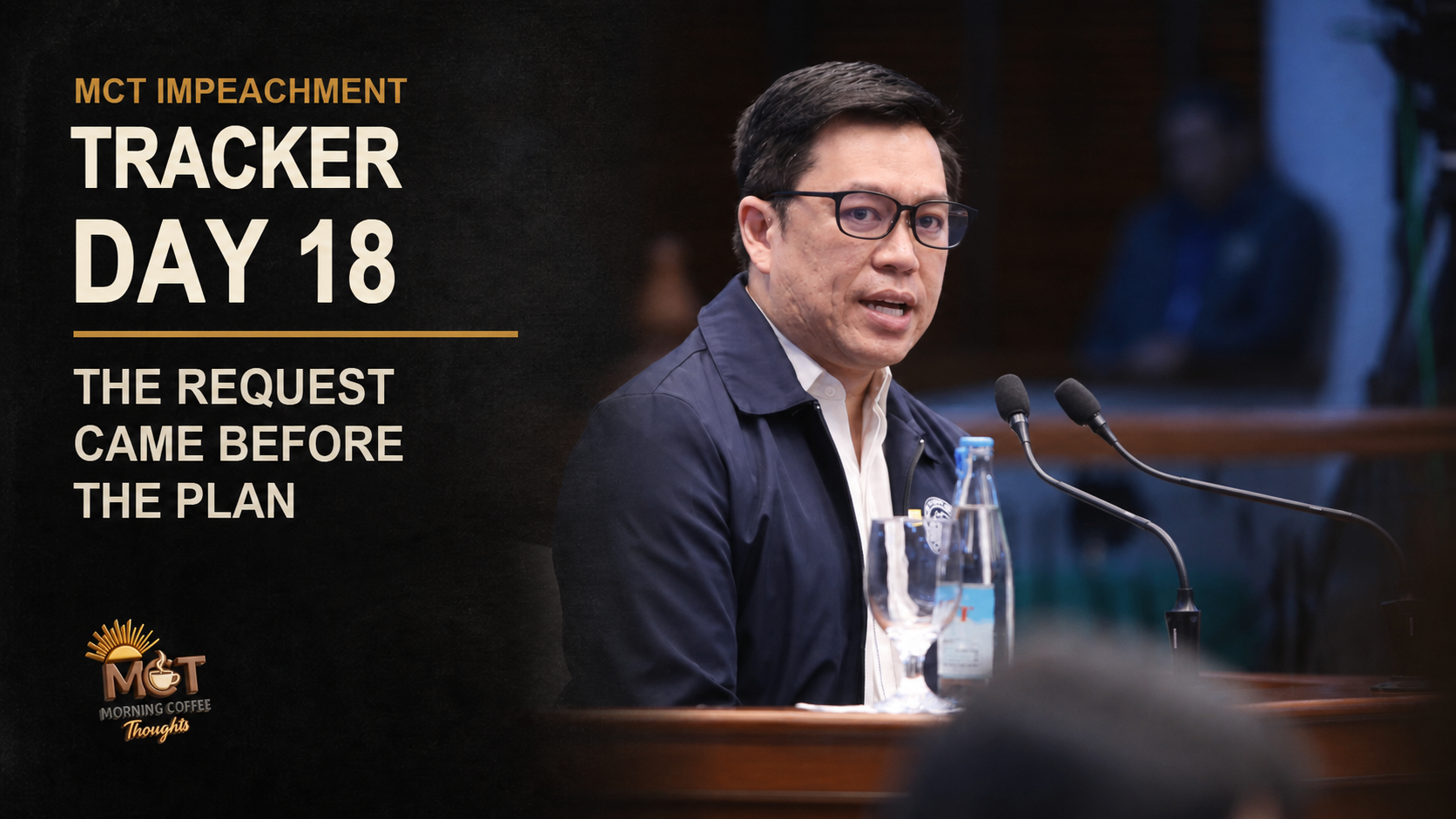
The Senate impeachment court opened with 15 senator-judges present, enough to establish a quorum.
The court continued hearing Article I, which accuses Vice President Sara Duterte of misappropriating and irregularly liquidating ₱612.5 million in confidential funds: ₱500 million from the Office of the Vice President and ₱112.5 million from the Department of Education.
These remain allegations being tried. The Senate has not decided Duterte’s guilt or innocence.
These are live notes from the hearing, prepared while the testimony and documents were being presented. If I missed anything critical or described anything inaccurately, please let me know. I will be happy to review and correct it.
LEMUEL ORTONIO TAKES THE WITNESS STAND
The prosecution called its sixth witness, OVP Assistant Secretary and Assistant Chief of Staff Lemuel Ortonio.
Ortonio has served under Duterte in several government positions since 2008. He worked as chief of staff in the Davao City vice mayor’s and mayor’s offices, later headed the Davao City Investment Promotion Center and Human Resource Management Office, and joined the OVP in July 2022.
He reports directly to Duterte. His appointment is coterminous with hers and is considered a position of trust and confidence.
Ortonio also confirmed that he declined several invitations to appear before the House Committee on Good Government and Public Accountability in 2024. He considered them mere invitations and did not seek any judicial order against them.
WHY HE WAS DECLARED A HOSTILE WITNESS
The prosecution initially explored Ortonio’s family and social connections while seeking to establish that he had an interest adverse to the prosecution.
Presiding officer Francis Escudero stopped that line of questioning after confirming that Ortonio remained a coterminous OVP official serving at Duterte’s pleasure. If Duterte were removed from office, Ortonio’s appointment would also end.
The court found that employment relationship sufficient and declared Ortonio the prosecution’s second hostile witness, after former OVP special disbursing officer Gina Acosta.
“Hostile witness” is a procedural classification that allows leading questions. It does not mean the court found Ortonio dishonest.
Before questioning him, the prosecution read an 11-point offer describing what it hoped his testimony would prove. The defense objected that the statements were unproved conclusions, speculation and sound bites.
The court allowed the prosecution to attempt to prove its assertions through testimony. It did not adopt the 11 claims as established facts.
WHAT ORTONIO SUPERVISED
Ortonio testified that he exercises overall supervision over the OVP’s internal affairs. This includes the Administrative and Financial Services Office, which handles budgeting, disbursement, accounting and liquidation, and the Strategy Management Office, which handles planning and monitoring of OVP programs.
The directors of both offices report to him. His authority and instructions ultimately come from Duterte.
Ortonio repeatedly clarified that his supervision was general. He did not personally prepare every document or participate in every confidential operation.
THE REQUEST CAME BEFORE THE CONFIDENTIAL-FUND PLAN
When the Duterte administration entered the OVP in July 2022, the office had no confidential-fund allocation. Ortonio said the records available to the OVP also showed no confidential funds under former Vice President Leni Robredo.
On August 22, 2022, Duterte signed a letter asking the Department of Budget and Management for four items. These included additional financial assistance, special-duty allowances, 192 additional coterminous and contractual positions, and ₱250 million in confidential funds.
The first three requests came with computations, projections and supporting documents. The confidential-fund request had no computation, projection, physical and financial plan or supporting attachment.
Ortonio testified that Duterte ultimately determined the amount to be requested.
The letter stated that the OVP was committed to formulating programs, projects and activities related to national security, peace and order. Ortonio agreed that while the OVP already had ordinary programs, the security-related activities mentioned in the confidential-fund request were still to be formulated.
DBM asked for a physical and financial plan on September 15. The plan was prepared and approved on September 16 and transmitted to DBM on September 19.
The plan identified only the broad “Good Governance Program.” It did not itemize the particular confidential activities or the proposed amount for each activity.
The 2023 plan contained substantially the same targets, wording and amounts but used “Socioeconomic Program Delivery” as its umbrella program.
The documents therefore show that the physical and financial plan supporting the confidential-fund request was produced after the ₱250-million amount had already been requested. General OVP programs already existed, but the confidential activities and their individual costs were not identified in the August 22 request.
That sequence raises a legitimate question about how the ₱250-million figure was calculated. It does not, by itself, prove that the fund had no legitimate purpose.
LACHICA’S DESIGNATION CAME AFTER THE REQUEST
The August 22 confidential-fund request also preceded Col. Raymund Dante Lachica’s documented designation as the OVP security officer.
Ortonio said Lachica began serving in that capacity in September. The designation memorandum presented during the hearing was dated September 16.
This does not prove that no one was performing security planning before Lachica’s designation. It establishes only that the request for ₱250 million came before his documented appointment as the official later identified as the implementer of the confidential activities.
THE EXISTING REGULAR BUDGET
The prosecution presented the OVP’s regular budget to question whether some activities cited to justify the confidential funds were already publicly funded.
Ortonio confirmed that the Good Governance Program was an umbrella for OVP initiatives such as medical assistance, Libreng Sakay and satellite offices. The 2022 General Appropriations Act contained a regular allocation of approximately ₱621 million for good-governance engagement and social-service projects.
The August 22 request also sought ₱144.72 million in regular funding for medical and burial assistance, supported by beneficiary projections and computations.
These regular appropriations do not automatically prove that the confidential funds duplicated existing expenses. The prosecution raised the figures to question why separate confidential funding was necessary, but the impeachment court did not make a final finding of duplication.
TWO DIFFERENT-LOOKING SIGNATURES
Escudero observed that Duterte’s signature on the August 22 request appeared different from her signature on the September 16 physical and financial plan.
Ortonio, who said he was familiar with Duterte’s signature, identified both as hers. No party pursued a forgery allegation, and the court made no finding of falsification.
The visual difference should not be reported as proof that either signature was forged.
THE APPROVAL AND CHECK CHAIN
Ortonio identified four disbursement vouchers covering the OVP’s confidential-fund releases in late 2022 and 2023.
The vouchers bore signatures Ortonio identified as Duterte’s, certifying that the expenses and cash advances were necessary, lawful and incurred under her direct supervision.
Ortonio signed the “approved for payment” portion as Duterte’s authorized representative. Escudero established that Duterte’s certification came before Ortonio’s approval and that without the required approval, the money could not have been released.
Ortonio also signed the corresponding LandBank checks under an office order from Duterte authorizing him to sign checks exceeding ₱1 million.
He accompanied Acosta to the LandBank Shaw Boulevard branch during all four encashments.
Ortonio did not testify that he personally encashed, carried or received the money. Acosta was the payee and designated special disbursing officer.
Initially, Ortonio could not confirm whether Duterte knew that he had personally accompanied Acosta to the bank. Near the end of his testimony, however, he said he performed no confidential-fund-related action without Duterte’s knowledge and authorization.
That apparent tension may be explored during cross-examination.
ANSWERING COA WITHOUT FIRSTHAND KNOWLEDGE OF THE SPENDING
Ortonio confirmed receiving audit observation memoranda on Duterte’s behalf and signing acknowledgments of receipt. The memoranda presented included audit documents dated September 14 and October 3, 2023.
The memoranda were addressed to Duterte, with attention to Acosta and other OVP officials. Duterte instructed Ortonio to prepare the OVP’s responses.
Ortonio acknowledged that he had no personal knowledge of how the confidential funds were actually spent. He obtained the information for his replies from Acosta and Lachica.
He saw the liquidation reports, certifications and accomplishment reports but said he did not examine their details. As the OVP’s confidential-fund liaison, he also delivered protective intelligence operations reports to COA in sealed envelopes without reading them.
Ortonio did not ask Acosta or Lachica what specific threats had been discovered or what the sealed reports contained.
The hearing therefore established that Ortonio drafted and signed official explanations based largely on information provided by the officials who reportedly handled or implemented the activities. It did not establish that he independently verified their accounts.
WHAT THE LIQUIDATION REPORT SHOWED
The 2022 liquidation report covered December 21 to 31, 2022. On the face of the document, the full ₱125-million cash advance was liquidated within that 11-day reporting period.
The money had been encashed on December 20. The physical and financial plan covered the fourth quarter, or October through December.
Ortonio also confirmed that any unused year-end cash allocation or remaining cash-advance balance would have had to be returned to the Treasury.
Asked whether he personally knew of an extraordinary threat requiring the rapid utilization of the fund during the final days of December, Ortonio said he knew of none. He also had no information about whether the OVP coordinated with law-enforcement agencies concerning specific threats before requesting the fund.
Security operations were outside his responsibilities. His lack of knowledge does not prove that no threat or coordination existed.
THE OVP DISPUTED THE ELEVEN-DAY INTERPRETATION
In a November 30, 2023 response to COA, the OVP denied that the money was truly spent only within the 11-day period shown in the liquidation report.
The letter said the December 20 cash advance facilitated payment for “obligations already incurred” and that the expenses had been planned, implemented and paid over October to December.
The spending period is therefore disputed. The liquidation report covers 11 days, while the OVP said the underlying activities and arrangements extended over three months.
Ortonio explained that “obligations already incurred” referred to arrangements made before the money became available. He confirmed, however, that no confidential-fund allotment or certification of available funds existed during October, November and early December.
He also agreed that government obligations require an appropriation and allotment, and that a cash advance is supposed to precede spending rather than reimburse earlier expenses.
The release authority was issued on December 13. The check was encashed on December 20. The OVP’s November 2023 response said the office was able to finalize “definitive agreements” after the release authority became available.
Ortonio could not explain whether a nationwide network of agreements had been finalized within those seven days. No written agreement was provided to him or identified during his testimony.
This created a serious tension between the wording of the OVP’s explanation and the rules discussed in court. Whether the arrangements amounted to prohibited obligations or reimbursements remains for the impeachment court to determine.
THE REPEATED AMOUNTS
The first three accomplishment reports used the same six categories in the same order: purchase of information, payment of rewards, safe-house expenses, supplies, medical and food assistance, and incentives or travel.
Each of the four quarterly reports totaled exactly ₱125 million, with no balance returned.
Safe-house rental and maintenance remained exactly ₱16 million in the first three reports even though the reporting periods covered 11 days, 52 days and 67 days. The incentives-or-travel category similarly remained at ₱10 million during those periods.
The reports claimed coverage of 132 areas during the 11-day period in 2022, 127 areas during 52 days in early 2023, 111 areas during 67 days and 122 areas during 79 days.
The shortest reporting period therefore listed the largest number of areas.
Medical and food assistance amounted to ₱40 million, ₱42 million and ₱40 million in the first three reports. The OVP received the first relevant COA audit observation on October 4, 2023.
Five days later, the OVP submitted its third-quarter report without the medical-and-food category, but the total remained ₱125 million.
Ortonio could confirm what the documents contained but could not explain whether the removed amount had been transferred to other categories. He did not prepare the reports.
The 2022 report also recorded 100-percent implementation even though the OVP received only ₱125 million of the ₱250 million it requested. Ortonio clarified that the 100 percent referred to the ₱125 million actually released, not the original request.
The repeated figures and timing support further questioning. They do not, standing alone, prove that the reports were fabricated or altered to answer COA.
THE NO-INCIDENT CERTIFICATIONS
The OVP submitted certifications stating that no untoward incident occurred during the implementation of its projects and Duterte’s official engagements.
The certifications were presented to COA as support for the OVP’s explanation that confidential funds had financed surveillance and security activities.
Ortonio confirmed that the certifications did not identify an amount spent, a confidential-fund recipient or the location where the spending occurred. One certification stated that it had been issued at the OVP’s request “for whatever legal purpose it may serve.”
The first certification covered December 20 to 31, while the liquidation report covered December 21 to 31. Ortonio acknowledged the one-day difference.
These certifications support the claim that no incident was reported. Their lack of transaction details limits their ability to verify where the money went or what particular activity it funded.
MEDICINE, FOOD AND SUPPLIES
COA questioned whether medical and food assistance was an allowable confidential expense. The OVP defended it under the Joint Circular provision covering supplies, materials and equipment for confidential operations.
This was an audit dispute. The impeachment court did not rule during Day 18 that the category was either permissible or prohibited.
According to the information Lachica gave Ortonio, money was handed directly to informants or agents, who then purchased their own medicine, food, tables or chairs. The acknowledgment receipts supposedly documented the release of the money to those informants.
Ortonio said no official receipts were provided to him. He had also not personally seen the acknowledgment receipts and could not say whether Acosta or Lachica possessed receipts that he had not seen.
Escudero contrasted this procedure with the OVP’s regular medical-assistance program. Under the regular program, the OVP purchased medicines from partner pharmacies, obtained receipts and released medicine—not cash—to beneficiaries.
The confidential-fund reports also included approximately ₱3.5 million in tables, chairs, desktop computers, printers and supplies.
Ortonio said no inventory for those particular items was submitted to COA. He saw no invoices, official receipts or donation records and could not personally identify where the items were located.
This established a documentation and verification gap within Ortonio’s knowledge. It did not establish that the items never existed.
WHEN “INCENTIVES” BECAME TRANSPORTATION
The word “incentives” does not appear among the allowable confidential expenses listed in the Joint Circular.
In its responses to auditors, the OVP said it had not actually paid incentives. It described the reported expenses instead as vehicle rentals, van rentals, transportation and tracking services connected with confidential activities.
Ortonio said he had not seen any vehicle-rental contract or similar supporting document.
The hearing therefore did not resolve what services the reported ₱10 million actually purchased or how those services were verified.
THE ₱150,000 MISMATCH
COA found that the OVP accomplishment report recorded ₱125 million in expenses, while the supporting payment documents totaled ₱125.15 million.
The difference was an excess of ₱150,000 in the supporting documents—not ₱150,000 in missing public money.
The OVP’s initial response on March 13, 2024 said receipts might have been inadvertently mixed with other documents.
Nine days later, a supplemental response provided a different explanation. It said Ortonio had supplied ₱150,000 from his personal funds: ₱50,000 for rewards and ₱100,000 for supplies.
Ortonio testified that Acosta approached him concerning an urgent request from Lachica and that he provided the money. He described this as unusual and said he had never been reimbursed.
The prosecution noted that ₱150,000 was close to Ortonio’s gross monthly salary of approximately ₱180,000 to ₱190,000.
No receipt proving the personal payment was identified during the hearing. Ortonio also confirmed that the alleged payment did not appear in any OVP record.
His sworn testimony supports his claim that he supplied the money. The direct examination did not independently verify it.
THE 473-PERSON SECURITY DETAIL
An October 11, 2022 OVP letter listed 473 AFP and PNP personnel on the vice-presidential security roster as of October 10.
The prosecution argued that Duterte already had a large government-funded security force when the OVP sought confidential funds partly for security and surveillance.
The defense objected to questions about the personnel’s salaries. Escudero sustained the objection because confidential funds were not being used to pay their regular salaries.
The exchange established the reported size of Duterte’s security detail. It did not establish that confidential activities were unnecessary or that the same security work was being paid for twice.
Ortonio also confirmed that the OVP already operated seven satellite offices in Bacolod, Cebu, Dagupan, Davao, Surigao, Tacloban and Zamboanga. The August 2022 letter said each office served an average of 100 to 150 clients daily.
He testified that no untoward incident had been reported in the satellite offices before the confidential funds were released or after the OVP stopped receiving them following the third quarter of 2023.
The absence of reported incidents does not prove that confidential funding had no preventive value.
DIFFERENT EXPLANATIONS FOR THE SAME FUND
The documents presented during the hearing described the confidential funds in different ways.
The August 2022 request referred to the safe implementation of the Good Governance Program, official engagements and functional representation. The 2022 plan referred only to the Good Governance Program, while the 2023 plan used Socioeconomic Program Delivery.
The certifications referred to surveillance and information gathering intended to prevent untoward incidents. The protective intelligence reports referred to intelligence gathering, while the later audit responses said surveillance was needed to identify where OVP programs should be implemented.
The last explanation had not appeared in the original request. The August 2022 letter also showed that the OVP had already selected locations for seven satellite offices and had identified other planned program locations before receiving confidential funds.
Ortonio agreed that different justifications had been given for the fund.
Some of these explanations could be complementary rather than mutually exclusive. Whether they reflect legitimate elaboration or changing explanations created to answer audit findings is an issue the Senate must decide from the complete evidence.
WHAT ORTONIO SAID ABOUT DUTERTE’S KNOWLEDGE
Near the end of the direct examination, Escudero reformulated the prosecution’s question in neutral terms.
He asked whether everything connected with the confidential funds—from the request, release, encashment and spending to the liquidation and responses to COA—was known to, authorized by and conducted under Duterte’s supervision.
Ortonio answered that, based on his understanding and knowledge, Duterte knew about the confidential activities and how they were being implemented.
Asked whether he personally performed any confidential-fund-related action without Duterte’s knowledge or authorization, he answered no. Asked whether all his actions were known to and authorized by her, he answered yes.
When the same question was extended to Acosta and Lachica, however, Ortonio said he had no personal knowledge of whether they performed any action outside Duterte’s knowledge or authority.
His testimony strengthened the prosecution’s documented chain of authorization reaching Duterte. It did not establish that she physically received or personally kept any portion of the money.
“SCAM,” “LYING” AND “MASTERMIND” WERE STRICKEN
Prosecutor Mae Divinagracia asked whether the changing explanations could mean that someone was lying or that the confidential-fund operation was a “scam.” She later described Duterte as its “architect” and “mastermind.”
The defense objected. Escudero sustained the objections and ordered the inflammatory descriptions stricken from the record.
Senator-judge Alan Peter Cayetano warned that emotionally charged labels can go viral and take on a life of their own even after being withdrawn. He asked the lawyers and senator-judges to choose their words carefully.
Divinagracia apologized for being carried away by her zeal and passion and said the prosecution would try to observe greater restraint.
The impeachment court did not find that the fund operation was a scam, that anyone was lying or that Duterte was its mastermind.
OTHER COURTROOM NOTES
The defense said it received the prosecution’s proposed stipulations for Ortonio only the previous night. After a short recess, the defense agreed to stipulate to the authenticity of the common documents, while reserving the right to comment when the prosecution formally offered them as evidence.
Near the close of the hearing, the defense asked for clarification of the rule requiring advance disclosure of witnesses. Escudero said that, as a general rule, witnesses for the following week should be announced during the preceding Wednesday’s hearing.
Exceptions could be allowed when unexpected circumstances, such as a witness’s illness, required substitution, provided both sides received adequate preparation time.
Escudero acknowledged receiving the clerk of court’s report comparing acknowledgment receipts previously presented in the trial. He ordered copies furnished to the parties and senator-judges but did not announce its findings in open court. No conclusion from that comparison can yet be reported.
The Senate Medical and Dental Bureau validated former DepEd special disbursing officer Edward Fajarda’s need for bed rest through September 3. His appearance was moved to September 7.
Senator-judge Juan Miguel Zubiri also asked how the impeachment schedule would be reconciled with the coming national-budget deliberations. Escudero said he remained hopeful that the trial could be completed before the end of the year, although a more specific schedule would depend on the Senate’s budget calendar.
Divinagracia held a small wooden cross during her questioning, later describing it as a comfort cross she brings to hearings. When her throat became strained, senator-judges sent medicine and she briefly paused to drink salabat.
Ortonio’s direct examination ended during Day 18. His cross-examination was scheduled for August 26, meaning the defense had not yet tested his testimony when the court adjourned.
WHAT DAY 18 ESTABLISHED
The documents bore signatures Ortonio identified as Duterte’s on the confidential-fund request and key planning, disbursement, liquidation and certification documents.
Ortonio approved the releases and signed the checks under authority delegated by Duterte. He also accompanied Acosta during all four bank encashments.
The hearing established that the ₱250-million request preceded the physical and financial plan submitted to DBM, that later reports repeatedly totaled exactly ₱125 million and that Ortonio prepared official responses to COA without firsthand knowledge of the underlying spending.
On the face of the 2022 liquidation report, the ₱125-million cash advance was liquidated over an 11-day reporting period. The OVP disputed that interpretation and said the activities and obligations extended over October to December.
Ortonio testified that Duterte knew about and authorized his confidential-fund-related actions. He could not provide the same firsthand assurance regarding everything Acosta and Lachica did on the ground.
Day 18 did not prove that Duterte personally pocketed the money. It did not prove that every reported confidential activity was fictitious or that the medicine, supplies and equipment never existed.
Conversely, Ortonio’s lack of firsthand knowledge does not prove that the transactions were proper. It leaves unresolved how the actual payments, purchases, recipients and operations were verified before official documents were signed and submitted.
The defense’s cross-examination remains essential. Until that is completed and the full evidence is weighed, Ortonio’s testimony should be treated as one part of the case—not as the verdict.