
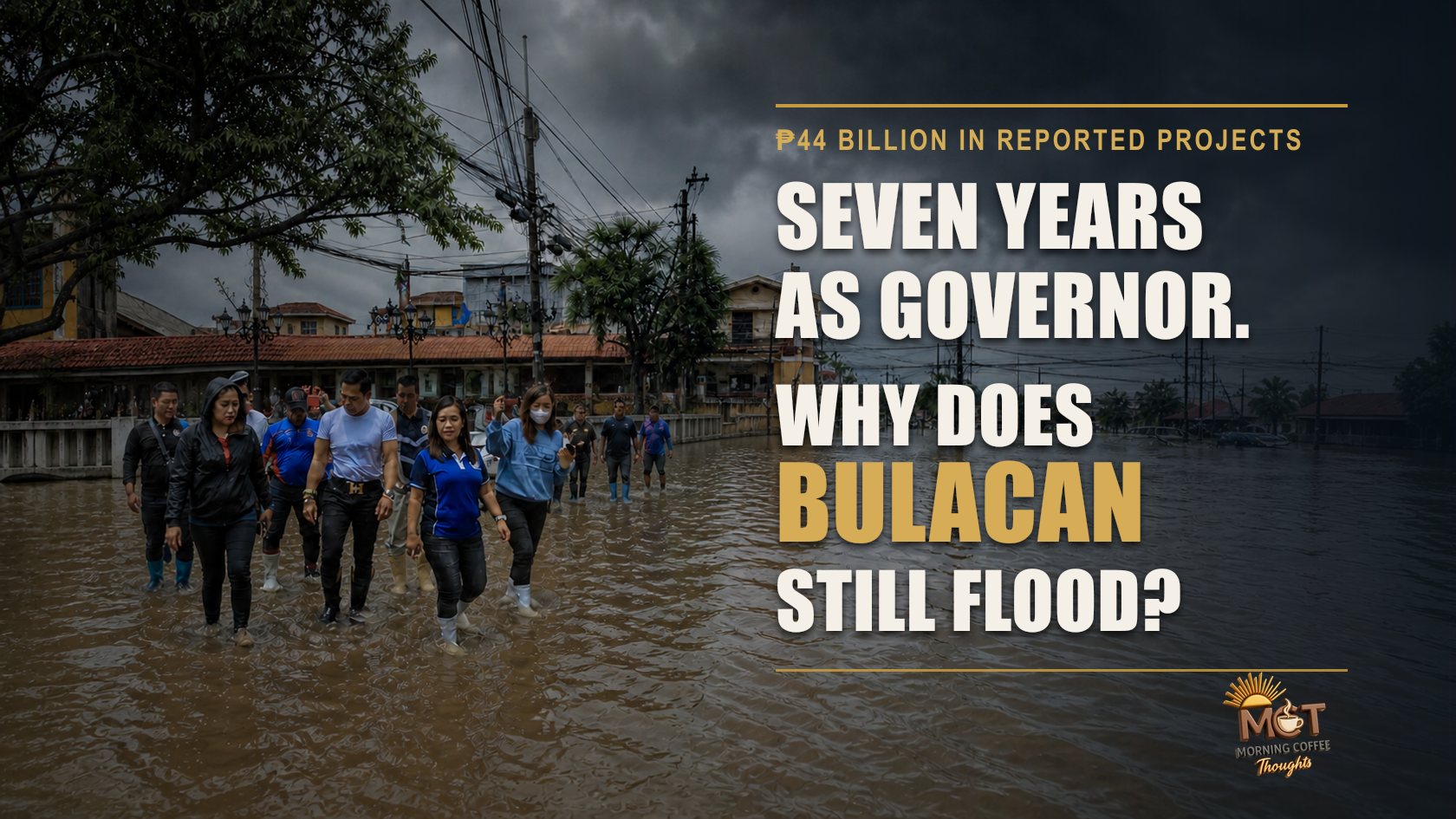
On August 20, I watched Ted Failon interview Bulacan Governor Daniel Fernando. Failon asked him a simple question: Had flooding in Bulacan improved, or had it worsened?
Fernando said it had worsened.
His response appeared to me almost half-amused. That is only my impression of his delivery, but the answer itself was unmistakable. After seven years under his leadership, flooding in Bulacan had not improved. According to the governor himself, it had become worse.
That made me curious. How long had Daniel Fernando been governor? What happened during those years? How could flooding worsen despite all the projects and public money supposedly devoted to controlling it?
If you came here expecting me to have already judged Fernando or Bulacan, you would be disappointed. The truth is, I did not know enough about the issue in Bulacan to begin with a conclusion. This article is my attempt to understand why the flooding worsened, what happened to the projects and who should explain the results.
I frequently pass through Bulacan. On almost every trip, I find myself braking hard to avoid a large pothole. I curse, recover and continue driving. Then I wonder why the people of Bulacan allow themselves to experience this kind of governance, commuting and travel.
The pothole may be on a national, provincial, municipal or barangay road. Responsibility depends on which agency controls it. But commuters do not experience government according to jurisdiction charts. They experience the pothole, the traffic, the floodwater and the failure of different offices to work together.
It made me wonder why voters continue to accept the same conditions and what they should reasonably demand from those they elect.
HOW LONG HAS FERNANDO BEEN IN GOVERNMENT?
Daniel Fernando became governor of Bulacan on June 30, 2019. As of August 2026, he has been governor for a little more than seven years.
Before that, he served as vice governor from 2010 to 2019. He has therefore occupied one of Bulacan’s two highest provincial positions continuously for more than 16 years.
A vice governor does not exercise the same authority as a governor. But Fernando entered the governorship with nine years of experience immediately below it. He was already familiar with the provincial government, its municipalities, its roads, its rivers and the communities that repeatedly go underwater.
He was reelected to a third consecutive term as governor in 2025 with more than 1.1 million votes. Few local officials receive a mandate that large.
A mandate that large should produce accountability equally large.
THE FLOODING RECORD
The flooding did not begin with Fernando, and no governor can stop a typhoon. Elected leaders can still be judged by whether years of planning, spending and construction make communities safer when the weather arrives.
The record during Fernando’s governorship shows a recurring provincial emergency.
After Typhoon Ulysses in 2020, the provincial government reported that more than 800,000 people in Bulacan had been affected. More than 18,000 people were evacuated.
In 2021, floods affected 106 barangays and caused an estimated ₱155 million in agricultural and infrastructure damage.
After Super Typhoon Karding in 2022, Fernando publicly estimated that Bulacan had suffered approximately ₱1.2 billion in crop and infrastructure damage. Five rescuers died in San Miguel while attempting to save residents during a flash flood.
In 2023, Bulacan declared a state of calamity after flooding affected more than 228,000 families in 171 barangays.
In 2024, Typhoon Carina and the enhanced southwest monsoon affected all four cities and 20 municipalities. The provincial government reported that more than 1.67 million residents were affected and damage exceeded ₱895 million.
In 2025, the province reported more than ₱626 million in damage from successive storms. Nine local government units were placed under states of calamity.
In August 2026, Bulacan again declared a province-wide state of calamity. Approximately 960,000 people were reported directly affected.
The figures are not perfectly comparable. Different reports count individuals, families, barangays, evacuations or economic damage over different reporting periods.
But they reveal a pattern that cannot be dismissed as one unusually severe storm. Flooding remained widespread, destructive and recurrent throughout Fernando’s seven years as governor.
Then Fernando himself said it had worsened.
WHY BULACAN KEEPS FLOODING
Bulacan faces unusually complex flood risks. The province combines low-lying coastal areas, multiple river systems, upstream inflows, dam releases, high tides, rapid urbanization and significant land subsidence.
Water comes from heavy local rainfall and from upstream watersheds. Rivers and drainage channels must carry it toward Manila Bay, where high tides can slow its release. Water coming through the Pampanga River system can compound the problem.
There is also the fact that portions of Bulacan are sinking.
A University of the Philippines study covering 2014 to 2020 found subsidence rates in parts of Bulacan reaching as much as 109 millimeters, or 10.9 centimeters, per year.
A separate study of Hagonoy and Calumpit, covering a different period and geographic area, measured subsidence of as much as 124.51 millimeters, or about 12.45 centimeters, per year near areas of intensive groundwater extraction.
The two studies should not be combined into one continuous measurement. But both point to the same serious danger. Groundwater extraction, urbanization and the natural compaction of sediment are causing parts of the province to lose elevation while rising seas and high tides make drainage increasingly difficult.
This is why isolated dikes, short river walls, occasional dredging and pumps installed without a larger system will not be enough. Bulacan needs coordinated management of its watersheds, rivers, drainage systems, pumping stations, floodgates, coastal defenses, groundwater use and land development.
The problem is technically difficult. That should have created more urgency, better planning and tighter coordination.
That complexity required a unified provincial strategy.
₱44 BILLION AND 668 PROJECTS
From July 2022 to May 2025, COA-cited government records and subsequent reporting identified approximately 668 DPWH flood-control projects in Bulacan. Their reported combined value was roughly ₱44 billion.
Bulacan reportedly had the largest number of projects among the provinces examined. The amount represented approximately 45 percent of the nearly ₱98 billion in flood-control projects identified across Central Luzon during that period.
These were principally national DPWH projects rather than ₱44 billion personally controlled by Fernando. The provincial government still belongs in the discussion because the projects were built in Bulacan, supposedly for the benefit of Bulakenyos, during Fernando’s administration.
Without measurable results, the ₱44 billion records spending alone. It does not establish that the projects successfully controlled flooding.
THE FLOOD-CONTROL SCANDAL
The situation became worse when auditors and investigators began finding serious irregularities in some Bulacan projects.
The Commission on Audit ordered a fraud audit. Inspections reportedly found projects that were missing, incomplete, inconsistent with official descriptions or built below the expected standard.
Those findings do not automatically apply to all 668 projects. But neither can they be treated as minor paperwork errors.
In Barangay Bulusan, Calumpit, President Ferdinand Marcos Jr. inspected a river-protection project worth approximately ₱96.4 million. Records reportedly indicated that it had been completed in February 2023. On the ground, portions appeared missing, damaged or unfinished.
The President demanded an explanation from the contractor.
A completed project should exist. It should match its plans, survive reasonable inspection and provide the protection taxpayers paid for.
When a flood-control project is listed as completed but is missing, defective or unfinished, the problem goes beyond poor performance. Public money may have failed to become public protection.
That is the real scandal.
BULACAN HAD A SENATOR ASKING THE SAME QUESTION
Bulacan also has a sitting senator from Bocaue: Joel Villanueva.
Villanueva had publicly questioned flood-control spending before the present scandal fully emerged. In 2023, he asked whether Bulakenyos were receiving any benefit from the national flood-control program while communities in his home province were again experiencing deep floods.
A local report identified approximately ₱1.7 billion in flood-control funding for Bulacan that year.
After the Carina floods in July 2024, Villanueva again questioned the results. He said roads that had been impassable during floods 10 or 15 years earlier remained impassable. He criticized piecemeal interventions and called for an integrated master plan.
In an official Senate press release containing the transcript of a July 31, 2024 media interview, Villanueva said: “Sa amin sa Bulacan, 30 billion eh. 30 billion yung gagastusin this year.”
That establishes that Villanueva publicly cited a ₱30-billion figure for Bulacan. It does not establish how the figure was calculated, how much was released or paid, or whether every peso was exclusively for flood control.
The amount also should not be added to the later ₱44-billion total. The figures cover overlapping periods and may use different stages of government spending.
But Villanueva’s question was valid: If that much money was being directed toward Bulacan, why were Bulakenyos not experiencing relief?
Then Villanueva himself was linked to the flood-control controversy.
THE ALLEGATIONS AGAINST VILLANUEVA
In 2025, former DPWH personnel alleged that approximately ₱600 million in 2023 Bulacan flood-control projects was associated with Villanueva. One former official also alleged that ₱150 million was delivered as a kickback through an aide.
Senator Panfilo Lacson confirmed that the budget contained eight Bulacan projects valued at ₱75 million each, for a total of ₱600 million.
That confirms the existence of the budget items. It does not prove Villanueva requested them or received money.
Villanueva denied requesting flood-control projects and said the original request involved multipurpose buildings. He also denied receiving kickbacks and described the accusations as a demolition job.
The Independent Commission for Infrastructure later recommended that the Ombudsman consider charges against Villanueva and several other individuals in connection with alleged irregularities in flood-control projects.
In March 2026, the Department of Justice endorsed its findings on malversation complaints involving alleged ghost flood-control projects to the Ombudsman.
In June 2026, the Ombudsman said it found the DOJ case buildup lacking and would conduct its own preliminary investigation before deciding whether to file a possible case in the Sandiganbayan. The DOJ subsequently said it would continue working to strengthen the evidence.
As of the latest public information reviewed for this article, the allegations had not produced a final judicial finding against Villanueva.
But the contradiction remains politically significant. A senator who publicly questioned why Bulacan’s flood-control spending was not producing results was later linked, through allegations he denies, to some of the budget items being investigated.
That deserves a complete investigation and a complete public explanation.
WHAT DID FERNANDO DO?
Fernando’s administration did not ignore flooding completely. It conducted rescue and relief operations, declared states of calamity, coordinated evacuations, distributed assistance and repeatedly requested help from the national government.
In 2022, Fernando acknowledged that dredging was only a temporary response. He said longer-term protection required dikes, pumps, floodgates and walls.
In 2023, he asked the national government for urgent support and called for a proper flood-control master plan.
In 2024, the province launched an inter-agency river-dredging and restoration effort with private-sector participation. The administration later said poor weather delayed portions of the work.
Fernando also complained that national flood-control projects were being planned and implemented without adequate coordination with the provincial government.
That complaint may be true. It also shows that the coordination system was failing.
Once the governor knew national agencies were building projects without sufficient coordination, he had a responsibility to demand complete records and establish strong provincial tracking. His complaint does not explain why Bulacan’s own coordinating machinery remained weak for so long.
THE MASTER PLAN THAT NEVER ARRIVED
In October 2025, the provincial government said DPWH still had not submitted the flood-control master plan requested under a 2023 provincial executive order.
In December 2025, more than six years after Fernando became governor, the province created a Provincial Infrastructure Coordinating Council intended to coordinate national and local infrastructure projects.
By August 2026, DPWH was discussing a ₱200-million comprehensive feasibility study that could be funded in 2027, with implementation potentially beginning in 2028.
Throughout those years, severe flooding continued while hundreds of projects worth tens of billions of pesos appeared across Bulacan.
Yet after all of that, the province was still waiting for another comprehensive study and the possibility of unified implementation beginning in 2028.
Earlier regional, basin-level and Manila Bay studies existed. Years of studies, budgets and construction still failed to produce one transparent program that Bulakenyos could examine and measure.
Hundreds of projects should not have come before the plan connecting them.
THE GOVERNOR’S RESPONSIBILITY TO KNOW
A governor does not need to control every DPWH project to keep track of what is being built inside his province. He does not need to control Congress to demand a list of appropriations. He does not need to supervise national contractors to inspect whether their projects exist.
Fernando has political influence and access to mayors, provincial engineers, district offices and national officials.
If DPWH kept him uninformed, why did he not use that mandate to force the issue much earlier?
In my view, seven years without a publicly demonstrated, province-wide tracking and performance system is inadequate provincial oversight.
My judgment concerns Fernando’s performance as governor. I am not accusing him of stealing flood-control funds.
He was responsible for leading the province while hundreds of projects were being funded and constructed. He now has a political obligation to explain what those projects accomplished, why flooding worsened and why the province had no complete public record showing the results.
WHAT SHOULD BULAKENYOS DEMAND?
Bulakenyos should demand a public inventory of every major flood-control project in the province.
Each entry should identify the project’s exact location, cost, funding source, contractor, implementing office, construction status, inspection results and intended function within the larger flood-control system.
The province should publish measurable results: flood depth, drainage time, roads closed, families evacuated and communities repeatedly inundated.
It should identify which projects worked, which failed and which merely transferred water from one area to another.
It should explain whether groundwater extraction and land subsidence are being incorporated into engineering designs and land-use decisions.
It should also name the agencies and contractors that refuse to provide records or coordinate with the provincial government.
People should not have to wait for a presidential inspection, congressional hearing or television interview to learn that a supposedly completed project is missing or defective.
WHY DO VOTERS KEEP ACCEPTING THIS?
Fernando received more than 1.1 million votes in 2025 despite the recurring floods.
Some voters may value his visibility during disasters, assistance programs, accessibility or work in other areas. Others may believe that DPWH, Congress and Malacañang deserve more blame because they control most national infrastructure funding.
Some may see flooding as unavoidable. Others may not believe an alternative candidate would perform better. Political machinery, alliances and name recognition also influence local elections.
But elections should not become rewards for appearing at evacuation centers after another disaster. Voters should judge whether years of planning and spending reduced the disaster in the first place.
Bulakenyos should not accept potholes, flooded roads, destroyed livelihoods and repeated evacuations as the permanent cost of living in their province.
They should demand answers from Fernando, Villanueva, district representatives, mayors, DPWH officials, contractors and everyone else who participated in proposing, funding, approving, constructing and inspecting these projects.
THE BOTTOM LINE
Daniel Fernando did not cause Bulacan’s geography, typhoons, high tides or land subsidence. He also did not personally control every peso attached to national DPWH projects.
After seven years as governor, he remains accountable for how the province monitored those projects, coordinated with national agencies and measured whether Bulakenyos became safer.
Bulacan endured recurring calamities while hundreds of flood-control projects worth tens of billions of pesos were associated with the province. Audits and inspections found serious irregularities in some projects. Fernando himself acknowledged that flooding had worsened.
That is a governance failure.
The people of Bulacan deserve more than relief goods after another flood. They deserve leaders who know what is being built, who is building it, how much it costs, whether it works and who should answer when it does not.
Seven years is enough time to expect those answers.
More than ₱44 billion is enough money to demand them.
SOURCES
- Provincial Government of Bulacan, Governor Daniel R. Fernandohttps://bulacan.gov.ph/government/elective-officials/gov-fernando/
- Provincial Government of Bulacan, Daniel Fernandohttps://bulacan.gov.ph/general-info/provincial-governors/daniel-fernando/
- Philippine News Agency, Actor Daniel Fernando proclaimed Bulacan governorhttps://www.pna.gov.ph/articles/1070075
- Ted Failon interview with Governor Daniel Fernando, August 20, 2026https://www.youtube.com/watch?v=iaO_zRupwR4
- Politiko, Bulacan governor denies knowing about reported DPWH flood-control fundinghttps://politiko.com.ph/2026/08/20/i-dont-know-bulacan-gov-denies-knowing-dpwhs-p41-b-flood-control-pot/politiko-lokal/
- Provincial Government of Bulacan, Typhoon Ulysses state-of-calamity reporthttps://bulacan.gov.ph/fernando-places-bulacan-under-state-of-calamity-after-typhoon-ulysses/
- Philippine News Agency, Habagat damage and affected barangays in Bulacan, 2021https://www.pna.gov.ph/articles/1148932
- ABS-CBN News, Fernando’s estimate of Karding damage in Bulacanhttps://www.abs-cbn.com/news/09/29/22/karding-leaves-p12-b-damage-in-bulacan-governor
- Manila Bulletin, Bulacan rescuers killed during Kardinghttps://mb.com.ph/2022/09/26/four-confirmed-dead-one-missing-in-san-miguel-bulacan-flash-flood
- Provincial Government of Bulacan, 2023 state-of-calamity declarationhttps://bulacan.gov.ph/fernando-declares-state-of-calamity-in-bulacan/
- Provincial Government of Bulacan, Carina damage and affected population, 2024https://bulacan.gov.ph/uemwith-over-p895-million-in-total-damage-em-ubrpbbm-conducts-situational-briefing-lays-aid-to-ts-carina-hit-bulacan/
- Provincial Government of Bulacan, 2025 storm damage and recovery operationshttps://bulacan.gov.ph/over-p626m-damages-from-recent-typhoonsbulacan-intensifies-relief-and-recovery-operations/
- Philippine Daily Inquirer, Bulacan under state of calamity in 2026https://newsinfo.inquirer.net/2288928/bulacan-under-state-of-calamity-due-to-floods
- University of the Philippines Diliman College of Science, land-subsidence findingshttps://science.upd.edu.ph/up-geologists-report-subsidence-rates-in-select-ph-metropolitan-cities/
- ISPRS Annals, groundwater extraction, urbanization and land subsidence in Hagonoy and Calumpithttps://isprs-annals.copernicus.org/articles/X-5-W4-2025/307/2026/
- Daily Tribune, COA probe of approximately ₱44 billion in Bulacan projectshttps://tribune.net.ph/2025/08/19/coa-probes-p44-b-bulacan-projects
- Philippine Daily Inquirer, COA fraud audit of Bulacan flood-control projectshttps://newsinfo.inquirer.net/2096840/coa-orders-fraud-audit-into-flood-control-projects-in-bulacan
- GMA News, COA findings on ghost and mismatched Bulacan projectshttps://www.gmanetwork.com/news/topstories/nation/965797/coa-finds-p344-m-bulacan-flood-control-projects-as-ghost-mismatched/story/
- Philippine Daily Inquirer, Marcos inspection of the Bulusan, Calumpit projecthttps://newsinfo.inquirer.net/2096173/marcos-asks-st-timothy-construction-explain-failed-bulacan-river-project
- Senate of the Philippines, Villanueva’s oath-taking in Bocauehttps://legacy.senate.gov.ph/press_release/2016/0630_villanueva1.asp
- Senate of the Philippines, Villanueva questions flood-control spending, 2023https://legacy.senate.gov.ph/photo_release/2023/0809_06.asp
- News Core Bulacan, Villanueva questions Bulacan’s reported ₱1.7-billion flood-control programhttps://newscorebulacan.net/sen-villanueva-calls-as-failure-the-p1-7-billion-bulacan-flood-control-program/
- Senate of the Philippines, Villanueva on national flood-control spending and recurring flooding, July 2024https://legacy.senate.gov.ph/press_release/2024/0729_villanueva1.asp
- Senate of the Philippines, official press release and transcript containing Villanueva’s ₱30-billion statementhttps://legacy.senate.gov.ph/press_release/2024/0731_villanueva1.asp
- GMA News, Lacson confirms ₱600 million in Bulacan flood-control itemshttps://www.gmanetwork.com/news/topstories/nation/959593/lacson-p600-million-flood-control-projects-bulacan-unprogrammed-funds/story/
- Philippine News Agency, ICI recommends charges in connection with flood-control projectshttps://www.pna.gov.ph/articles/1262102
- GMA News, Villanueva files counter-affidavit and denies the allegationshttps://www.gmanetwork.com/news/topstories/nation/973926/joel-villanueva-counter-affidavit-malversation-flood-control/story/
- GMA News, DOJ endorses findings on malversation complaints to the Ombudsmanhttps://www.gmanetwork.com/news/topstories/nation/980346/joel-villanueva-flood-control-projects-ombudsman/story/
- Philippine Daily Inquirer, Ombudsman finds DOJ case buildup lackinghttps://newsinfo.inquirer.net/2254882/ombudsman-rejects-doj-recommendation-on-villanuevas-flood-mess-case
- GMA News, DOJ and Ombudsman continue case builduphttps://www.gmanetwork.com/news/topstories/nation/993197/ombudsman-flood-control-joel-villanueva/story/
- Provincial Government of Bulacan, Fernando on dredging and permanent flood-control measureshttps://bulacan.gov.ph/dredging-is-a-temporary-yet-effective-solution-to-flooding-fernando/
- Provincial Government of Bulacan, Fernando requests national support and a master planhttps://bulacan.gov.ph/fernando-petitions-for-urgent-support-from-national-government/
- Provincial Government of Bulacan, river-dredging and restoration programhttps://bulacan.gov.ph/governor-fernando-leads-inter-agency-program-to-control-flooding-and-restore-rivers-in-bulacan/
- Provincial Government of Bulacan, DPWH coordination and the requested master planhttps://bulacan.gov.ph/dpwh-bulacan-vows-to-coordinate-future-projects-with-local-government-officials-addresses-other-infrastructure-problems-in-the-province/
- Provincial Government of Bulacan, creation of the Provincial Infrastructure Coordinating Councilhttps://bulacan.gov.ph/addressing-the-compelling-need-for-a-comprehensive-infra-master-plan-fernando-issues-eo-creating-provincial-infrastructure-coordinating-council/
- Philippine Daily Inquirer, proposed ₱200-million Bulacan flood-planning studyhttps://newsinfo.inquirer.net/2277293/bulacan-needs-p200-million-to-plan-better-for-floods
- Provincial Government of Bulacan, Fernando’s 2025 election resulthttps://bulacan.gov.ph/fernando-castro-secure-a-landslide-victory-in-2025-midterm-elections/
- Philippine Daily Inquirer, Fernando wins third term with more than 1.1 million voteshttps://www.inquirer.net/443619/fernando-wins-3rd-term-in-bulacan-makes-record-with-1-1-million-votes/