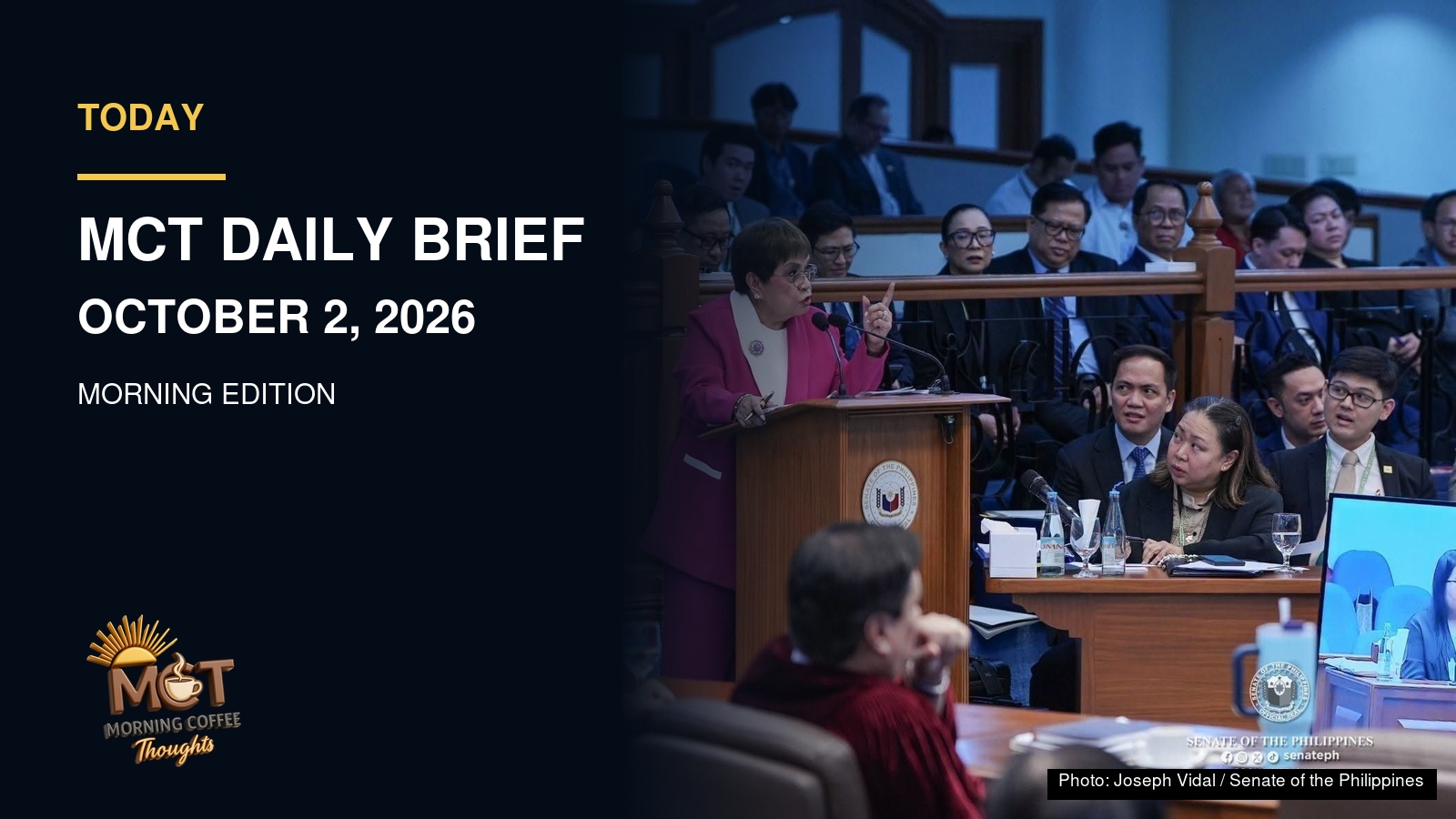
MCT DAILY
No fake news. No noise. Just the facts you need.
The morning Daily Brief anchors the day. New developments and short explainers follow when the story changes.
FIVE THINGS TO KNOW…
Short explainers published throughout the day.
MCT READER PULSE · MCT-PULSE-2026-002
MCT READER SURVEY
Are you in favor of Pax Silica?Pabor ka ba sa Pax Silica?
This short reader pulse asks MCT readers for their present view of Pax Silica.
This is an informal MCT reader pulse, not a scientific or nationally representative poll. It reflects only the views of verified readers who choose to participate.
View reader pulse archive →Thank you for joining this MCT reader pulse. Results will be published after it closes.
Results reflect only verified MCT readers who voluntarily participated. They do not represent the views of the general Philippine population. Demographic groups with fewer than five responses are not displayed.
MCT DAILY BRIEF: August 18, 2026 · Morning
No fake news. No noise. Just the facts you need.
AUGUST 18, 2026 | MORNING
Good morning.
Today’s brief follows the continuing monsoon emergency, another round of fuel-price increases, questions raised in Congress about proposed budget amounts, new survey findings on the Walang Gutom Program, and a Senate bill intended to strengthen protections for patients who cannot immediately settle hospital bills.
Here are five developments worth understanding today.
MONSOON FLOODING CONTINUES IN METRO MANILA AND NEARBY PROVINCES
Heavy southwest-monsoon rains flooded roads and communities in Metro Manila and nearby provinces on Monday. The Metropolitan Manila Development Authority recorded 201.7 millimeters of rain in the capital region between 9 a.m. and 2 p.m. on August 17, including 138 millimeters in just two hours.
The San Juan River reached its critical level, while the Marikina River reached the second alarm. Classes were suspended in affected areas, and Malacañang authorized alternative work arrangements for government offices in Metro Manila and 14 provinces on August 18. Private employers decide whether to adopt similar arrangements.
In Bulacan, officials reported flooding in 130 barangays and more than 8,700 people staying in evacuation centers. Initial provincial estimates placed damage to agriculture and fisheries at about ₱96.2 million, with additional losses in livestock and poultry.
For households, the danger does not end when the rain weakens. Rivers can remain high, roads may still be blocked, and floodwater can carry sewage, sharp objects and electrical hazards. Residents should follow current warnings from PAGASA and local authorities rather than old screenshots or forwarded messages.
WHAT TO WATCH
Watch PAGASA rainfall warnings, river levels, local evacuation orders and class or work advisories. Reported casualty and damage figures may change as local governments complete their assessments.
FUEL PRICES RISE AGAIN AS THE PUV SUBSIDY CONTINUES
Fuel companies are implementing another round of price increases today. The maximum adjustments reported by the Department of Energy are ₱2.49 per liter for gasoline, ₱3.84 for diesel and ₱5.01 for kerosene.
The government raised the public-utility-vehicle fuel subsidy from ₱10 to ₱12 per liter on August 15. Eligible drivers can receive support for up to 150 liters a week, or a maximum of ₱1,800. Energy Secretary Sharon Garin said the program could continue until the end of the year if funds remain available.
The department reported that ₱491.61 million had been paid to 96,197 unique beneficiaries through 3,312 participating fuel stations. The subsidy is reviewed monthly, so the amount and duration are not guaranteed for the rest of the year.
For commuters, the subsidy can ease pressure on drivers and operators, but it does not automatically prevent fare petitions. Higher fuel costs also affect deliveries, fishing, farming and food prices because the Philippines imports most of its oil.
WHAT TO WATCH
Watch the next monthly subsidy review, the remaining program funds and any transport-sector petition for higher fares. Also check whether fuel-price increases begin appearing in food and delivery costs.
A LAWMAKER ALLEGES THAT SOME PROPOSED BUDGET ITEMS WERE INFLATED
ACT Teachers Representative Antonio Tinio questioned large differences between several amounts proposed in the National Expenditure Program and the amounts eventually approved in the 2026 General Appropriations Act. He described the pattern as possible budget padding intended to create room for other items later in the process.
Tinio cited foreign-assisted projects of the Department of Transportation that went from ₱135.85 billion in the proposed budget to ₱64.07 billion in the enacted law. He also cited a Department of Public Works and Highways item that went from ₱100 billion to ₱17.7 billion.
Acting Budget Secretary Kim Robert de Leon rejected the suggestion that the proposed amounts were arbitrary. He said the National Expenditure Program is based on evaluated agency requirements and that the amounts proposed by the executive branch can already be lower than what agencies originally requested. He also said later reductions had contributed to project delays.
The figures establish that large reductions occurred. They do not, by themselves, prove that anyone deliberately inflated the original amounts. For taxpayers, the unresolved question is why the estimates changed so much and whether the budget process clearly documents each reduction and the items that replaced it.
WHAT TO WATCH
Watch for project-level documents showing the original agency requests, the Budget department’s evaluation, congressional reductions and the new items funded from those reductions. The allegation needs records, not only a comparison of totals.
A SURVEY FOUND IMPROVEMENT AMONG SAMPLED WALANG GUTOM BENEFICIARIES
A Social Weather Stations survey commissioned by Globe found lower hunger and food insecurity among sampled households enrolled in the government’s Walang Gutom Program between February and July 2026.
The survey covered 2,400 respondents in two rounds. Among program beneficiaries in the sample, hunger declined from 33.6 percent to 26.9 percent. Food insecurity fell from 94 percent to 89.3 percent. The changes among non-beneficiaries were smaller or moved in the opposite direction on some measures.
The program currently serves about 600,000 households and provides food credits that can be used for selected nutritious products. The government plans to add 150,000 households and reach 750,000 beneficiaries.
The survey is evidence that the program may be helping the households studied. It is not proof that every one of the roughly 600,000 enrolled families is eating better. Social Welfare Secretary Rex Gatchalian made the same qualification when discussing the results.
For families, the important test is whether food support reaches eligible households regularly, improves the quality and quantity of meals, and remains useful as food prices change.
WHAT TO WATCH
Watch the full survey methodology, later survey rounds and administrative records on delivery, redemption and missed benefits. Expansion should be accompanied by evidence that the program can maintain its quality as enrollment grows.
THE SENATE PASSES A BILL TO STRENGTHEN THE BAN ON HOSPITAL DETENTION
The Senate approved Senate Bill 1511, the proposed Enhanced Anti-Hospital Detention Act, by a vote of 18 in favor, none against and one abstention.
Philippine law already prohibits hospitals from detaining patients because they cannot fully pay their bills. The new Senate bill would broaden the protection to all public and private hospitals and clinics, cover patients and the release of deceased persons, and prohibit withholding discharge summaries, prescriptions and medical certificates.
The proposal does not erase unpaid hospital bills. A patient who is medically cleared for discharge may still be asked to sign a secured promissory note or present a guarantee from an authorized institution. The bill includes a different process for indigent senior citizens endorsed by a hospital social-service office.
Hospital directors or managers who establish a detention policy could face penalties of up to six years in prison and a fine of up to ₱1 million. The bill also calls for a grievance system and coordination with agencies that can help patients settle eligible expenses.
The Senate vote does not make the proposal a law. It still needs action in the House of Representatives, agreement on the final text and the President’s approval or the completion of the constitutional process without his signature.
WHAT TO WATCH
Watch the House version, any changes to the promissory-note and indigent-patient rules, and the final enforcement mechanism. Hospitals also need a workable way to seek payment without denying a medically cleared patient the right to leave.
BOTTOM LINE
Today’s developments require attention to details and timing. The monsoon emergency requires immediate local action. The fuel-price increase is already taking effect, while the subsidy that softens it depends on remaining funds. The budget issue is an allegation that needs project-level records. The Walang Gutom findings are encouraging but apply to a sample, not automatically to every beneficiary. The hospital-detainment measure has passed the Senate but is not yet law. The useful questions are practical: What is happening now, what remains a proposal, and what evidence would confirm the claim? No noise. Just the facts, their limits and what to watch next.
SUPPORT MCT
HELP KEEP INDEPENDENT POLITICAL WRITING GOING.
Morning Coffee Thoughts is reader-supported. Contributions help pay for research tools, hosting, and the work required to verify and explain each development.
RECENT COMMENTARY
THE LATEST FROM MCT