
LATEST COMMENTARY
FIVE THINGS TO KNOW
MCT READER PULSE · MCT-PULSE-2026-017
MCT READER SURVEY
Gaano ka nagtitiwala na tama ang ginagawa ng Kongreso sa budget ng bayan?
This is an informal survey of people who choose to participate. It is not a scientific or nationally representative sample.
ABOUT UNORDERED COD PARCELS: WHAT TO DO BEFORE YOU PAY
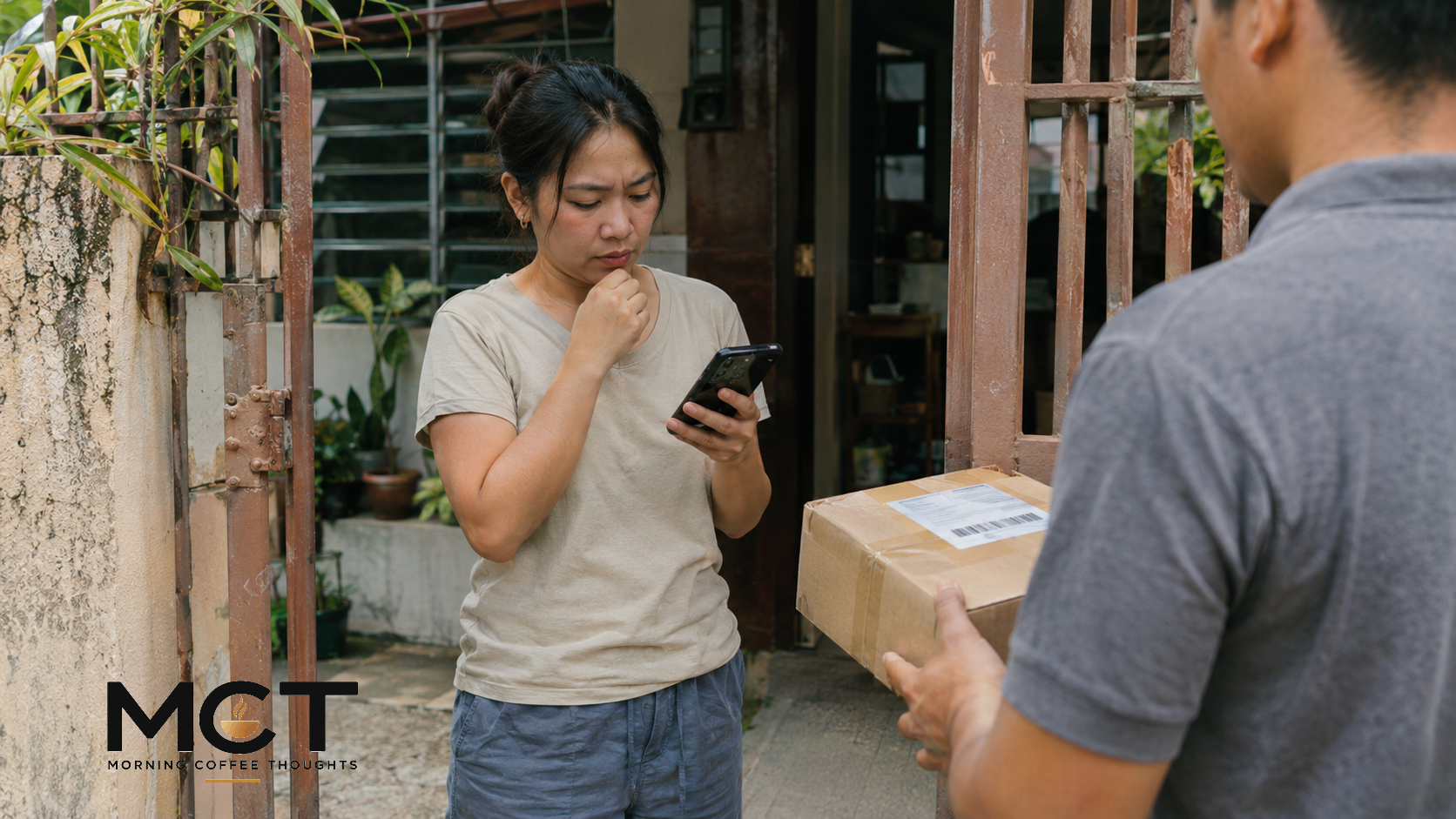
A rider arrives with a parcel bearing your name and address. The delivery is cash on delivery, or COD, which means payment is collected when it arrives. You do not remember buying anything, but someone at home pays because the label looks right.
Having your details on a package does not prove that you ordered it. Before anyone hands over money, find the purchase it belongs to.
1
CHECK THE ORDER, NOT JUST THE NAME ON THE LABEL
Open the shopping app yourself and compare the item, seller, amount due and tracking number with the delivery. If you bought through a seller’s page, check your actual conversation and order confirmation. A name and address alone are not enough.
Ask the other people at home whether the order is theirs. For expected deliveries, leave a short list of the items and amounts to be paid. That gives the person receiving them something more reliable than a guess.
2
REFUSE A COD PARCEL YOU DID NOT ORDER
If nobody ordered it, decline the delivery and payment. Tell the rider plainly that it is not your order. Do not pay just to end an awkward conversation.
Opening first is not a universal option. Ninja Van’s published policy, for example, requires payment before opening but allows recipients to refuse suspicious or unordered COD parcels. Check the applicable courier or platform policy instead of assuming every delivery has an inspection-before-payment service.
The rider delivering a sealed package is not automatically the person behind a scam. Keep the conversation calm and report the shipment through the courier’s official support channel.
3
DO NOT USE A DELIVERY LINK TO “FIX” THE PROBLEM
A text may claim that your address is incomplete or that a parcel needs another payment. Open the courier’s official website or your shopping app directly instead of using the link in the message.
Do not give a caller your banking password or a code that authorizes access to your bank or e-wallet, even if they say it is needed to cancel a parcel or obtain a refund. Read what a code is for before sharing anything.
4
IF SOMEONE HAS PAID, KEEP THE EVIDENCE AND ASK FOR HELP
Keep the packaging and shipping label. Save photographs of the contents, proof of payment and any messages. Note when it arrived, how much was paid and the tracking number. These details help identify the shipment when you report it.
Contact the courier through its official app or website and request an investigation and refund. If the parcel corresponds to an order in a shopping platform, use that platform’s complaint process too. A report starts the review; it does not guarantee an immediate refund.
For a consumer dispute involving an identifiable seller, you can seek DTI assistance through https://consumercare.dti.gov.ph/ or [email protected]. Include the seller’s available details, your account of what happened and the evidence. For suspected online fraud, contact the Cybercrime Investigation and Coordinating Center through hotline 1326 or [email protected]. Do not pay another fee to someone promising to recover your money.
5
PROTECT THE DETAILS ON YOUR DELIVERY LABELS
Keep labels needed for an unresolved complaint. Once you no longer need the packaging, remove or destroy the part showing your name, address, phone number and other identifying details before throwing it away.
If you post a warning online, cover those details in the photograph, including readable codes. Someone having your address does not, by itself, establish where they obtained it. Report what happened without inventing an explanation for how your information was exposed.
BOTTOM LINE
Before paying, match the parcel to a purchase that you or someone at home actually made. If there is no order, refuse it. If money has already changed hands, preserve the evidence and use verified support and complaint channels.
SOURCES
- Ninja Van Philippines, parcel delivery scams advisory and opening-before-payment policy: https://www.ninjavan.co/en-ph/parcel-scams-advisory
- Ninja Van Philippines, steps to avoid COD scams: https://blog.ninjavan.co/en-ph/how-to-avoid-cod-scams/
- PHLPost, warning about messages requesting address and banking details: https://phlpost.gov.ph/cpt-press-releases/public-warned-on-scam-messages-online-using-phlpost-name/
- DTI Fair Trade Enforcement Bureau, consumer complaint channels: https://fairtrade.dti.gov.ph/services/complaints-handling/
- CICC, Kontra Scam guide and reporting contacts: https://cicc.gov.ph/wp-content/uploads/2025/04/KONTRA-SCAM-Brochure.pdf
- National Privacy Commission, shopping and delivery-label precautions: https://privacy.gov.ph/keeping-privacy-merry-and-bright/
GOOGLE PREFERRED SOURCES
FOLLOW MCT ON GOOGLE
Google’s Preferred Sources feature lets you choose publications you want Google to prioritize for you. Select “Add to Preferred Sources” to make MCT easier to find in Top Stories and other eligible Google results. This does not subscribe you to email.