
MCT DAILY
No fake news. No noise. Just the facts you need.
The morning Daily Brief anchors the day. New developments and short explainers follow when the story changes.
FIVE THINGS TO KNOW…
Short explainers published throughout the day.
MCT READER PULSE · MCT-PULSE-2026-005
MCT READER SURVEY
Based on the evidence presented so far, has the prosecution made a convincing case that the confidential funds of the OVP and DepEd were improperly spent?Batay sa mga ebidensiyang naiharap sa ngayon, nakapaglahad na ba ang prosekusyon ng kapani-paniwalang kaso na hindi wastong ginastos ang confidential funds ng OVP at DepEd?
This question asks readers to assess the prosecution’s presentation so far. The impeachment trial is still ongoing, and this survey does not presume that any allegation has been proven.
Review a recent recap of the evidence and arguments before answering.
This is an informal survey of verified MCT readers who choose to participate. It is not nationally representative.
Open the shareable survey page →View reader pulse archive →
Thank you for joining this MCT reader pulse. Results will be published after it closes.
Results reflect only verified MCT readers who voluntarily participated. They do not represent the views of the general Philippine population. Demographic groups with fewer than five responses are not displayed.
ABOUT LEPTOSPIROSIS AFTER FLOOD EXPOSURE
Cases rose after weeks of flooding. Here is how exposure happens, which symptoms to watch, and when to seek care.

The Department of Health recorded 4,285 leptospirosis cases nationwide as of August 22. That total was lower than the number reported during the same period last year, but the more recent trend moved in the wrong direction: 495 cases were recorded from July 26 to August 8, up from 383 during the previous two weeks.
After widespread flooding, many people worry that stepping into floodwater guarantees illness. It does not. People who were exposed need to know how infection happens, what symptoms to watch for, and when to seek care.
FLOODWATER CAN CARRY THE BACTERIA THROUGH ANIMAL URINE
Leptospirosis is caused by bacteria that can be shed in the urine of infected animals. People can become infected when contaminated water or soil reaches broken skin or the moist surfaces of the eyes, nose, or mouth. Flooding increases the chance that water, mud, sewage, and animal waste will mix.
A visible rat is not required for exposure. Dogs, livestock, and other animals can also carry the bacteria, and contaminated water may look no different from ordinary floodwater. Risk rises when a person wades for a long time, has cuts or abrasions, handles flood-soaked waste, or works in drains, farms, or other wet environments.
Contact does not mean automatic infection. It means the exposure should be remembered and mentioned if symptoms appear. That detail can help a health worker decide what evaluation and treatment are needed.
WHAT TO WATCH
Remember when and where the exposure happened, whether you had cuts or skin problems, and whether floodwater reached your eyes, nose, or mouth.
SYMPTOMS MAY APPEAR DAYS AFTER THE WATER HAS RECEDED
The DOH says the usual incubation period is about five to 15 days. A person may feel well after wading through a flood and only develop symptoms later, when the street is already dry and the exposure is easy to forget.
Possible symptoms include fever, chills, headache, muscle pain, red eyes, vomiting, or weakness. More serious illness can affect the kidneys, liver, lungs, heart, or brain. These symptoms can resemble dengue, influenza, or other infections, so a social-media checklist cannot establish the diagnosis.
Recent exposure followed by illness is the relevant combination. Tell the doctor or health worker about the floodwater even if the consultation happens several days later.
WHAT TO WATCH
Fever, severe headache, calf or lower-back pain, red eyes, vomiting, yellowing of the skin or eyes, reduced urination, breathing difficulty, or unusual weakness after flood exposure.
SEEK CARE EARLY INSTEAD OF DIAGNOSING YOURSELF
The DOH advises people who develop symptoms after flood exposure to seek consultation promptly. Waiting for severe signs can make treatment more difficult because leptospirosis may progress quickly in some patients.
Do not take leftover antibiotics or copy another person's prescription. A clinician must consider the timing and type of exposure, symptoms, medical history, possible laboratory tests, and other illnesses that can look similar. Preventive antibiotics may be considered in particular situations, but that decision also belongs with a qualified health professional.
The DOH has activated 33 leptospirosis fast lanes and is managing referrals and bed capacity in affected areas. A barangay health center, local clinic, or hospital can direct a patient to the appropriate facility.
WHAT TO WATCH
If symptoms begin, contact a health facility as soon as possible and clearly say that there was recent exposure to floodwater or mud.
PROTECTION STARTS WITH AVOIDING CONTACT WHEN POSSIBLE
The safest choice is not to enter floodwater unless it is necessary. Floods can hide open drains, sharp objects, live electrical hazards, chemicals, and strong currents in addition to infection risks.
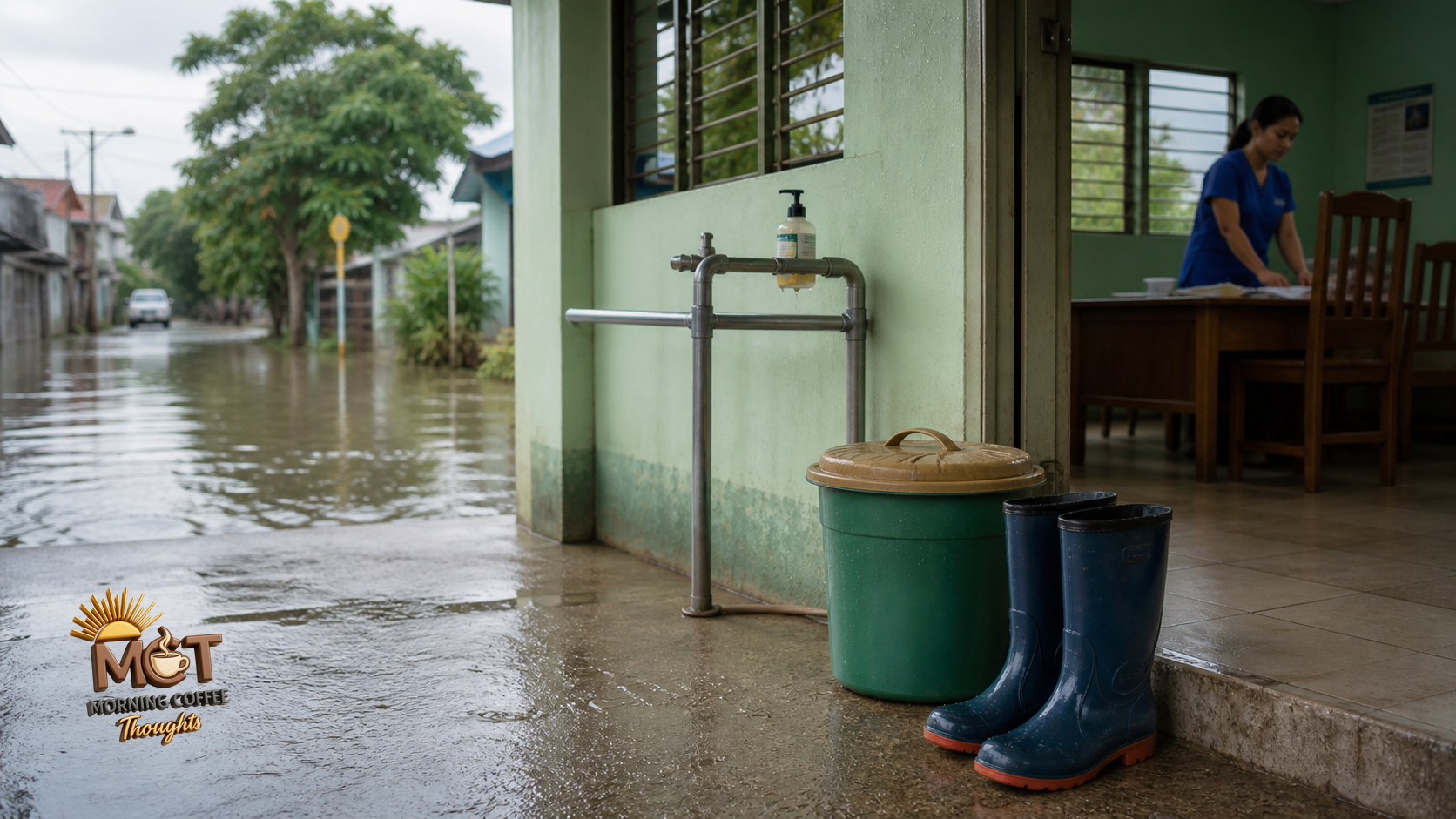
If contact cannot be avoided, wear rubber boots and waterproof gloves, cover cuts with waterproof dressings, and wash exposed skin and wounds with clean water and soap afterward. Do not use floodwater to prepare food, brush teeth, or wash dishes. Food that touched floodwater should be discarded.
Protection is harder for people whose homes, work, or routes require them to enter flooded areas. Local governments and employers still have duties to provide safe routes, protective equipment, sanitation, and clear health advice. Prevention cannot be placed entirely on individuals.
WHAT TO WATCH
Whether evacuation sites, cleanup crews, waste workers, and residents in repeatedly flooded communities receive boots, gloves, clean water, and access to early consultation.
THE NATIONAL TOTAL IS LOWER, WHILE RECENT CASES HAVE RISEN
The 4,285 cases reported by August 22 were 37 percent lower than the 6,839 cases recorded during the same period in 2025. That comparison is encouraging, but it does not erase the 29 percent increase between the two most recent reporting periods.
The DOH identified the National Capital Region, Cagayan Valley, and Central Luzon as areas with the highest concentrations of cases. Recent flooding and the delay between exposure and symptoms mean health facilities must remain ready even after rain weakens.
PhilHealth issued a 2026 benefit package for moderate to severe leptospirosis, while the DOH said admitted indigent patients in its hospitals are covered by the Zero Balance Billing policy. Patients or families should still ask the hospital or PhilHealth desk what applies to their case and facility.
WHAT TO WATCH
The next DOH surveillance update, local case clusters, hospital capacity, and whether people in flood-affected areas can obtain timely diagnosis and treatment without being deterred by cost.
BOTTOM LINE
Leptospirosis is not an automatic consequence of touching floodwater, but exposure should not be forgotten. Avoid contact when possible, use protective gear when it is unavoidable, clean exposed skin and wounds, and seek medical advice promptly if fever or other symptoms appear in the following days. The most important information to give the health worker is simple: I was exposed to floodwater.
SUPPORT MCT
HELP KEEP INDEPENDENT POLITICAL WRITING GOING.
Morning Coffee Thoughts is reader-supported. Contributions help pay for research tools, hosting, and the work required to verify and explain each development.
RECENT COMMENTARY
THE LATEST FROM MCT