MCT DAILY
No fake news. No noise. Just the facts you need.
The morning Daily Brief anchors the day. New developments and short explainers follow when the story changes.
FIVE THINGS TO KNOW…
Short explainers published throughout the day.
MCT READER PULSE · MCT-PULSE-2026-003
MCT READER SURVEY
Do you find Sen. Loren Legarda’s explanation for her medical leave and overseas travel credible?Sa tingin mo, kapani-paniwala ba ang paliwanag ni Sen. Loren Legarda tungkol sa kanyang medical leave at pagbiyahe sa ibang bansa?
This short reader pulse asks whether MCT readers find Sen. Loren Legarda’s public explanation credible.
This survey measures reader perception. It cannot establish anyone’s medical condition or determine wrongdoing. It reflects only the views of verified MCT readers who choose to participate and is not nationally representative.
View reader pulse archive →Thank you for joining this MCT reader pulse. Results will be published after it closes.
Results reflect only verified MCT readers who voluntarily participated. They do not represent the views of the general Philippine population. Demographic groups with fewer than five responses are not displayed.
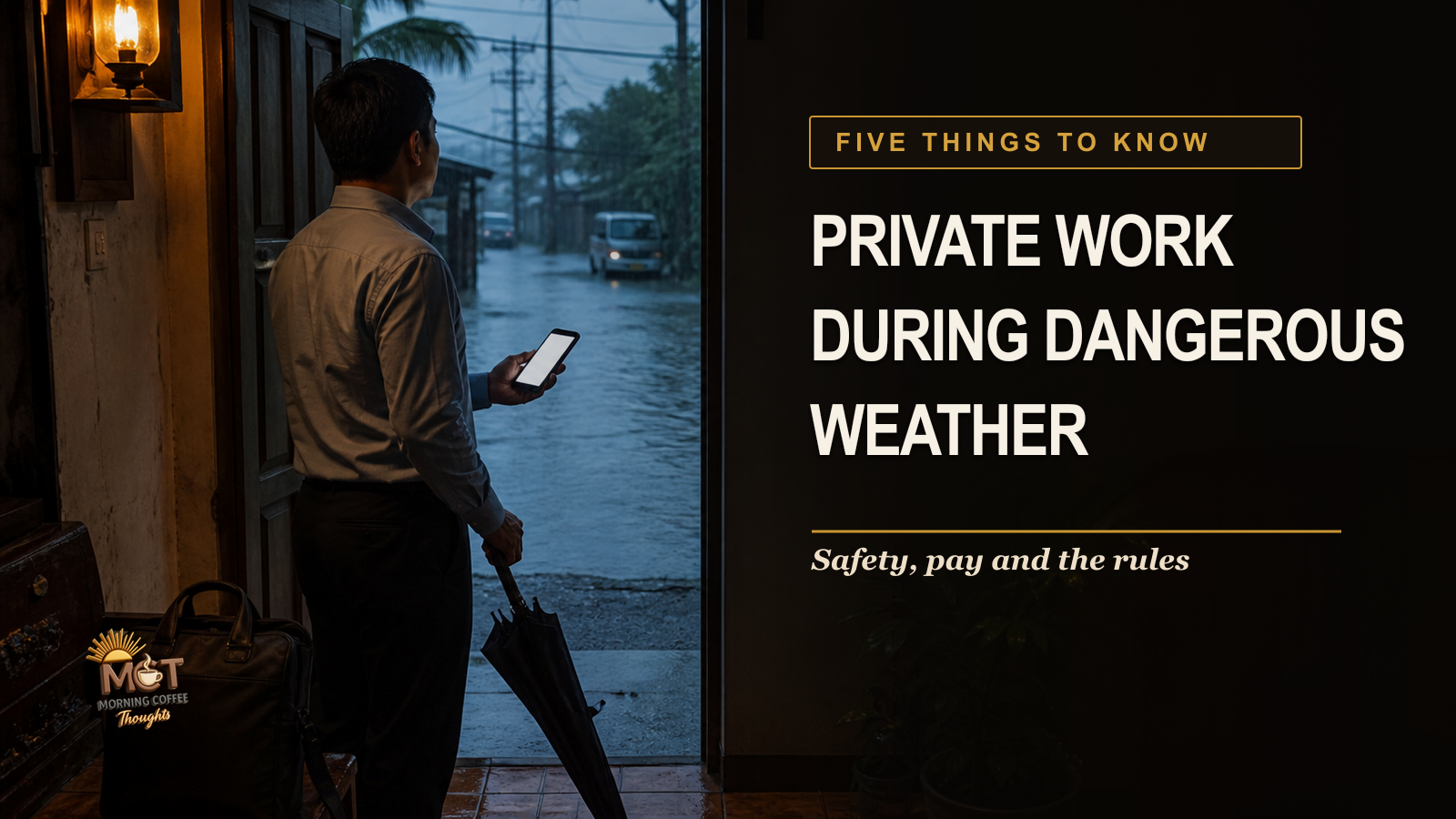
FIVE THINGS TO KNOW ABOUT PRIVATE-SECTOR WORK DURING DANGEROUS WEATHER
What private workers need to know about attendance, discipline and pay when severe weather makes travel unsafe.

Government work and classes can be placed under alternative arrangements during severe weather, while private companies usually make their own decisions. That difference leaves workers asking practical questions: Can an employer still require attendance? Can a worker be disciplined for staying home? Will the day be paid?
The Department of Labor and Employment has standing guidance for private workplaces during weather disturbances. Here are five things to know about it.
A GOVERNMENT WORK ANNOUNCEMENT DOES NOT AUTOMATICALLY SUSPEND PRIVATE WORK
When Malacañang announces alternative work arrangements for government offices, the announcement normally states separately how private workplaces are treated. For August 20, management retains the decision on whether to suspend onsite work or use another arrangement.
DOLE guidance allows a private employer to suspend work when weather creates a safety or health risk. The decision should be coordinated with the company’s safety and health committee, safety officer or another responsible officer.
Employees should look for a direct notice from management or human resources. A government announcement can describe the danger in the area, but it is not automatically a company suspension notice.
WHAT TO WATCH
The exact wording of the government announcement and the employer’s own instruction. Save copies of messages about reporting arrangements and travel hazards.
A WORKER MAY REFUSE TO TRAVEL WHEN THERE IS IMMINENT DANGER
Under DOLE’s weather guidance, an employee who fails or refuses to work because of imminent danger caused by severe weather should not face an administrative sanction.
The key phrase is imminent danger. A worker should promptly explain the specific hazard to the employer. Examples may include an impassable flooded road, an evacuation order, dangerous river levels, cancelled public transport or another immediate threat during the trip to work.
This protection should not be treated as permission to disappear without notice. A worker who can communicate should inform a supervisor or human resources office, describe the hazard and keep reliable evidence such as an official local advisory or a time-stamped photograph taken safely.
WHAT TO WATCH
Whether the employer has an emergency reporting procedure and what evidence it reasonably requires. If discipline is threatened despite a documented danger, the worker may seek guidance from DOLE.
STAYING HOME FOR SAFETY DOES NOT ALWAYS MEAN THE DAY IS PAID
Protection from discipline and entitlement to pay are separate questions.
If no work is performed, the general rule is that regular pay is not required. Payment may still be available when a company policy, established practice or collective bargaining agreement provides it. An employee may also be allowed to use accrued leave credits.
Remote work changes the situation if the employee actually performs assigned work under an approved arrangement. The company’s remote-work policy and the hours worked will matter.
WHAT TO WATCH
The company handbook, collective bargaining agreement, leave balance and written instructions on remote work. Ask human resources how the day will be recorded before assuming it is paid or unpaid.
WORKERS WHO REPORT ARE PAID ACCORDING TO THE HOURS THEY WORK
DOLE’s weather-specific guidance says an employee who reports and works for at least six hours is entitled to full regular pay for the day. A worker who renders less than six hours receives a proportionate amount of regular pay, unless a company policy or practice gives a better benefit.
DOLE has also encouraged employers to give additional incentives to people who report despite dangerous weather. An encouragement is different from a universally required hazard payment. Any additional entitlement depends on the Labor Code, the worker’s circumstances and an applicable company policy or agreement.
Workers in essential operations may be required to follow special continuity arrangements. Employers still have a duty to manage workplace and travel risks responsibly.
WHAT TO WATCH
The recorded hours, payroll treatment, applicable overtime rules and any written company promise of transport, meals, hazard pay or other assistance.
BOTH SIDES SHOULD DOCUMENT THE DECISION BEFORE A DISPUTE STARTS
Employers should issue clear instructions early, identify essential roles, explain remote-work options and provide a contact person for workers facing unsafe routes. Vague or late announcements force employees to make high-risk decisions with incomplete information.
Workers should report hazards promptly and truthfully. Useful records include official rainfall or flood warnings, local evacuation notices, transport cancellations and messages sent to supervisors.
When a disagreement cannot be resolved internally, workers may contact DOLE or use the Single Entry Approach for assistance. The facts of the situation will matter, including the actual danger, the notice given, the work arrangement and the employer’s policy.
WHAT TO WATCH
A written company emergency policy that clearly answers who decides, how workers report danger, which jobs are essential, what remote options exist and how pay will be calculated.
BOTTOM LINE
Private work is not automatically suspended whenever government offices use alternative arrangements. Employers decide whether their operations continue, while workers retain protection from administrative sanctions when imminent weather danger prevents them from reporting. That protection does not guarantee regular pay for hours that were not worked. Company policies, collective agreements, leave credits and approved remote work can change the result. The safest approach is early communication supported by specific information. Employers should make clear decisions, and workers should report actual hazards before attempting a dangerous trip.
SUPPORT MCT
HELP KEEP INDEPENDENT POLITICAL WRITING GOING.
Morning Coffee Thoughts is reader-supported. Contributions help pay for research tools, hosting, and the work required to verify and explain each development.
RECENT COMMENTARY
THE LATEST FROM MCT