
Morning Coffee ThoughtsSearch MCT
MCT CASE TRACKERTracking Sara Duterte’s impeachmentHearings, documents and disputed issues.Follow the trial → MCT CASE TRACKERTracking Rodrigo Duterte’s ICC caseCourt records, hearing dates and sourced notes.Follow the case →

LATEST COMMENTARY

View all commentary →

FIVE THINGS TO KNOW

3-minute read

WHY WINNING DOES NOT END A VOTE-BUYING CASE

If a candidate has already won and been proclaimed, can a vote-buying case still cost them the position? The Supreme Court’s latest announcement on two Candijay, Bohol candidates shows why the election result does not settle everything.

Read the explainer →
5-minute read

HOW THE NEXT CHIEF JUSTICE IS CHOSEN

The Judicial and Bar Council has finished interviewing candidates to succeed Chief Justice Alexander Gesmundo, who is due to retire on November 6. GMA News reported the completed interviews on October 27. The interviews are one stage of a process that gives the President a choice, but also sets limits on who can be chosen and how the appointment is made.

Read the explainer →
4-minute read

ABOUT COMPENSATION FOR WORK-RELATED HEAT ILLNESS

If someone becomes ill while working in extreme heat, the problem can continue after the shift ends: medical bills, missed work and uncertainty about where to ask for help. The Department of Labor and Employment (DOLE) announced guidelines on October 23 for heat-illness claims under the existing Employees' Compensation Program (ECP).

Read the explainer →
5-minute read

ABOUT BATO DELA ROSA’S ₱50-MILLION BOUNTY

The DILG announced a ₱50-million bounty for Senator Bato dela Rosa’s capture on October 23. The announcement came after months of talk about a possible reward—and days after Interior Secretary Jonvic Remulla said authorities knew dela Rosa was in Mindanao and were negotiating for his turnover.

Read the explainer →
Afternoon6-minute read

ABOUT THE OVP’S 2027 BUDGET AFTER A 16-MINUTE SENATE HEARING

The Office of the Vice President’s proposed budget moved through a Senate panel today in 16 minutes. Vice President Sara Duterte was absent; her chief of staff answered for the office. Yesterday’s MCT explainer looked at parliamentary courtesy. Today’s question is what that short hearing actually did to the spending plan, and what it left for the Senate to examine.

Read the explainer →
Afternoon6-minute read

ABOUT THE EDSA BUSWAY’S 2027 BUDGET GAP

The Department of Transportation is again asking Congress to fund the EDSA Busway. Its original ₱1.756 billion request received zero in the administration’s proposed 2027 National Expenditure Program. A House budget panel later inserted ₱75 million. Those two statements describe different stages of the same budget process. Neither tells us yet what Congress will finally approve.

Read the explainer →
Afternoon7-minute read

ABOUT DECLARING AN AMBASSADOR PERSONA NON GRATA

Several lawmakers want Chinese Ambassador Jing Quan sent home. The Chinese Embassy has challenged them to follow through. That exchange leaves an ordinary reader with a reasonable question: if our own officials say an ambassador should leave, why is he still here?

Read the explainer →
7:23 AM5-minute read

ABOUT LINO CAYETANO AND THE CHANGE AT THE PCO

President Ferdinand Marcos Jr. announced on October 11 that Lino Cayetano would replace Dave Gomez at the Presidential Communications Office. He said Gomez had been bypassed by the Commission on Appointments and that the change would be formalized when they returned from Singapore.

Read the explainer →
6:10 PM4-minute read

ABOUT THE DISPUTE OVER CHANGING THE ORDER OF IMPEACHMENT WITNESSES

The argument at Thursday’s impeachment hearing was about which witness the prosecution could present next. It began with an absent lawyer and became a dispute over preparation and notice. Understanding the exchange helps explain why a courtroom can pause even when the parties, documents and another potential witness are already in the building.

Read the explainer →
3:01 PM3-minute read

ABOUT MARK VILLAR’S MOVE TO THE SENATE MAJORITY

Senator Mark Villar has formally left the Senate minority and joined the majority. The October 8 move strengthens the bloc supporting the chamber’s leadership and gives Villar two significant positions. Its implications for Sara Duterte’s impeachment trial, however, require more than counting political allies.

Read the explainer →
9:56 AM4-minute read

ABOUT THE MANAGER’S CHECKS AND THE QUESTIONS OVER SARA DUTERTE’S SALN

A bank balance can fall even when the value represented by the money has not disappeared. That distinction sits behind the prosecution’s questions about manager’s checks in Sara Duterte’s impeachment trial. To understand the October 7 testimony, we need to follow the instrument, the person entitled to its value and the declaration of assets for the relevant year.

Read the explainer →
9:08 PM3-minute read

ABOUT WHAT COA’S REJECTION OF THE OVP APPEAL MEANS

COA has rejected the request to reconsider the ₱73.287-million disallowance involving the Office of the Vice President’s December 2022 confidential expenses. The October 5 resolution became public on October 7. Its significance is easier to understand when the amount, the audit finding and the available legal remedies are kept separate.

Read the explainer →
7:47 AM3-minute read

ABOUT WHAT BANK SECRECY PROTECTS IN AN IMPEACHMENT TRIAL

The arguments over bank records in Sara Duterte’s impeachment trial involve several protections. The privacy of a peso deposit, the protection of a foreign-currency deposit, and the confidentiality of a report sent to the AMLC come from different rules. Understanding those differences helps explain what the court has allowed and what remains in dispute.

Read the explainer →
8:43 AM8-minute read

ABOUT THE AMLC RECORDS IN SARA DUTERTE’S IMPEACHMENT TRIAL

₱4.4 billion is a figure that can dominate a conversation before anyone asks what it counts. AMLC Executive Director Ronel Buenaventura presented that approximate total in the Senate impeachment court on October 5, covering reported transactions involving Vice President Sara Duterte and her husband, Manases Carpio. He also explained that a bank correction had reduced the earlier figure of ₱6.7 billion.

Read the explainer →
6:44 PM5-minute read

ABOUT THE COINS.PH CASH-IN RESTRICTION AND WHAT USERS SHOULD CHECK

If you use Coins.ph to receive money or pay bills, a failed cash-in can disrupt plans for the day. Coins.ph has announced that some incoming peso services are temporarily unavailable following a BSP directive to improve its internal controls. Its advisory also identifies services that existing customers can still use.

Read the explainer →
12:00 PM5-minute read

ABOUT THE PROPOSED RULES ON SECONDHAND PHONES

A secondhand phone can put a useful device within reach of someone who cannot afford a new one. The problem comes when the buyer has no clear information about where it came from, what condition it is in, or who will fix it if it fails.

Read the explainer →
8:35 PM6-minute read

ABOUT THE SUPREME COURT’S DECISION ON THE IMPEACHMENT VOTE THRESHOLD

The Supreme Court dismissed three petitions on September 30 challenging how the Senate impeachment court would count the votes needed to convict Vice President Sara Duterte. The dismissal leaves the Senate’s September 23 ruling in place, but it needs to be read carefully. A case can be dismissed because it does not meet the requirements for the Court to hear it, without settling whether the challenged action is constitutional.

Read the explainer →
6:12 AM6-minute read

ABOUT WHAT BASTE DUTERTE SHOULD HAVE CHECKED AS MAYOR

Davao City Mayor Sebastian “Baste” Duterte told the Senate impeachment court on September 29 that he had been unfamiliar with GenCorp Industries Inc. before it came up in the proceedings. He also said he did not know about Vice President Sara Duterte’s declared business interest in the company.

Read the explainer →
10:45 PM7-minute read

ABOUT THE OCTOBER WATER-RATE INCREASES

Metro Manila households served by Maynilad and Manila Water will see slightly higher water charges beginning October 1. The announced increases are small for many residential customers, but the figures vary by concessionaire and consumption level. That makes it easy to misunderstand a notice expressed only in centavos per cubic meter.

Read the explainer →
7:21 AM6-minute read

ABOUT THE NOTE HANDED TO GIBO TEODORO IN SEOUL

Defense Secretary Gilberto “Gibo” Teodoro Jr. was answering questions at the Seoul Defense Dialogue on September 8 when a man handed him a note. He read it aloud, challenged its rejection of the 2016 South China Sea ruling and objected to being interrupted that way.

Read the explainer →
9:55 AM8-minute read

ABOUT EL NIÑO AND PREPARING FOR LESS RAIN

It can be raining outside while PAGASA warns about El Niño. That can sound confusing when the immediate problem is a wet road or a flooded field. The two warnings describe different periods: the weather happening now and the rainfall conditions that may develop over the coming months.

Read the explainer →
5:30 AM8-minute read

ABOUT THE NEW ARREST WARRANTS AGAINST ZALDY CO, MARTIN ROMUALDEZ AND TWO OTHERS

The Sandiganbayan has ordered the arrest of Zaldy Co, Martin Romualdez and two other accused in the plunder case filed on September 7. By Monday evening, authorities had served Romualdez's warrant and carried out booking procedures at Cardinal Santos Medical Center in San Juan. His arrest is a confirmed development; it does not establish that his three co-accused are also in custody.

Read the explainer →
3:15 PM8-minute read

ABOUT THE PLUNDER CASE AGAINST MARTIN ROMUALDEZ

The Office of the Ombudsman filed a plunder case against former House Speaker Martin Romualdez at the Sandiganbayan on September 7 over his alleged involvement in flood-control kickbacks. The accusations have now reached the court that will handle the criminal case. Romualdez denies wrongdoing and remains presumed innocent.

Read the explainer →
1:18 PM7-minute read

ABOUT THE NEW SWS POVERTY NUMBERS

Self-rated poverty and food poverty declined in June, but the figures also show how many Filipino families remain under pressure and why lower household budgets do not necessarily mean life became cheaper.

Read the explainer →
2:02 PM11-minute read

ABOUT THE CHILDREN'S SOCIAL MEDIA SAFETY ACT

House Bill No. 9965 would bar children below 13 from having social media accounts, require parental consent for users aged 13 to 17, regulate platform algorithms, and impose fines reaching P50 million. It is still being deliberated in the House.

Read the explainer →
12:02 PM7-minute read

ABOUT THE SEALED BIR BOX

Marcos authorized the BIR to comply with the Senate subpoena. That did not open the records to the public or prove the unexplained-wealth allegation.

Read the explainer →

MCT READER PULSE · MCT-PULSE-2026-016

MCT READER SURVEY

Gaano kalaki ang tiwala mo sa mga balita ng mga news organization sa Pilipinas?

Answer the survey →

This is an informal survey of people who choose to participate. It is not a scientific or nationally representative sample.

View previous survey results →
November 4, 2026

HOW THE NEW CLASS-SUSPENSION RULES WORK

Executive Order No. 130 sets out three ways to suspend classes, conditions for a safe return, and learning-continuity requirements. Here is what families should check in school and local-government announcements.

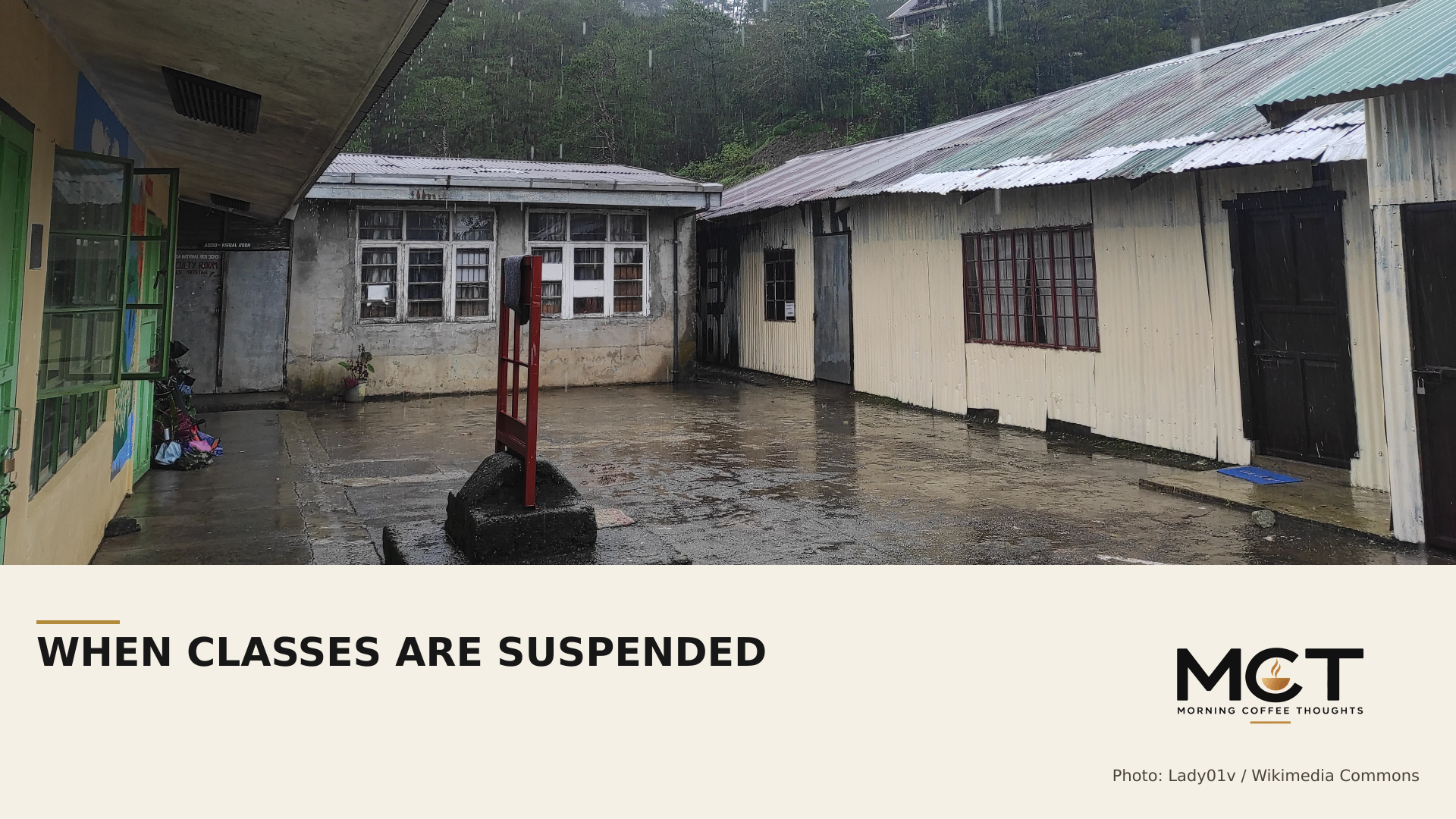
Sagada National High School in a September 3, 2023 file photo, with the headline about the new class-suspension rules.
Sagada National High School, September 3, 2023. Illustrative file photo by Lady01v / Wikimedia Commons. Cropped and resized. Lady01v · Wikimedia Commons photo · CC BY-SA 4.0 (photo and adaptations)

Five Things · November 4, 2026

A suspension announcement can leave families with several questions: Is our school covered? Are lessons continuing at home? Who decides when it is safe to return?

Executive Order No. 130, signed on October 28 and announced by the Palace on November 3, sets out a framework for suspending and resuming in-person classes, school activities and onsite work in public and private educational institutions and learning centers. It recognizes that conditions can differ between communities and even between schools in the same locality.

Here are five things to understand about the order and the decisions families will need to follow.

1

There are three ways a suspension can be declared

The framework distinguishes automatic, localized and school-level suspensions.

Automatic suspension is tied to official hazard information and the technical thresholds prescribed under the framework. Localized suspension is a decision by the concerned local chief executive, based on conditions and documented risk in the affected area when no applicable automatic suspension is in force.

The third route is a granular, or school-level, suspension. It allows an institution to respond to a documented threat specific to its location, subject to the order's conditions and coordination requirements.

These routes answer different questions. An official hazard warning provides technical information about a hazard. A local assessment considers how that hazard affects a community. A school assessment examines conditions that may be specific to the institution and its surroundings.

For a family reading an announcement, the useful details are which places and schools it covers, which activities are suspended, and how long the decision applies. An announcement for one area should not be assumed to cover every nearby school.

2

A school can act on a specific threat, but it must coordinate

Section 4 allows a duly authorized school official to declare a granular suspension when an actual or imminent threat to learners or personnel is established through documented, site-specific conditions.

This route applies in the absence of an applicable automatic suspension or localized suspension declared by the concerned local chief executive. The school must coordinate with that local official.

The distinction matters when conditions are uneven. A problem affecting a particular campus can require action even when the wider locality has not suspended classes. The order gives schools a way to address that situation through an assessment and a recorded decision.

It does not mean that an informal message or a general claim that an area is unsafe automatically establishes a school suspension. Families should check announcements from the institution's authorized officials and the relevant local authorities to see which decision applies.

3

Returning early requires safety evidence and local concurrence

Suspending classes and resuming them involve separate decisions.

Under Section 5, a school seeking to resume while a localized suspension remains in force needs the concurrence of the concerned local chief executive. It must also have a documented, site-specific safety assessment.

That assessment includes safe and unimpeded access to and from the institution. A campus can be usable while the route to it remains affected. Looking only at the condition of the classrooms would miss that part of the requirement.

The Palace's explanation also states that automatic and localized resumption remain subject to the required safety assessments and inspections. A warning being lifted or a suspension period ending should therefore be read together with the applicable safety requirements and any official resumption instructions.

For parents and staff, the practical question is whether the return has been authorized under the relevant mechanism and whether safe access has been considered.

4

Suspending in-person classes does not automatically stop all learning

Section 3 distinguishes suspension of physical attendance from suspension of learning.

Institutions are directed to use learning-continuity measures whenever feasible and appropriate, consistent with the policies of the agencies that supervise them. The condition matters: the order does not say that every disruption must become an online class, regardless of circumstances.

Families need clear instructions from their school about the arrangement that applies. That includes the learning materials or activities to use, how instructions will reach students, and whom to contact when access is a problem.

The framework aims to protect both safety and learning time. Whether a particular arrangement is workable depends on the hazard, the affected learners and the relevant education policies. A suspension notice alone does not answer every question about the day's lessons.

5

Detailed thresholds and procedures belong in the implementing guidelines

EO 130 directs DepEd to coordinate with the other concerned agencies and issue implementing guidelines within 30 days from the order's effectivity. The required guidelines cover the detailed thresholds and procedures used to apply the framework.

The order takes effect upon publication in the Official Gazette or a newspaper of general circulation. Its signing date and the date of the Palace announcement should not automatically be substituted for that publication trigger when calculating a deadline.

The new framework should also not be read as a fresh list of storm-signal, rainfall, heat or other numerical cutoffs. Families should follow the applicable official hazard advisories, education issuances and school or local-government announcements rather than infer a threshold from a general news summary.

The central change is a more specific basis for decisions: the hazard, the affected place, the institution's conditions and the requirements for a safe return. Clear announcements and documented coordination will determine how useful that framework is on the next disrupted school day.

SOURCES

  1. Official Gazette, Executive Order No. 130, s. 2026, signed October 28, 2026https://www.officialgazette.gov.ph/2026/10/28/executive-order-no-130-s-2026/
  2. Signed published order, Sections 3–5, 7 and 12https://www.officialgazette.gov.ph/downloads/2026/10oct/20261028-EO-130-FRM.pdf
  3. Presidential Communications Office, via Philippine Information Agency, November 3, 2026https://pia.gov.ph/news/president-marcos-signs-eo-establishing-unified-rules-on-class-suspensions-resumption/
  4. EDCOM 2, explanation of EO 130, November 3, 2026https://edcom2.gov.ph/eo-130-replaces-blanket-class-suspensions-policy-with-area-and-school-level-decisions/

GOOGLE PREFERRED SOURCES

FOLLOW MCT ON GOOGLE

Google’s Preferred Sources feature lets you choose publications you want Google to prioritize for you. Select “Add to Preferred Sources” to make MCT easier to find in Top Stories and other eligible Google results. This does not subscribe you to email.

← Back to MCT home

SUPPORT MCT

HELP KEEP INDEPENDENT POLITICAL WRITING GOING.

Morning Coffee Thoughts is reader-supported. Contributions help pay for research tools, hosting, and the work required to verify and explain each development.

Monthly PayPal subscription — choose your support amount.Subscribe monthly through PayPal

PayPal automatically charges your chosen amount every month until you cancel the subscription in PayPal.

Send support through GCash or Maya0969 314 4839