MCT DAILY
No fake news. No noise. Just the facts you need.
The morning Daily Brief anchors the day. New developments and short explainers follow when the story changes.
FIVE THINGS TO KNOW…
Short explainers published throughout the day.
MCT READER PULSE · MCT-PULSE-2026-002
MCT READER SURVEY
Are you in favor of Pax Silica?Pabor ka ba sa Pax Silica?
This short reader pulse asks MCT readers for their present view of Pax Silica.
This is an informal MCT reader pulse, not a scientific or nationally representative poll. It reflects only the views of verified readers who choose to participate.
View reader pulse archive →Thank you for joining this MCT reader pulse. Results will be published after it closes.
Results reflect only verified MCT readers who voluntarily participated. They do not represent the views of the general Philippine population. Demographic groups with fewer than five responses are not displayed.
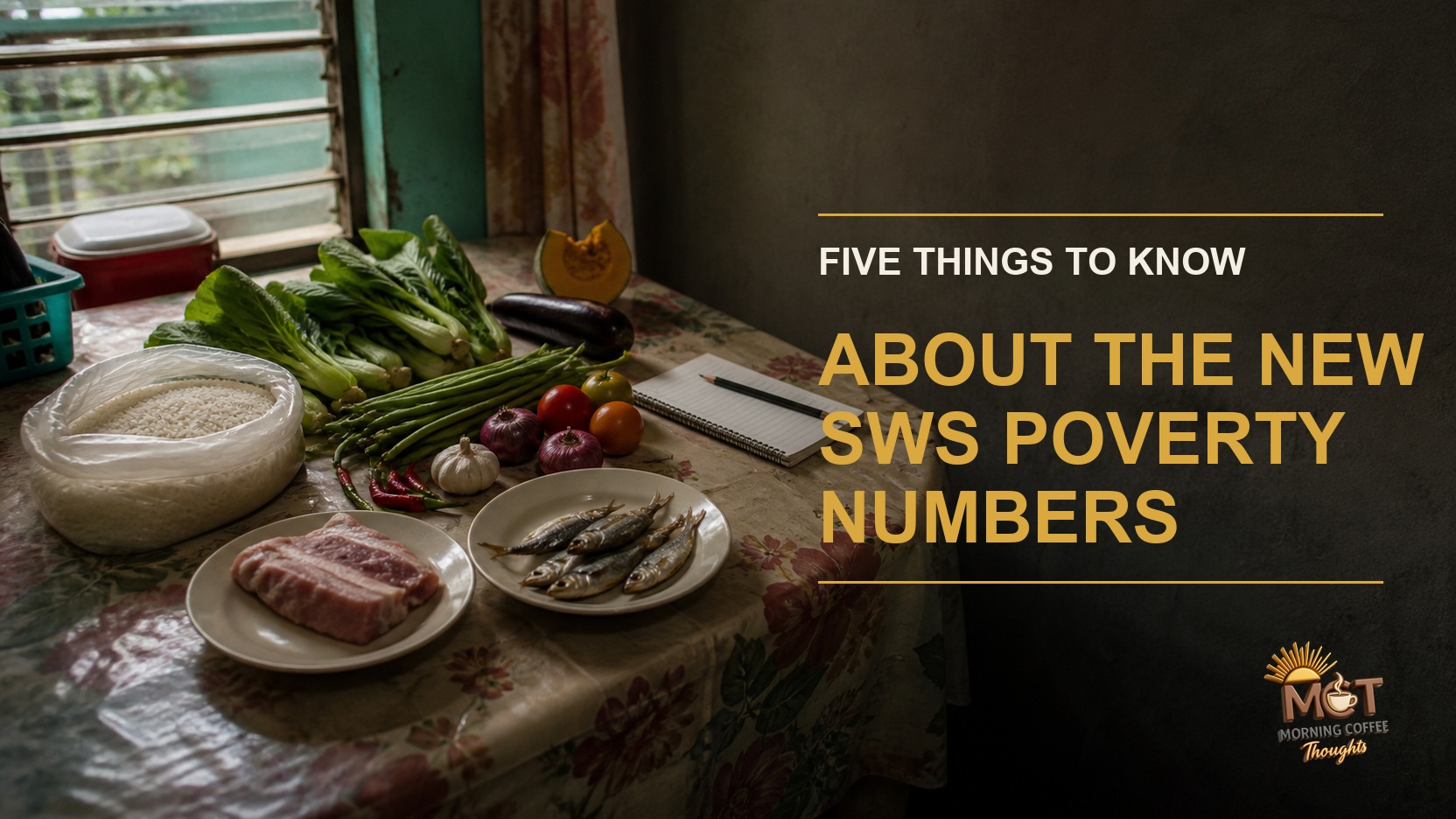
FIVE THINGS TO KNOW ABOUT THE NEW SWS POVERTY NUMBERS
Self-rated poverty and food poverty declined in June, but the figures also show how many Filipino families remain under pressure and why lower household budgets do not necessarily mean life became cheaper.

Fewer Filipino families described themselves as poor or food-poor in June 2026 than three months earlier, according to the latest Social Weather Stations survey.
That is welcome news. It does not mean, however, that poverty has disappeared or that everyday expenses have become easy to manage.
The survey also found that the amount families said they needed for basic expenses became smaller. SWS warned that this may reflect belt-tightening and lower living standards rather than cheaper living costs.
Here are five things ordinary readers should understand about the new figures.
NEARLY HALF OF FILIPINO FAMILIES STILL CONSIDER THEMSELVES POOR
The June 2026 SWS survey found that 49 percent of Filipino families considered themselves poor. This was three percentage points lower than the 52 percent recorded in March.
SWS estimated that the number of self-rated poor families declined from about 14.5 million to 13.6 million. Another 14 percent placed themselves on the borderline between poor and not poor, while 37 percent considered themselves not poor.
The decline is meaningful because it represents roughly 900,000 fewer families describing their condition as poor. The national result, however, still means that almost one out of every two families believes its income and living conditions are inadequate.
The survey interviewed 1,200 adults nationwide. Its national percentages have a sampling margin of error of plus or minus three percentage points, so small changes should be read with care.
WHAT TO WATCH
Watch the next quarterly SWS survey. A continuing decline would be more encouraging than a single movement between two surveys.
SELF-RATED POVERTY IS DIFFERENT FROM THE OFFICIAL PSA POVERTY RATE
SWS asks respondents to place their own families on a card marked poor, not poor or on the borderline. The result reflects how people judge their actual living conditions and whether their income meets what they believe their family needs.
The Philippine Statistics Authority uses a different method. It compares measured family income with an official poverty threshold based on the cost of basic food and non-food needs.
The latest complete official poverty statistics cover 2023. The PSA estimated that 10.9 percent of Filipino families were poor that year. This cannot be directly compared with the 49 percent SWS figure because the two measures use different standards and refer to different periods.
Both figures are useful. The PSA rate estimates how many families fall below an official income threshold. The SWS result shows how many families feel that their actual resources are insufficient, even when some may sit above the official line.
WHAT TO WATCH
Watch for the PSA's 2025 Family Income and Expenditure Survey results, expected in August 2026. They will provide a newer official estimate of poverty and household income.
FEWER FAMILIES CALLED THEMSELVES FOOD-POOR, BUT PRESSURE REMAINS
The proportion of families that considered themselves food-poor fell from 42 percent in March to 36 percent in June. SWS estimated that the number declined from about 11.7 million to 10.2 million families.
Another 15 percent placed themselves on the food borderline, up from 12 percent. The remaining 49 percent considered themselves not food-poor.
The improvement does not mean food became inexpensive. PSA data show that food inflation for households in the bottom 30 percent of the income distribution reached 8.2 percent in June 2026. These are the families that spend a larger share of their money on food.
Slower inflation, when it occurs, only means prices are increasing more slowly. It does not automatically return rice, vegetables, meat and other necessities to their old prices.
WHAT TO WATCH
Watch monthly food inflation and the next SWS hunger survey. Families may describe themselves as less food-poor while still reducing portions, changing what they eat or borrowing money for food.
THE NATIONAL NUMBER HIDES LARGE REGIONAL DIFFERENCES
Self-rated poverty was highest in Mindanao at 61 percent and the Visayas at 59 percent. It was lower in Balance Luzon at 41 percent and Metro Manila at 40 percent.
Self-rated food poverty was 45 percent in both Mindanao and the Visayas, compared with 31 percent in Balance Luzon and 27 percent in Metro Manila.
The Visayas recorded the largest declines between March and June: seven percentage points for self-rated poverty and nine points for self-rated food poverty.
Regional results come from 300 respondents in each broad area and have a sampling margin of error of plus or minus six percentage points. They identify important differences, but one regional movement should not be treated as a precise count of every province or city.
WHAT TO WATCH
Watch whether the regional changes appear again in later SWS surveys and whether official employment, wage and poverty figures point in the same direction.
A LOWER POVERTY BUDGET DOES NOT AUTOMATICALLY MEAN LIFE BECAME CHEAPER
Among families that considered themselves poor, the median amount they said they needed each month for basic expenses fell from P15,000 in March to P14,000 in June.
Among food-poor families, the median monthly amount they said they needed for food fell from P8,000 to P6,000.
SWS warned that falling thresholds may reflect belt-tightening and lower living standards. A family may report needing less because it has stopped buying certain food, delayed medical care, reduced transport, taken children out of activities or accepted a more limited standard of living.
The amounts also differ sharply by location. In Metro Manila, poor families gave a median general poverty threshold of P21,000 and a median food-poverty threshold of P15,000.
WHAT TO WATCH
Watch wages, household income and the detailed 2025 FIES results. A genuine improvement should eventually show families earning more and meeting their needs without continually lowering what they consider an acceptable budget.
BOTTOM LINE
The June SWS results moved in a positive direction, but they do not support the conclusion that poverty is no longer a major problem. About 13.6 million families still described themselves as poor, and about 10.2 million described themselves as food-poor. The fall in the budgets families said they needed deserves particular attention. It may reflect adaptation to hardship rather than lower prices or improved living conditions. The next SWS surveys, the PSA's updated poverty figures, food prices, wages and household income will show whether this is the beginning of lasting progress or only a temporary improvement in how families described their situation.
SUPPORT MCT
HELP KEEP INDEPENDENT POLITICAL WRITING GOING.
Morning Coffee Thoughts is reader-supported. Contributions help pay for research tools, hosting, and the work required to verify and explain each development.
RECENT COMMENTARY
THE LATEST FROM MCT