FIVE THINGS TO KNOW…

Short explainers published throughout the day.

1:18 PM7-minute read

ABOUT THE NEW SWS POVERTY NUMBERS

Self-rated poverty and food poverty declined in June, but the figures also show how many Filipino families remain under pressure and why lower household budgets do not necessarily mean life became cheaper.

Read the explainer →
2:02 PM11-minute read

ABOUT THE CHILDREN'S SOCIAL MEDIA SAFETY ACT

House Bill No. 9965 would bar children below 13 from having social media accounts, require parental consent for users aged 13 to 17, regulate platform algorithms, and impose fines reaching P50 million. It is still being deliberated in the House.

Read the explainer →
12:02 PM7-minute read

ABOUT THE SEALED BIR BOX

Marcos authorized the BIR to comply with the Senate subpoena. That did not open the records to the public or prove the unexplained-wealth allegation.

Read the explainer →

MCT READER PULSE · MCT-PULSE-2026-006

MCT READER SURVEY

After Gilas Pilipinas’ wins over Jordan and Iran, how confident are you that the team will qualify for the 2027 FIBA Basketball World Cup?Matapos ang mga panalo ng Gilas Pilipinas laban sa Jordan at Iran, gaano ka kumpiyansa na makakapasok ang koponan sa 2027 FIBA Basketball World Cup?

Gilas improved to 4–4 after beating Jordan and Iran, but the Philippines remains fifth in Group E with four games left. This survey asks about readers’ confidence; qualification has not yet been secured.

Read where Gilas stands before answering.

This is an informal survey of verified MCT readers who choose to participate. It is not nationally representative.

Open the shareable survey page →
View previous survey results →
Checking your reader session…

September 1, 2026 · 7:45 AM6-minute read

FIVE THINGS TO KNOW ABOUT THE HAZE AFFECTING PARTS OF THE PHILIPPINES

What unhealthy air readings mean, who faces greater risk, and how to reduce exposure while authorities verify the haze’s source.

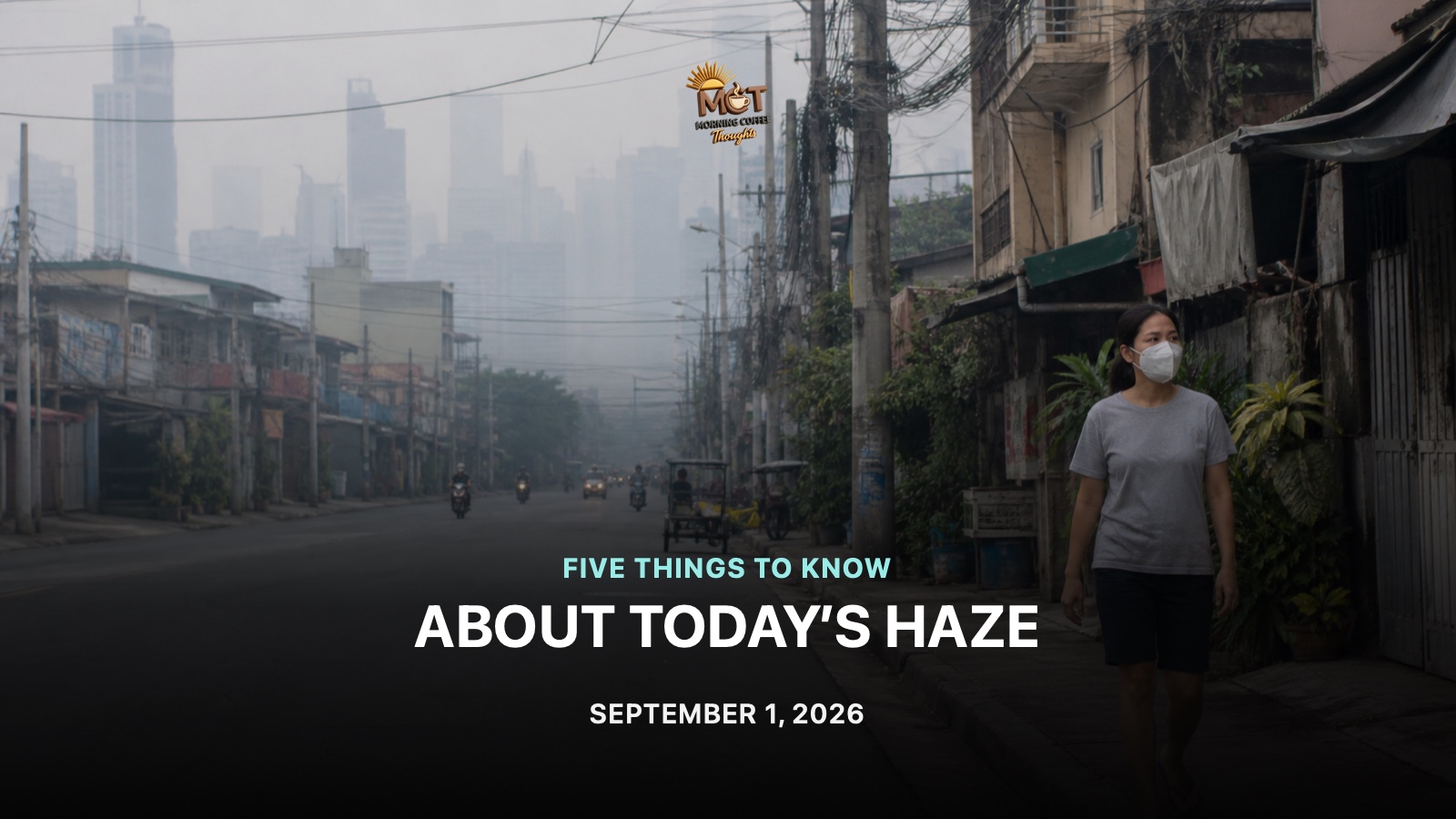
A conceptual editorial image of a masked pedestrian on a hazy Metro Manila street. Not a documentary image.

The gray sky over parts of Metro Manila, Calabarzon, and Mimaropa comes with a health concern. Government air monitors have recorded unhealthy conditions, and the Environmental Management Bureau said the haze may be connected to fires in Kalimantan, Indonesia.

The possible source still needs continued verification. The health precaution does not. Here are five things to know while authorities monitor the air.

1

HAZE CAN TRAVEL FAR FROM THE FIRE THAT PRODUCED IT

Smoke from large vegetation or forest fires can travel hundreds or even thousands of kilometers, depending on winds and weather patterns. That is why a fire outside the Philippines can affect visibility and air quality here.

Wildfire smoke is a mixture of gases and particles. The greatest health concern is usually fine particulate matter, especially PM2.5. These particles are small enough to travel deep into the lungs and may aggravate asthma, heart disease, and other respiratory or cardiovascular conditions.

The EMB said the current haze was possibly connected to fires in Kalimantan. The word “possibly” is doing real work: the source attribution was not yet presented as final. Readers should separate the confirmed air-quality readings from the still-qualified explanation of where the haze came from.

WHAT TO WATCH

Watch for a firmer source assessment from the EMB and for updates on wind direction and fires in the region. Do not treat an early, qualified explanation as a settled conclusion.

2

AIR-QUALITY READINGS MATTER MORE THAN HOW THE SKY LOOKS

Haze can be visible before it becomes dangerous, and dangerous concentrations of fine particles may persist even when the sky looks clearer. The safer guide is the reading from the nearest reliable monitoring station.

The EMB reported “very unhealthy” conditions at monitoring locations in ten Metro Manila cities and “acutely unhealthy” air in Parañaque. Under the agency's PM2.5 guidance, very unhealthy conditions call for postponing unnecessary trips and keeping people with heart or respiratory disease indoors as much as possible. At the acutely unhealthy level, everyone should limit outdoor exertion.

Air quality can change within the day. A reading from another city, or from several hours earlier, may not describe the air where you are now.

WHAT TO WATCH

Check the EMB's real-time monitoring page and local government advisories. Look at the location and time of the reading before relying on a category or color shared in a screenshot.

3

SOME PEOPLE FACE MORE RISK, BUT POOR AIR IS NOT ONLY THEIR PROBLEM

Children, older adults, pregnant women, outdoor workers, and people with asthma or heart or lung disease are more likely to suffer harm from smoke exposure. They should reduce outdoor activity early rather than wait for symptoms to become severe.

Healthy adults are not immune. Smoke can cause eye and throat irritation, coughing, headache, tiredness, wheezing, or shortness of breath. Strenuous outdoor activity increases the amount of polluted air a person breathes into the lungs.

People with existing medical conditions should follow their treatment plan and seek medical advice if symptoms worsen. Chest pain, serious difficulty breathing, confusion, or other severe symptoms require urgent attention.

WHAT TO WATCH

Watch for coughing, wheezing, chest discomfort, shortness of breath, or an asthma flare. Schools, employers, and sports organizers should also review outdoor activities when local readings remain unhealthy.


4

A WELL-FITTING PARTICLE RESPIRATOR WORKS BETTER THAN A LOOSE FACE MASK

If going outside cannot be avoided, a properly fitted N95 or comparable certified particle-filtering respirator can reduce exposure to fine particles. A poor seal lets air bypass the filter.

A cloth mask or loose surgical mask may help with droplets. It does not create the seal needed for fine smoke particles. No mask makes prolonged outdoor exposure harmless, especially during strenuous activity.

Very young children may not be able to use adult respirators safely or achieve a proper seal. For them, reducing exposure and keeping indoor air cleaner are more reliable precautions.

WHAT TO WATCH

Check that the respirator covers the nose and mouth and seals reasonably well. Replace it if it becomes damaged, dirty, wet, or difficult to breathe through.

5

INDOOR AIR CAN BE PROTECTED, BUT “STAY INSIDE” IS NOT THE WHOLE PLAN

Close doors and windows when outdoor air is poor, provided doing so does not create dangerous indoor heat. If an air-conditioning system allows it, use recirculation mode instead of drawing outside air in. A properly sized air cleaner with a high-efficiency particle filter can help reduce indoor particle levels.

Avoid adding more pollution indoors. Smoking, burning candles or incense, and unnecessary frying can worsen particle levels. In a vehicle, close the windows and set the air conditioner to recirculate.

Conditions may improve or worsen as winds change. Keep outdoor air out while readings are poor, then ventilate when reliable readings improve and conditions allow it.

WHAT TO WATCH

Monitor both outdoor air quality and indoor heat. If your home cannot keep the air reasonably clean or cool, follow local guidance about cleaner-air spaces or safer temporary locations.

BOTTOM LINE

The source of the haze should continue to be verified. People can protect themselves while that work continues. Use current local air-quality readings, reduce outdoor exertion, protect vulnerable family members, wear a well-fitting particle respirator when necessary, and keep indoor air as clean as practical. This calls for caution without panic and precision without pretending that an early explanation is already final.

SOURCES

  1. Environmental Management Bureau PM2.5 guidancehttps://air.emb.gov.ph/denr-administrative-order-on-establishing-breakpoints-for-pm-2-5-air-quality-index-reviewed-and-approved-by-emb/
  2. EMB NCR real-time air monitoringhttps://ncr.emb.gov.ph/realtimeairmonitoring/
  3. GMA News Onlinehttps://www.gmanetwork.com/news/topstories/nation/1000608/haze-possibly-from-indonesia-fires-reached-ncr-calabarzon-mimaropa/story/
  4. World Health Organizationhttps://www.who.int/news-room/fact-sheets/detail/wildfires-and-health
  5. U.S. Environmental Protection Agencyhttps://www.epa.gov/wildfires/frequent-questions-about-wildland-fire-smoke-individuals

GOOGLE PREFERRED SOURCES

FOLLOW MCT ON GOOGLE

Google’s Preferred Sources feature lets you choose publications you want Google to prioritize for you. Select “Add to Preferred Sources” to make MCT easier to find in Top Stories and other eligible Google results. This does not subscribe you to email.

← Back to MCT home

LATEST COMMENTARY

View all commentary →

SUPPORT MCT

HELP KEEP INDEPENDENT POLITICAL WRITING GOING.

Morning Coffee Thoughts is reader-supported. Contributions help pay for research tools, hosting, and the work required to verify and explain each development.

Choose the monthly support amount you are comfortable with.Continue through PayPal
Send support through GCash0969 314 4839