MCT DAILY

No fake news. No noise. Just the facts you need.

The morning Daily Brief anchors the day. New developments and short explainers follow when the story changes.

FIVE THINGS TO KNOW…

Short explainers published throughout the day.

August 15, 2026 · 8:45 AM8-minute read

FIVE THINGS TO KNOW ABOUT PAX SILICA AFTER THE SENATE HEARING

The Philippines has joined a technology partnership, but the proposed New Clark City hub still needs detailed agreements, investors, utilities, and safeguards.

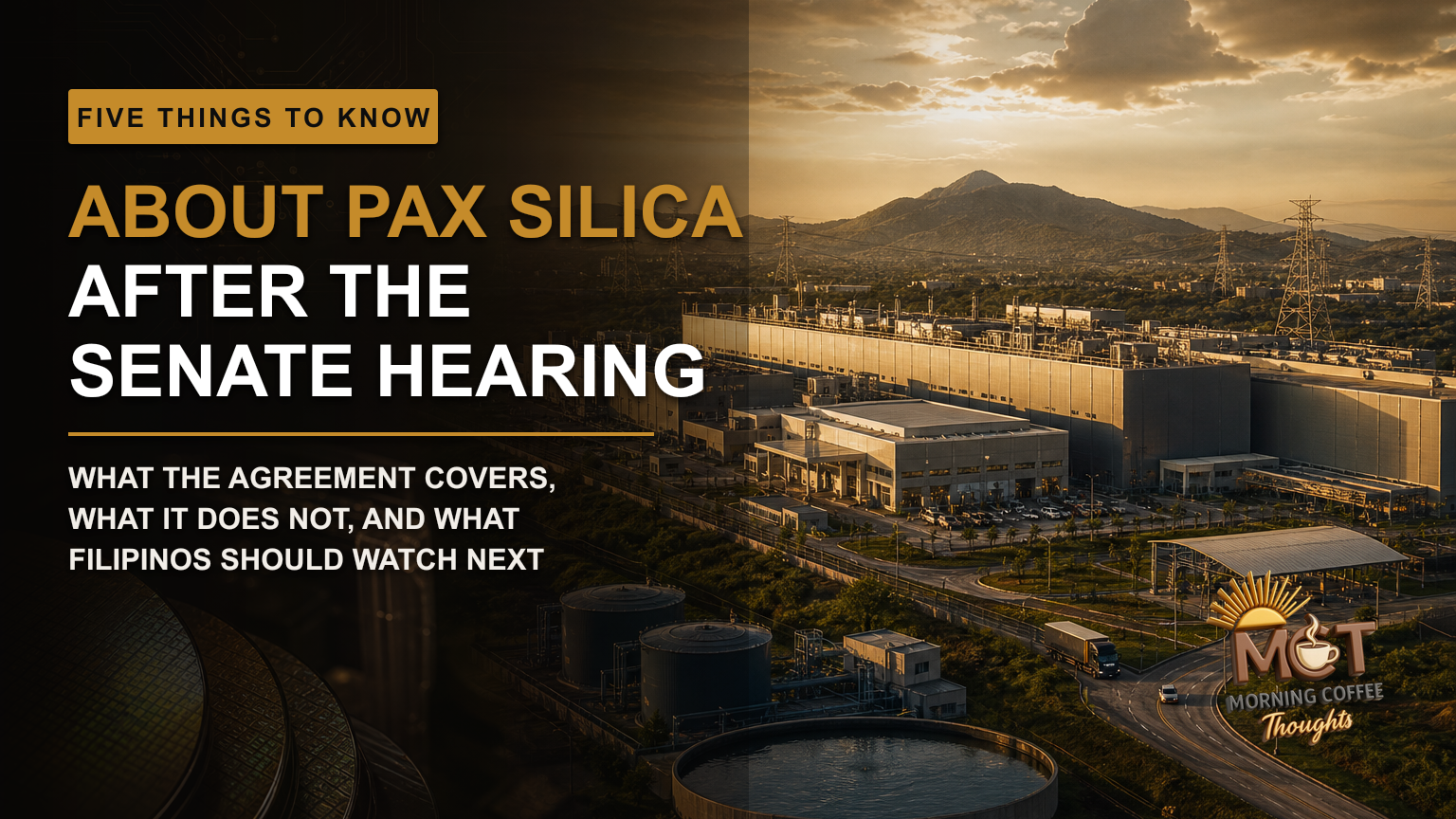
MCT cover showing a proposed industrial and technology hub for an explainer about Pax Silica

Pax Silica has been described as an AI project, a semiconductor hub, a critical-minerals partnership and an industrial development that could create more than 130,000 jobs. It has also faced questions over its possible use of land, water and electricity.

The Senate hearing on August 14 brought those questions back into public discussion. Government documents and statements from the Bases Conversion and Development Authority help separate the current plans from claims circulating online. They also show how many important details remain unsettled.

The Philippines has joined the wider Pax Silica initiative. A proposed industrial zone in New Clark City is being developed under that framework. Those are related developments, but they are not the same agreement.

Here are five things Filipinos should understand about the project.

1

THE PHILIPPINES SIGNED A BROAD DECLARATION, NOT A COMPLETE CONSTRUCTION CONTRACT

The Philippines joined Pax Silica on April 16, 2026. Trade Undersecretary Ceferino Rodolfo signed the declaration on behalf of the country.

The declaration covers cooperation in critical minerals, energy, advanced manufacturing, semiconductors, AI infrastructure and logistics. It expresses a shared intention to build more secure technology supply chains among participating countries.

The document does not contain the complete terms for constructing the proposed industrial hub in New Clark City. It does not name the final investors, specify how much the Philippine government will spend, set lease prices or guarantee a particular number of jobs.

The United States and the Philippines separately announced plans for a 4,000-acre Economic Security Zone, equivalent to about 1,620 hectares, inside New Clark City. That proposed zone still requires detailed agreements, technical studies, regulatory approvals and actual investors.

For an ordinary Filipino, this means the country has entered a partnership and offered a location for a possible industrial hub. It does not mean that every factory, power plant or research facility being discussed has already been financed or approved.

WHAT TO WATCH

Watch for the proposed framework agreement and the contracts that follow it. These should identify what the Philippines will provide, what private investors will finance, how long land may be leased, which incentives will be granted and what happens if promised investments fail to arrive.

2

BINGCANG SAYS THE NEW CLARK CITY HUB IS NOT A DATA-CENTER COMPLEX

BCDA President Joshua Bingcang clarified during a July 23 government briefing that the proposed New Clark City development is intended primarily as a manufacturing and industrial hub. It is not being planned as one enormous data center.

The proposed zone may still include one or two data centers. Bingcang’s point was that these would form only a small part of a larger development intended for semiconductor, electronics, advanced-manufacturing and critical-mineral-processing companies.

Much of the public debate has treated Pax Silica as though the entire 1,620-hectare site would be occupied by water-intensive data centers. Based on BCDA’s current description, that is inaccurate.

The clarification does not settle the questions about water and electricity. Manufacturing plants, mineral-processing facilities and semiconductor operations can also require substantial utilities. Their actual requirements will depend on which companies enter the zone and what facilities they construct.

For workers, the proposed manufacturing focus could produce more permanent technical and industrial jobs than a development dominated by data centers. The number, quality and salaries of those jobs will remain projections until companies sign contracts and disclose their employment plans.

WHAT TO WATCH

Look for signed commitments from named companies, the number of permanent jobs attached to each investment and the qualifications those jobs require. Government should also disclose how Filipino students and workers will be trained before recruitment begins.

3

THE WATER AND POWER SYSTEMS ARE STILL PROPOSALS

BCDA estimates that the project could require between 65 million and 90 million liters of water each day when fully developed.

The agency says it plans to avoid taking groundwater used by nearby communities. Its proposed solution is a surface-water harvesting system designed to collect and store rainwater. The initial facility is supposed to provide up to 120 million liters per day and could eventually be expanded to 300 million liters.

Those figures describe planned capacity. They do not yet prove how the system will perform during a long dry season, where the water will be stored, how much the facilities will cost or who will pay for them.

The project’s electricity requirements are also under review. The Department of Energy has said that dedicated power sources will be needed and that the rest of the country should not be placed at a disadvantage. Renewable-energy projects and a dedicated connection for New Clark City have been discussed, but the final combination of power sources has not been settled.

For households and small businesses, the concern is practical. A new industrial zone should not cause more brownouts, compete with communities for water or transfer the cost of new infrastructure to consumers who receive few of its benefits.

WHAT TO WATCH

Wait for completed water and power feasibility studies. These should show dry-season supply, environmental effects, construction costs, backup sources and whether the industrial hub or ordinary electricity and water customers will pay for the required infrastructure.

4

GOVERNMENT SAYS PHILIPPINE LAW WILL APPLY, BUT COMPLIANCE MUST BE SHOWN PROJECT BY PROJECT

BCDA says the proposed hub will remain governed by Philippine law. It has also said that investors will not receive diplomatic immunity and that the project will be subject to the BCDA Charter, investment rules and environmental regulation.

BCDA says the proposed site is public land titled to the agency and designated for development. It also says no mining will occur inside the New Clark City site, although mineral processing may form part of the wider industrial plan.

The agency has promised that individual project components will need Environmental Compliance Certificates before construction. It also says at least 40 percent of the project area will be reserved for parks, open spaces and green areas.

Those assurances still need to be tested against the final design and the people using or living near the affected land. A government land title does not by itself answer every question about farmers, informal occupants, Indigenous communities, water systems, access roads and surrounding ecosystems.

People affected by the development need more than a promise that the law will be followed. They need to know whether they will lose access to land or livelihoods, what consultation will occur and what assistance or compensation will be available if the project changes how they live or work.

WHAT TO WATCH

Watch for environmental impact studies, maps showing the exact project boundaries, records of community consultations and a clear accounting of households and livelihoods that may be affected. These documents should be available before irreversible construction begins.

5

THE PROJECT’S BIGGEST CLAIMS MAY TAKE YEARS TO TEST

BCDA said in July that contract negotiations were expected during 2026, planning would continue in 2027 and construction could begin in early 2028.

Separate arrangements are already being explored. BCDA and the Subic Bay Metropolitan Authority signed a memorandum of understanding to evaluate the Port of Subic Bay as the project’s preferred maritime gateway. The plan is to use the port to move raw materials such as nickel and copper and export processed technology products.

That memorandum starts planning and evaluation. It does not guarantee a particular volume of cargo, a completed factory or a finished transport system between Subic and New Clark City.

The long timeline creates political and financial uncertainty. President Ferdinand Marcos Jr. leaves office in 2028. A succeeding administration could continue the project, change its terms, slow it down or abandon parts of it. Investors can also withdraw when costs, markets or government policies change.

Filipinos are being asked to assess large promises before the agreements needed to deliver them are complete. The safest test is whether each stage produces verifiable commitments, useful infrastructure, skilled Filipino employment and safeguards that remain enforceable after political leadership changes.

WHAT TO WATCH

Watch whether the government completes a public framework agreement before signing long leases or granting major incentives. Also monitor whether project deadlines are supported by financing, approved plans and named investors rather than repeated announcements.

BOTTOM LINE

The public discussion has established that Pax Silica is broader than a single data center and that the proposed New Clark City development remains in an early stage. The Philippines has signed the Pax Silica declaration. The industrial hub, however, still needs detailed agreements, investors, environmental approvals, water and power systems, community consultations and enforceable protections. The possible benefits are substantial: skilled jobs, new factories, stronger technology industries and a chance to process more Philippine minerals into higher-value products. The possible costs are also substantial. Land, water, electricity, public incentives and environmental risks will be involved. The decision should eventually rest on the terms the government signs, the safeguards it enforces and the share of the benefits that remains with Filipinos.

RECENT COMMENTARY

THE LATEST FROM MCT

View all commentary →

SUPPORT MCT

HELP KEEP INDEPENDENT POLITICAL WRITING GOING.

Morning Coffee Thoughts is reader-supported. Contributions help pay for research tools, hosting, and the work required to verify and explain each development.

Choose the monthly support amount you are comfortable with.Continue through PayPal
Send support through GCash0969 314 4839