FIVE THINGS TO KNOW…

Short explainers published throughout the day.

10:45 PM7-minute read

ABOUT THE OCTOBER WATER-RATE INCREASES

Metro Manila households served by Maynilad and Manila Water will see slightly higher water charges beginning October 1. The announced increases are small for many residential customers, but the figures vary by concessionaire and consumption level. That makes it easy to misunderstand a notice expressed only in centavos per cubic meter.

Read the explainer →
7:21 AM6-minute read

ABOUT THE NOTE HANDED TO GIBO TEODORO IN SEOUL

Defense Secretary Gilberto “Gibo” Teodoro Jr. was answering questions at the Seoul Defense Dialogue on September 8 when a man handed him a note. He read it aloud, challenged its rejection of the 2016 South China Sea ruling and objected to being interrupted that way.

Read the explainer →
9:55 AM8-minute read

ABOUT EL NIÑO AND PREPARING FOR LESS RAIN

It can be raining outside while PAGASA warns about El Niño. That can sound confusing when the immediate problem is a wet road or a flooded field. The two warnings describe different periods: the weather happening now and the rainfall conditions that may develop over the coming months.

Read the explainer →
5:30 AM8-minute read

ABOUT THE NEW ARREST WARRANTS AGAINST ZALDY CO, MARTIN ROMUALDEZ AND TWO OTHERS

The Sandiganbayan has ordered the arrest of Zaldy Co, Martin Romualdez and two other accused in the plunder case filed on September 7. By Monday evening, authorities had served Romualdez's warrant and carried out booking procedures at Cardinal Santos Medical Center in San Juan. His arrest is a confirmed development; it does not establish that his three co-accused are also in custody.

Read the explainer →
3:15 PM8-minute read

ABOUT THE PLUNDER CASE AGAINST MARTIN ROMUALDEZ

The Office of the Ombudsman filed a plunder case against former House Speaker Martin Romualdez at the Sandiganbayan on September 7 over his alleged involvement in flood-control kickbacks. The accusations have now reached the court that will handle the criminal case. Romualdez denies wrongdoing and remains presumed innocent.

Read the explainer →
1:18 PM7-minute read

ABOUT THE NEW SWS POVERTY NUMBERS

Self-rated poverty and food poverty declined in June, but the figures also show how many Filipino families remain under pressure and why lower household budgets do not necessarily mean life became cheaper.

Read the explainer →
2:02 PM11-minute read

ABOUT THE CHILDREN'S SOCIAL MEDIA SAFETY ACT

House Bill No. 9965 would bar children below 13 from having social media accounts, require parental consent for users aged 13 to 17, regulate platform algorithms, and impose fines reaching P50 million. It is still being deliberated in the House.

Read the explainer →
12:02 PM7-minute read

ABOUT THE SEALED BIR BOX

Marcos authorized the BIR to comply with the Senate subpoena. That did not open the records to the public or prove the unexplained-wealth allegation.

Read the explainer →

MCT READER PULSE · MCT-PULSE-2026-008

MCT READER SURVEY

Senator-judges who are absent from the impeachment trial—including those on medical leave, in hiding, or detained—should still be allowed to cast a vote. Do you agree?Ang mga senator-judge na wala sa impeachment trial—kabilang ang naka-medical leave, nagtatago, o nakadetine—ay dapat payagan pa ring bumoto. Sang-ayon ka ba?

Senator-judge Erwin Tulfo asked the impeachment court to clarify who may validly vote and how absent members affect the constitutional two-thirds requirement. He cited one senator on medical leave abroad, one in hiding, and two in detention. The court had not resolved those questions when this survey opened. This survey asks for your view; it does not state what the Constitution or the impeachment rules require.

Background: Senate impeachment records, INQUIRER.net, and MindaNews.

This is an informal survey of verified MCT readers who choose to participate. It is not nationally representative.

Open the shareable survey page →
View previous survey results →
Checking your reader session…

September 14, 2026 · 4:10 PM8-minute read

ABOUT UNEXPLAINED WEALTH AT TODAY'S IMPEACHMENT HEARING

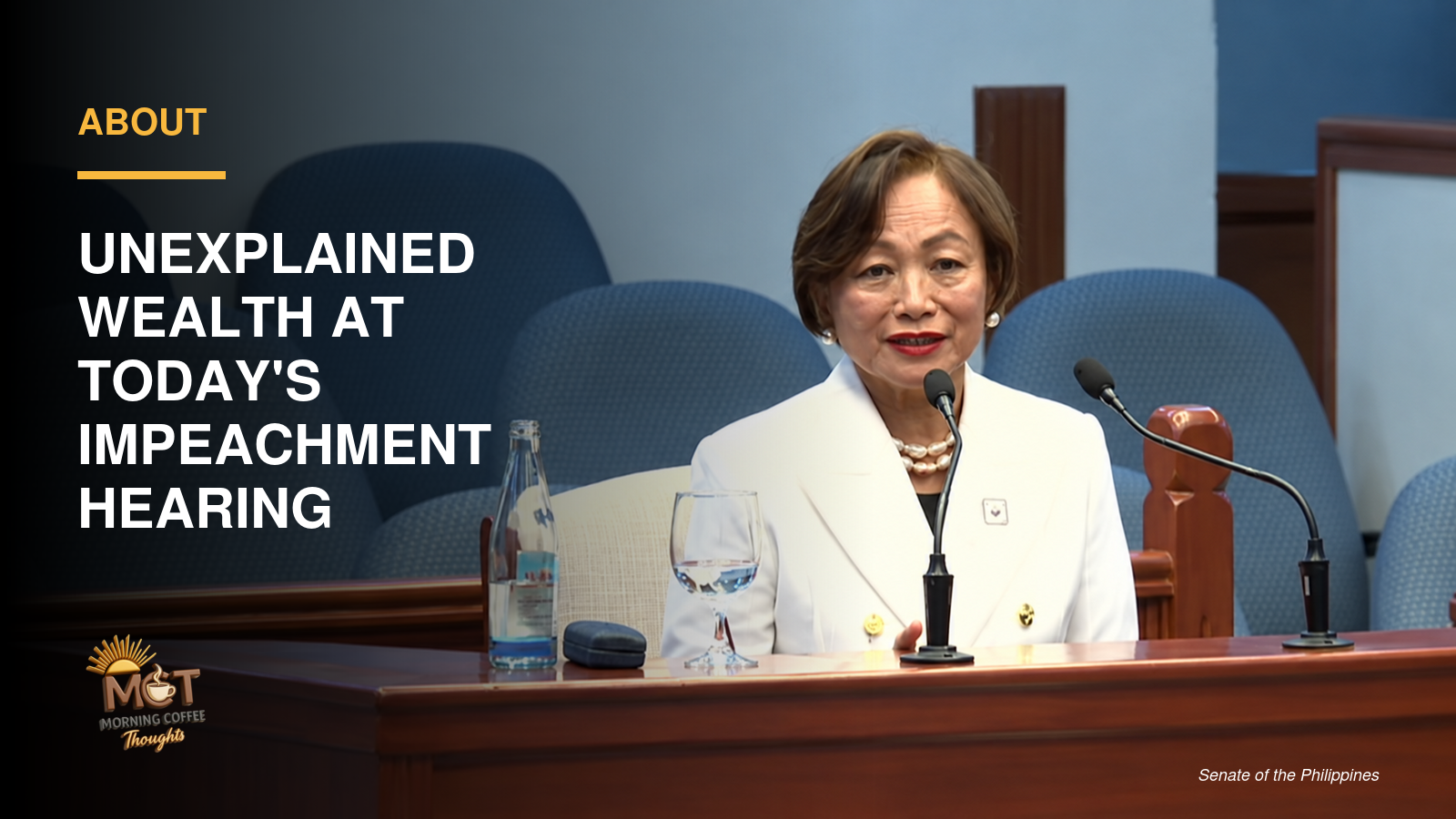
Retired Sandiganbayan Presiding Justice Amparo Cabotaje-Tang explained the legal framework for Article II. Her testimony laid out the test; it did not prove the allegations against Vice President Sara Duterte.

Retired Sandiganbayan Presiding Justice Amparo Cabotaje-Tang at the Senate witness table during the September 14, 2026 impeachment hearing.
Photo: Senate of the Philippines

The impeachment trial of Vice President Sara Duterte moved into Article II today, September 14, with retired Sandiganbayan Presiding Justice Amparo Cabotaje-Tang taking the witness stand. The article accuses Duterte of failing to disclose assets and business interests and of accumulating unexplained wealth. She denies the allegations.

Much of today's hearing was not yet about a specific bank account, company or property. It was about the legal terms the prosecution will use when it begins presenting records. Tang was called to explain how laws on public accountability, the Statement of Assets, Liabilities and Net Worth, and allegedly unexplained wealth are supposed to work. The defense objected to her testimony and later questioned whether she was politically biased.

That makes today's hearing important, but limited. It laid out the test. It did not settle whether the evidence against Duterte will meet that test.

1

1. ARTICLE II HAS FORMALLY STARTED

Article II accuses Duterte of amassing unexplained wealth, making false or incomplete declarations in her SALNs, and keeping interests in businesses while holding public office. Those are allegations in the impeachment case, not findings of guilt.

The prosecution began this stage with Tang instead of immediately presenting Duterte's SALNs, company records or bank documents. Its apparent purpose was to give the impeachment court a legal map before asking senator-judges to examine the paper trail. That map matters because the prosecution cannot prove its case by placing a large number beside Duterte's name. It must establish what property, financial interest or transaction is connected to her, when it was acquired or made, what her lawful income was during the relevant period, and why the difference cannot be satisfactorily explained.

The defense is entitled to challenge every part of that chain. It can dispute ownership, authenticity, dates, calculations and the meaning of the records. It can also present lawful sources of money or argue that the evidence does not belong in an impeachment trial.

WHAT TO WATCH

The next witnesses and exhibits should show whether the prosecution can move from broad accusations to identifiable assets, companies and transactions. Watch for records from the Ombudsman and the Securities and Exchange Commission, and for the defense's objections to how those records were obtained and used.

2

2. TANG EXPLAINED THE RULES, NOT DUTERTE'S BANK RECORDS

Tang led the Sandiganbayan, the court that hears graft and corruption cases involving public officials. The prosecution presented her as an expert witness to explain concepts tied to public accountability, SALNs, beneficial ownership and unexplained or illegally acquired wealth.

That gives her testimony weight, but it also sets a clear limit. She was not presented as the custodian of Duterte's SALNs, the keeper of corporate files or the officer who traced the Vice President's bank transactions. She could explain how the law approaches those records. Her testimony alone could not establish that a particular account, property or company belongs to Duterte, or that money passing through an account came from an illegal source.

Senator-judge Raffy Tulfo raised a practical question: would Tang's testimony be more useful after the documentary evidence has been presented, when the legal concepts could be applied to the actual records? That question goes to the order and usefulness of the evidence, not Duterte's guilt or innocence.

WHAT TO WATCH

Watch whether Tang is recalled after the documentary witnesses testify, and whether the court limits her role to explaining the law. The decisive question will be how the senator-judges connect, or refuse to connect, her framework to authenticated evidence.

3

3. HIDDEN, UNEXPLAINED AND ILL-GOTTEN WEALTH ARE NOT THE SAME THING

The hearing spent time separating terms that are often carelessly treated as synonyms.

Hidden wealth generally refers to an asset or financial interest that was concealed, omitted or placed under another name. But concealment by itself does not automatically prove that the money came from crime. Unexplained wealth usually involves property or spending that appears plainly out of proportion to a public official's lawful income and has not been satisfactorily accounted for under the applicable legal process. Ill-gotten wealth is a stronger accusation: it points to wealth allegedly acquired through abuse of office, misuse of public funds or another unlawful act.

Beneficial ownership is also important. The name written on a title or company record may not always identify the person who ultimately owns, controls or benefits from the asset. But beneficial ownership must still be established with evidence. It cannot simply be assumed because people are related, associated in business or politically connected.

The same caution applies to SALNs. A missing or inaccurate entry can be relevant and serious, but it does not automatically prove an impeachable offense, a crime or a right to forfeit property. The nature of the omission, the official's explanation and the surrounding evidence all matter.

WHAT TO WATCH

Listen for the exact legal basis the prosecution uses for each claim. If it calls an asset hidden, unexplained or ill-gotten, it should identify the evidence that supports that particular label rather than sliding from one term to another.

4

4. THE DEFENSE FOUGHT HER APPEARANCE AND TESTED HER IMPARTIALITY

Duterte's lawyers tried to exclude Tang's testimony, arguing that presenting her violated due process because she was not properly included in the pretrial order. The prosecution defended her appearance as necessary to explain the public-accountability framework. Her examination and cross-examination proceeded despite the objection.

During cross-examination, defense lawyer Mark Vinluan questioned Tang about possible political leanings and personal motives. He asked whether she was anti-Duterte, whether she was a Kakampink, and whether she had been disappointed that former President Rodrigo Duterte did not appoint her to the Supreme Court. Tang denied the suggestions. She also denied receiving or being promised anything in exchange for her testimony and said her testimony was not for sale.

The defense was within its role in testing the credibility and possible bias of a prosecution witness. But asking a question is not proof that its premise is true. Tang's denial also does not end the inquiry by itself. The impeachment court must judge her answers, qualifications, consistency and the proper weight of her opinions.

WHAT TO WATCH

Watch for a clearer ruling on the defense's procedural objection and for any evidence, beyond insinuation, offered to establish bias. The court must separately decide whether Tang was properly presented and how much reliance her testimony deserves.

5

5. THE CASE STILL TURNS ON THE DOCUMENTARY TRAIL

The prosecution has previously pointed to roughly P6.7 billion in reported bank transactions involving accounts it associates with Duterte and members of her family. That figure is politically explosive, but it must be handled carefully. A transaction total is not automatically the same as income, personal wealth or stolen money. Money may move more than once, flow between related accounts or come from lawful business and other legitimate sources.

To make the number meaningful, the prosecution must show whose accounts were involved, what period the transactions covered, whether the records are authentic, how the amounts were computed, and how they relate to Duterte's declared assets and lawful income. If it alleges that assets were held through companies or other people, it must prove the link rather than rely on association alone.

The defense, in turn, must do more than dismiss a figure as large or politically motivated if the underlying records are admitted and connected to Duterte. It will need to challenge the documents or provide a credible explanation for the transactions and any difference between the records and her declarations.

WHAT TO WATCH

The strongest evidence will be records that can be authenticated, matched across agencies and placed on a clear timeline. Watch whether the prosecution avoids double-counting and whether the defense supplies documents, not just denials, for any disputed source of funds or ownership.

BOTTOM LINE

Today's hearing supplied definitions and a legal framework for Article II. It did not prove that Sara Duterte possesses unexplained or ill-gotten wealth, and it did not clear her of the allegation. That work begins when the prosecution presents the actual SALNs, corporate files, bank records and witnesses who can authenticate them, and when the defense gets the chance to test and answer each one.

The crucial question is no longer whether P6.7 billion sounds alarming. It is whether admissible and reliable records can connect specific assets or transactions to Duterte, show a meaningful gap from lawful income or disclosures, and survive the defense's explanations. Until that documentary trail is placed before the impeachment court, the most responsible conclusion is also the simplest: Article II has started, but it has not yet been proved.

GOOGLE PREFERRED SOURCES

FOLLOW MCT ON GOOGLE

Google’s Preferred Sources feature lets you choose publications you want Google to prioritize for you. Select “Add to Preferred Sources” to make MCT easier to find in Top Stories and other eligible Google results. This does not subscribe you to email.

← Back to MCT home

LATEST COMMENTARY

View all commentary →

SUPPORT MCT

HELP KEEP INDEPENDENT POLITICAL WRITING GOING.

Morning Coffee Thoughts is reader-supported. Contributions help pay for research tools, hosting, and the work required to verify and explain each development.

Choose the monthly support amount you are comfortable with.Continue through PayPal
Send support through GCash or Maya0969 314 4839