FIVE THINGS TO KNOW…

Short explainers published throughout the day.

10:45 PM7-minute read

ABOUT THE OCTOBER WATER-RATE INCREASES

Metro Manila households served by Maynilad and Manila Water will see slightly higher water charges beginning October 1. The announced increases are small for many residential customers, but the figures vary by concessionaire and consumption level. That makes it easy to misunderstand a notice expressed only in centavos per cubic meter.

Read the explainer →
7:21 AM6-minute read

ABOUT THE NOTE HANDED TO GIBO TEODORO IN SEOUL

Defense Secretary Gilberto “Gibo” Teodoro Jr. was answering questions at the Seoul Defense Dialogue on September 8 when a man handed him a note. He read it aloud, challenged its rejection of the 2016 South China Sea ruling and objected to being interrupted that way.

Read the explainer →
9:55 AM8-minute read

ABOUT EL NIÑO AND PREPARING FOR LESS RAIN

It can be raining outside while PAGASA warns about El Niño. That can sound confusing when the immediate problem is a wet road or a flooded field. The two warnings describe different periods: the weather happening now and the rainfall conditions that may develop over the coming months.

Read the explainer →
5:30 AM8-minute read

ABOUT THE NEW ARREST WARRANTS AGAINST ZALDY CO, MARTIN ROMUALDEZ AND TWO OTHERS

The Sandiganbayan has ordered the arrest of Zaldy Co, Martin Romualdez and two other accused in the plunder case filed on September 7. By Monday evening, authorities had served Romualdez's warrant and carried out booking procedures at Cardinal Santos Medical Center in San Juan. His arrest is a confirmed development; it does not establish that his three co-accused are also in custody.

Read the explainer →
3:15 PM8-minute read

ABOUT THE PLUNDER CASE AGAINST MARTIN ROMUALDEZ

The Office of the Ombudsman filed a plunder case against former House Speaker Martin Romualdez at the Sandiganbayan on September 7 over his alleged involvement in flood-control kickbacks. The accusations have now reached the court that will handle the criminal case. Romualdez denies wrongdoing and remains presumed innocent.

Read the explainer →
1:18 PM7-minute read

ABOUT THE NEW SWS POVERTY NUMBERS

Self-rated poverty and food poverty declined in June, but the figures also show how many Filipino families remain under pressure and why lower household budgets do not necessarily mean life became cheaper.

Read the explainer →
2:02 PM11-minute read

ABOUT THE CHILDREN'S SOCIAL MEDIA SAFETY ACT

House Bill No. 9965 would bar children below 13 from having social media accounts, require parental consent for users aged 13 to 17, regulate platform algorithms, and impose fines reaching P50 million. It is still being deliberated in the House.

Read the explainer →
12:02 PM7-minute read

ABOUT THE SEALED BIR BOX

Marcos authorized the BIR to comply with the Senate subpoena. That did not open the records to the public or prove the unexplained-wealth allegation.

Read the explainer →

MCT READER PULSE · MCT-PULSE-2026-008

MCT READER SURVEY

Senator-judges who are absent from the impeachment trial—including those on medical leave, in hiding, or detained—should still be allowed to cast a vote. Do you agree?Ang mga senator-judge na wala sa impeachment trial—kabilang ang naka-medical leave, nagtatago, o nakadetine—ay dapat payagan pa ring bumoto. Sang-ayon ka ba?

Senator-judge Erwin Tulfo asked the impeachment court to clarify who may validly vote and how absent members affect the constitutional two-thirds requirement. He cited one senator on medical leave abroad, one in hiding, and two in detention. The court had not resolved those questions when this survey opened. This survey asks for your view; it does not state what the Constitution or the impeachment rules require.

Background: Senate impeachment records, INQUIRER.net, and MindaNews.

This is an informal survey of verified MCT readers who choose to participate. It is not nationally representative.

Open the shareable survey page →
View previous survey results →
Checking your reader session…

September 15, 2026 · 9:30 AM8-minute read

ABOUT CONGRESS’ PLAN TO MOVE THE BARANGAY AND SK ELECTIONS TO 2028

Both chambers have backed longer terms, but the November 2026 election remains the law until Congress completes one final bill and the President acts on it.

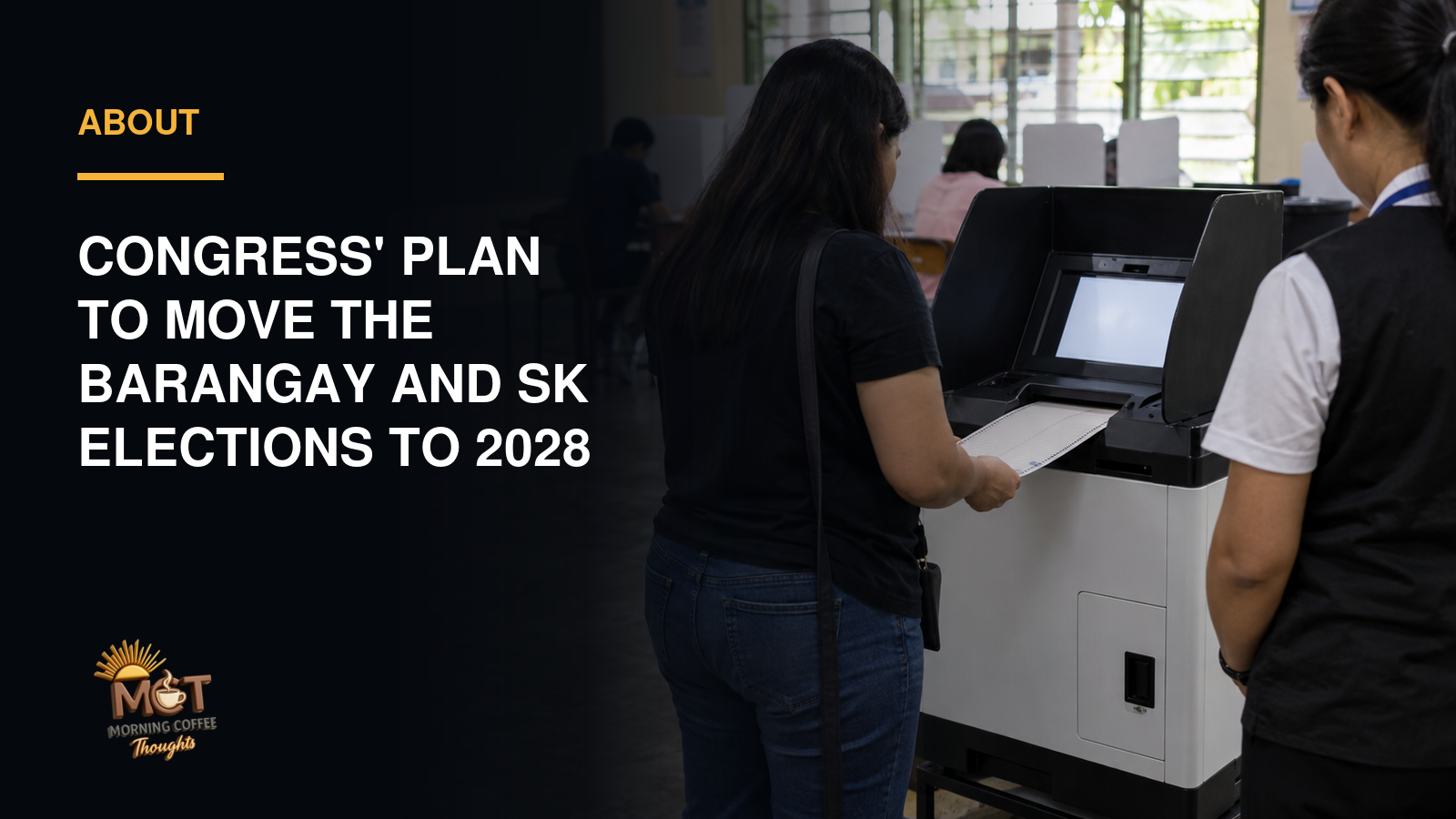
A Filipino voter feeds a paper ballot into an automated counting machine at a polling place.

Congress has moved closer to changing an election that is already scheduled for November 2, 2026. The House has approved House Bill 10971, while the Senate approved Senate Bill 2387 on third reading on September 14 by a vote of 13-5-0. Both measures seek five-year terms and a 2028 barangay and Sangguniang Kabataan election.

That does not mean the 2026 vote has already been cancelled. The chambers still need to settle any differences, approve the same final text and send it to the President. Until that process is completed, Republic Act 12232 remains in force.

Supporters say local officials need more time to finish projects. The harder question is whether Congress should make voters wait again after changing the election calendar only last year.

1

THE NEXT ELECTION IS STILL SET FOR NOVEMBER 2, 2026

Republic Act 12232 is the law today. It gives elected barangay and SK officials four-year terms and schedules the next regular elections for the first Monday of November 2026. This year, that date is November 2. Officials elected under the law are supposed to assume office on December 1.

The same law allows incumbents to remain until their successors are elected and qualified. That holdover rule prevents a vacancy if an election or assumption of office is delayed, but it does not by itself erase the scheduled vote.

A bill can pass one chamber or even both chambers and still fail to become law. The House and Senate votes make a change more likely, but Comelec cannot treat a proposal as if the President has already signed it.

Comelec has been preparing for the November election under the existing calendar, including a period for filing certificates of candidacy. Any claim that the election is already gone should therefore be checked against an enacted law, not a speech, a committee report or a chamber vote.

WHAT TO WATCH

One final bill with the same wording approved by both chambers, its transmission to Malacañang, presidential action and an official Comelec calendar issued after any new law takes effect.

2

THE HOUSE BILL WOULD KEEP INCUMBENTS IN OFFICE UNTIL 2028

The House approved House Bill 10971 on September 8 by a vote of 211-13-1. It proposes five-year terms and would move the next barangay and SK elections from November 2026 to November 2028. Elections would then be held every five years.

If enacted in that form, the practical result is not merely a new term for officials elected in the future. Current officials chosen in October 2023 would remain in office until successors elected in 2028 qualify. Voters who expected to choose new barangay and youth officials in 2026 would wait roughly two more years.

The House version also changes the future term limit for barangay officials from three consecutive terms under current law to two. SK officials would remain limited to one term. It treats the incumbents’ extended service as one completed term and bars those already serving a third consecutive barangay term from running for the same position in 2028.

The proposal also keeps unused money appropriated for the 2026 election available to Comelec for later election work. That does not eliminate the cost of preparations already made or explain every contract affected by a changed calendar.

WHAT TO WATCH

The final transition clause. Small changes in how a “term” is counted can decide who may run in 2028 and how long an incumbent may actually remain in office.

3

PASSAGE BY BOTH CHAMBERS IS NOT THE END OF THE PROCESS

The Senate vote was 13-5-0 on Senate Bill 2387. Its direction is similar to the House bill: five-year terms and a 2028 election. Similar headlines do not prove that every clause is identical.

The date can differ by a week. A term-limit rule can differ by one full term. The treatment of incumbents and unused Comelec funds can also change. Those details decide who stays, who may run again and when voters next get a choice.

If the House and Senate texts differ, a bicameral conference committee must settle them. Both chambers must then approve the same agreed version. The final bill can then go to the President, who may sign it, veto it or allow it to become law without his signature. A court challenge may still follow.

Only the final enrolled text will show exactly what both chambers agreed to. Until the legislative process is complete, the 2028 date is not settled.

WHAT TO WATCH

The official final Senate text, the bicameral conference report, each chamber’s ratification and the enrolled bill. A change in the election date, term limits or treatment of incumbents will affect who stays and who may run.

4

LONGER TERMS MAY HELP CONTINUITY, BUT THEY DELAY ACCOUNTABILITY

Supporters argue that short terms leave barangay officials too little time to learn the job, plan projects and deliver results before the next campaign begins. A five-year term could give local governments more continuity and reduce how often Comelec must organize a nationwide barangay and youth election.

That argument is not frivolous. Barangays handle services people feel directly, including local dispute settlement, disaster response, health programs and community records. Constant turnover can disrupt work, while repeated elections cost money and take time to prepare.

But the present proposal does more than set a longer term for the next group of winners. It would also postpone a vote that current law already promises in 2026. Incumbents would receive additional time without first asking voters for a new mandate.

Opponents call that a democratic cost. Longer continuity can also mean a longer wait to remove officials who perform poorly, entrench local political families or shut out new candidates. Congress changed the schedule in 2025; changing it again before the scheduled election demands a stronger explanation than administrative convenience.

WHAT TO WATCH

Whether lawmakers produce concrete evidence of costs, disrupted projects or election-preparation problems serious enough to justify extending current officials’ stay. General claims that longer terms are more efficient are not enough.

5

THE SUPREME COURT DID NOT GIVE CONGRESS A BLANK CHECK

The Supreme Court upheld Republic Act 12232 in 2025. The Court said Congress has authority to set the term of barangay and SK officials. It treated that law as a genuine term-setting measure because it created a regular and certain election schedule, not an open-ended cancellation of the vote.

Supporters of the new bills can point to that ruling because Congress may change terms and election cycles through a law. But the decision did not declare every future change automatically valid. In an earlier case, the Court struck down a barangay-election postponement after finding that Congress had not shown a good enough public reason for delaying the vote.

The new proposal raises a sharper question because the present four-year cycle is barely established and the November 2026 election is approaching. Although the bills describe a new five-year cycle, their immediate effect would be to let officials elected in 2023 remain until successors qualify after a 2028 vote.

Whether the Court would uphold that arrangement cannot be stated as fact. It would depend on the final law, the reasons Congress records and the arguments raised in an actual case.

WHAT TO WATCH

Congress’ final explanation, any petition filed with the Supreme Court and whether the government can show why another change serves voters rather than only the officials who benefit from staying longer.

BOTTOM LINE

Congress is close to moving the barangay and SK elections, but it has not finished the job. The November 2, 2026 vote remains the legal schedule until a new law takes effect. Longer terms may give local officials more time to work, yet this proposal also asks voters to surrender an election they were already promised. The final bill must therefore answer three simple questions: Why is the delay necessary now, exactly how long will current officials stay, and what protection remains for the public’s right to replace them?

GOOGLE PREFERRED SOURCES

FOLLOW MCT ON GOOGLE

Google’s Preferred Sources feature lets you choose publications you want Google to prioritize for you. Select “Add to Preferred Sources” to make MCT easier to find in Top Stories and other eligible Google results. This does not subscribe you to email.

← Back to MCT home

LATEST COMMENTARY

View all commentary →

SUPPORT MCT

HELP KEEP INDEPENDENT POLITICAL WRITING GOING.

Morning Coffee Thoughts is reader-supported. Contributions help pay for research tools, hosting, and the work required to verify and explain each development.

Choose the monthly support amount you are comfortable with.Continue through PayPal
Send support through GCash or Maya0969 314 4839