FIVE THINGS TO KNOW…

Short explainers published throughout the day.

10:45 PM7-minute read

ABOUT THE OCTOBER WATER-RATE INCREASES

Metro Manila households served by Maynilad and Manila Water will see slightly higher water charges beginning October 1. The announced increases are small for many residential customers, but the figures vary by concessionaire and consumption level. That makes it easy to misunderstand a notice expressed only in centavos per cubic meter.

Read the explainer →
7:21 AM6-minute read

ABOUT THE NOTE HANDED TO GIBO TEODORO IN SEOUL

Defense Secretary Gilberto “Gibo” Teodoro Jr. was answering questions at the Seoul Defense Dialogue on September 8 when a man handed him a note. He read it aloud, challenged its rejection of the 2016 South China Sea ruling and objected to being interrupted that way.

Read the explainer →
9:55 AM8-minute read

ABOUT EL NIÑO AND PREPARING FOR LESS RAIN

It can be raining outside while PAGASA warns about El Niño. That can sound confusing when the immediate problem is a wet road or a flooded field. The two warnings describe different periods: the weather happening now and the rainfall conditions that may develop over the coming months.

Read the explainer →
5:30 AM8-minute read

ABOUT THE NEW ARREST WARRANTS AGAINST ZALDY CO, MARTIN ROMUALDEZ AND TWO OTHERS

The Sandiganbayan has ordered the arrest of Zaldy Co, Martin Romualdez and two other accused in the plunder case filed on September 7. By Monday evening, authorities had served Romualdez's warrant and carried out booking procedures at Cardinal Santos Medical Center in San Juan. His arrest is a confirmed development; it does not establish that his three co-accused are also in custody.

Read the explainer →
3:15 PM8-minute read

ABOUT THE PLUNDER CASE AGAINST MARTIN ROMUALDEZ

The Office of the Ombudsman filed a plunder case against former House Speaker Martin Romualdez at the Sandiganbayan on September 7 over his alleged involvement in flood-control kickbacks. The accusations have now reached the court that will handle the criminal case. Romualdez denies wrongdoing and remains presumed innocent.

Read the explainer →
1:18 PM7-minute read

ABOUT THE NEW SWS POVERTY NUMBERS

Self-rated poverty and food poverty declined in June, but the figures also show how many Filipino families remain under pressure and why lower household budgets do not necessarily mean life became cheaper.

Read the explainer →
2:02 PM11-minute read

ABOUT THE CHILDREN'S SOCIAL MEDIA SAFETY ACT

House Bill No. 9965 would bar children below 13 from having social media accounts, require parental consent for users aged 13 to 17, regulate platform algorithms, and impose fines reaching P50 million. It is still being deliberated in the House.

Read the explainer →
12:02 PM7-minute read

ABOUT THE SEALED BIR BOX

Marcos authorized the BIR to comply with the Senate subpoena. That did not open the records to the public or prove the unexplained-wealth allegation.

Read the explainer →

MCT READER PULSE · MCT-PULSE-2026-008

MCT READER SURVEY

Senator-judges who are absent from the impeachment trial—including those on medical leave, in hiding, or detained—should still be allowed to cast a vote. Do you agree?Ang mga senator-judge na wala sa impeachment trial—kabilang ang naka-medical leave, nagtatago, o nakadetine—ay dapat payagan pa ring bumoto. Sang-ayon ka ba?

Senator-judge Erwin Tulfo asked the impeachment court to clarify who may validly vote and how absent members affect the constitutional two-thirds requirement. He cited one senator on medical leave abroad, one in hiding, and two in detention. The court had not resolved those questions when this survey opened. This survey asks for your view; it does not state what the Constitution or the impeachment rules require.

Background: Senate impeachment records, INQUIRER.net, and MindaNews.

This is an informal survey of verified MCT readers who choose to participate. It is not nationally representative.

Open the shareable survey page →
View previous survey results →
Checking your reader session…

September 15, 2026 · 10:20 PM9-minute read

ABOUT THE DOJ SUBPOENA TO ROBIN PADILLA OVER BATO DELA ROSA’S DEPARTURE

A DOJ subpoena requires the senator to answer an obstruction complaint. It is not an arrest warrant, a criminal charge in court or a conviction.

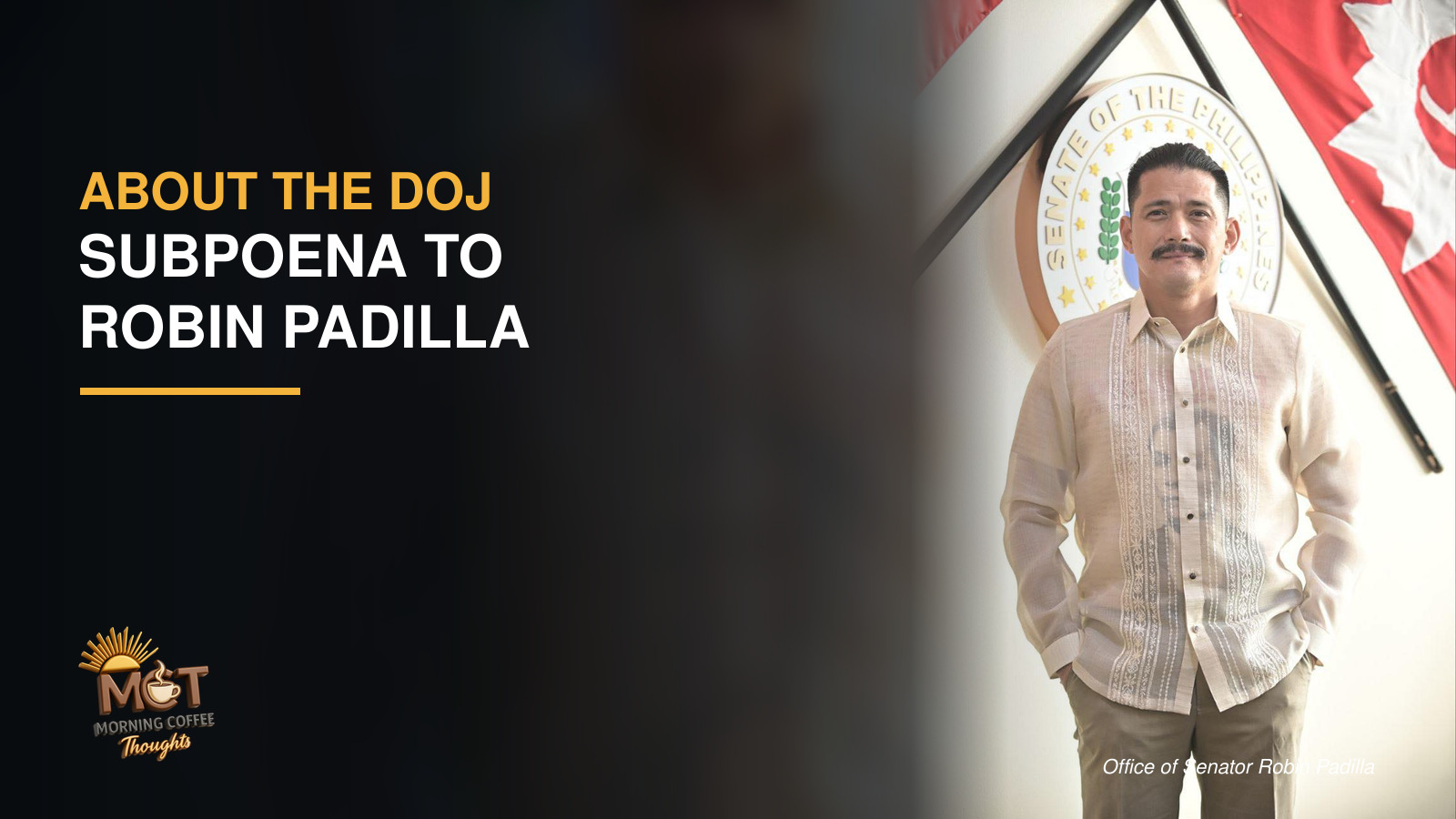
Senator Robin Padilla in a barong Tagalog before the Senate seal.

The Department of Justice has served Senator Robin Padilla a subpoena over the allegation that he helped Senator Ronald “Bato” dela Rosa leave the Senate while authorities were looking for Dela Rosa under an International Criminal Court arrest warrant.

The subpoena moves the complaint into a formal preliminary investigation. It does not mean Padilla has been charged in court, found liable or convicted. Prosecutors must first hear the respondents, examine the evidence and decide whether the case should proceed.

Padilla has said Dela Rosa merely rode with him and that he did not help the senator escape. The investigation now has to separate what is already visible—Dela Rosa leaving in a vehicle registered to Padilla—from what the law still requires the government to prove.

1

THE SUBPOENA REQUIRES AN ANSWER; IT IS NOT A WARRANT

A DOJ subpoena directs Padilla to appear in the preliminary investigation and submit his counter-affidavit and supporting evidence. Reports say hearings are set for September 25 and October 9. Other respondents connected to the incident have also been summoned.

This is not an arrest warrant. It does not authorize police to jail Padilla, and it is not a court’s finding that he committed a crime. At this stage, prosecutors are evaluating a complaint filed by the police Criminal Investigation and Detection Group.

Padilla may deny the allegations, question the evidence, submit documents and identify witnesses. After considering both sides, prosecutors may dismiss the complaint or find sufficient evidence to file an Information in court. Only then would a criminal case begin before a judge.

WHAT TO WATCH

Whether Padilla personally appears or submits through counsel, the evidence attached to his counter-affidavit and the DOJ resolution after the preliminary investigation.

2

THE COMPLAINT IS ABOUT WHAT HAPPENED AFTER THE SENATE SHOOTING

Police said video showed Dela Rosa and Padilla leaving the Senate compound in a white Toyota Fortuner registered to Padilla at about 2:30 a.m. on May 14. This followed the shooting incident outside the Senate and the breakdown of the protective-custody arrangement under which Dela Rosa had remained inside the building.

The CIDG alleges that this was not an innocent ride but a coordinated effort to move Dela Rosa away from authorities. Investigators have also referred to another vehicle allegedly following as an escort or backup. Those assertions remain allegations unless the evidence establishes who planned the movement, who knew its purpose and what each person actually did.

Padilla has not denied being with Dela Rosa. His position is that Dela Rosa simply hitched a ride and that he did not help him escape. That makes purpose and knowledge central: the same physical act can look very different under the law depending on what Padilla knew and intended at the time.

WHAT TO WATCH

The complete surveillance footage, communications before and after the departure, testimony from Senate security personnel and evidence identifying where the vehicles went after leaving the compound.

3

PD 1829 REQUIRES MORE THAN PROOF OF A RIDE

The complaint invokes Presidential Decree 1829, which punishes a person who knowingly or willfully obstructs, delays or frustrates the apprehension or prosecution of a criminal offender through specific acts. One listed act is harboring, concealing or facilitating the escape of a person whom the accused knows—or has reasonable grounds to believe—committed an offense under existing penal laws, when the purpose is to prevent arrest, prosecution or conviction.

Prosecutors therefore need more than proof that Padilla owned the vehicle or sat beside Dela Rosa. They must identify the specific prohibited act, show the required knowledge or reasonable belief and establish that the act was done to obstruct apprehension or prosecution.

The case also presents a legal question that cannot be skipped: Dela Rosa was being sought under an ICC warrant, while the complaint against Padilla is being pursued under Philippine law. Prosecutors must explain how the facts surrounding the international warrant satisfy every element of PD 1829, including the law’s reference to an offense under existing penal laws. The Philippines has a domestic law covering crimes against humanity, but that does not remove the government’s duty to prove the elements in this particular complaint.

WHAT TO WATCH

The exact subsection charged, the DOJ’s treatment of the ICC warrant and domestic law, and whether the evidence shows deliberate assistance rather than association or transport alone.

4

PADILLA’S PUBLIC OFFICE COULD MAKE THE CONSEQUENCES MORE SERIOUS

PD 1829 applies to private citizens and public officials. Section 2 says a public official who commits one of the prohibited acts may also face perpetual disqualification from public office in addition to the criminal penalty provided by the decree.

That consequence is not automatic merely because Padilla is a senator or because a complaint was filed. It would depend on a valid prosecution and conviction. The DOJ cannot impose criminal guilt or disqualification through a subpoena or preliminary-investigation resolution.

His office does, however, make the allegation more serious in public terms. A senator is not exempt from criminal investigation, and Senate premises cannot turn a private vehicle into legal immunity. At the same time, political anger cannot replace proof of what Padilla knew, intended and did.

WHAT TO WATCH

Whether prosecutors treat his status as a public official as part of the alleged offense, and whether any separate Senate ethics or disciplinary proceeding is initiated.

5

THE DOJ RESOLUTION WILL DECIDE WHETHER THIS REACHES COURT

After the counter-affidavits and any permitted replies are submitted, the prosecution panel will evaluate whether the evidence is strong enough to file a criminal case. Current DOJ rules require more than the existence of an accusation: prosecutors must see evidence that, if left unanswered, gives them reasonable certainty that they could obtain a conviction.

If the panel dismisses the complaint, that would end this stage unless the decision is reviewed or challenged through the available remedies. If it finds sufficient evidence, prosecutors may file an Information in the proper court. A judge would then handle the criminal case, and Padilla would remain presumed innocent unless proven guilty.

The subpoena is therefore important because it forces the allegation into a process with sworn answers and evidence. It is not the finish line. The decisive question is whether investigators can prove deliberate obstruction and answer the legal issues created by the ICC context.

WHAT TO WATCH

Compliance with the September 25 and October 9 settings, the panel’s written resolution, any motion for reconsideration or review, and whether an Information is eventually filed in court.

BOTTOM LINE

Robin Padilla has been summoned to answer a serious allegation, but he has not been charged or convicted. The known footage may establish that Dela Rosa left the Senate in Padilla’s vehicle. It does not, on its own, establish every element of obstruction of justice. Prosecutors must still prove knowledge, purpose and a specific act prohibited by PD 1829—and explain how the ICC warrant fits the domestic-law requirement. The subpoena matters because that test has finally begun.

GOOGLE PREFERRED SOURCES

FOLLOW MCT ON GOOGLE

Google’s Preferred Sources feature lets you choose publications you want Google to prioritize for you. Select “Add to Preferred Sources” to make MCT easier to find in Top Stories and other eligible Google results. This does not subscribe you to email.

← Back to MCT home

LATEST COMMENTARY

View all commentary →

SUPPORT MCT

HELP KEEP INDEPENDENT POLITICAL WRITING GOING.

Morning Coffee Thoughts is reader-supported. Contributions help pay for research tools, hosting, and the work required to verify and explain each development.

Choose the monthly support amount you are comfortable with.Continue through PayPal
Send support through GCash or Maya0969 314 4839