LATEST COMMENTARY

View all commentary →

FIVE THINGS TO KNOW

10:45 PM7-minute read

ABOUT THE OCTOBER WATER-RATE INCREASES

Metro Manila households served by Maynilad and Manila Water will see slightly higher water charges beginning October 1. The announced increases are small for many residential customers, but the figures vary by concessionaire and consumption level. That makes it easy to misunderstand a notice expressed only in centavos per cubic meter.

Read the explainer →
7:21 AM6-minute read

ABOUT THE NOTE HANDED TO GIBO TEODORO IN SEOUL

Defense Secretary Gilberto “Gibo” Teodoro Jr. was answering questions at the Seoul Defense Dialogue on September 8 when a man handed him a note. He read it aloud, challenged its rejection of the 2016 South China Sea ruling and objected to being interrupted that way.

Read the explainer →
9:55 AM8-minute read

ABOUT EL NIÑO AND PREPARING FOR LESS RAIN

It can be raining outside while PAGASA warns about El Niño. That can sound confusing when the immediate problem is a wet road or a flooded field. The two warnings describe different periods: the weather happening now and the rainfall conditions that may develop over the coming months.

Read the explainer →
5:30 AM8-minute read

ABOUT THE NEW ARREST WARRANTS AGAINST ZALDY CO, MARTIN ROMUALDEZ AND TWO OTHERS

The Sandiganbayan has ordered the arrest of Zaldy Co, Martin Romualdez and two other accused in the plunder case filed on September 7. By Monday evening, authorities had served Romualdez's warrant and carried out booking procedures at Cardinal Santos Medical Center in San Juan. His arrest is a confirmed development; it does not establish that his three co-accused are also in custody.

Read the explainer →
3:15 PM8-minute read

ABOUT THE PLUNDER CASE AGAINST MARTIN ROMUALDEZ

The Office of the Ombudsman filed a plunder case against former House Speaker Martin Romualdez at the Sandiganbayan on September 7 over his alleged involvement in flood-control kickbacks. The accusations have now reached the court that will handle the criminal case. Romualdez denies wrongdoing and remains presumed innocent.

Read the explainer →
1:18 PM7-minute read

ABOUT THE NEW SWS POVERTY NUMBERS

Self-rated poverty and food poverty declined in June, but the figures also show how many Filipino families remain under pressure and why lower household budgets do not necessarily mean life became cheaper.

Read the explainer →
2:02 PM11-minute read

ABOUT THE CHILDREN'S SOCIAL MEDIA SAFETY ACT

House Bill No. 9965 would bar children below 13 from having social media accounts, require parental consent for users aged 13 to 17, regulate platform algorithms, and impose fines reaching P50 million. It is still being deliberated in the House.

Read the explainer →
12:02 PM7-minute read

ABOUT THE SEALED BIR BOX

Marcos authorized the BIR to comply with the Senate subpoena. That did not open the records to the public or prove the unexplained-wealth allegation.

Read the explainer →

MCT READER PULSE · MCT-PULSE-2026-010

MCT READER SURVEY

Should Vice President Sara Duterte resign while her impeachment trial is ongoing?

Vote Now →

This is an informal survey of people who choose to participate. It is not a scientific or nationally representative sample.

View previous survey results →
September 24, 2026 · 8:00 AM7-minute read

ABOUT THE EU-PHILIPPINES FREE TRADE AGREEMENT AND WHAT COMES NEXT

What has been agreed, what is not yet final, and what Filipino consumers, workers, farmers, and businesses should watch.

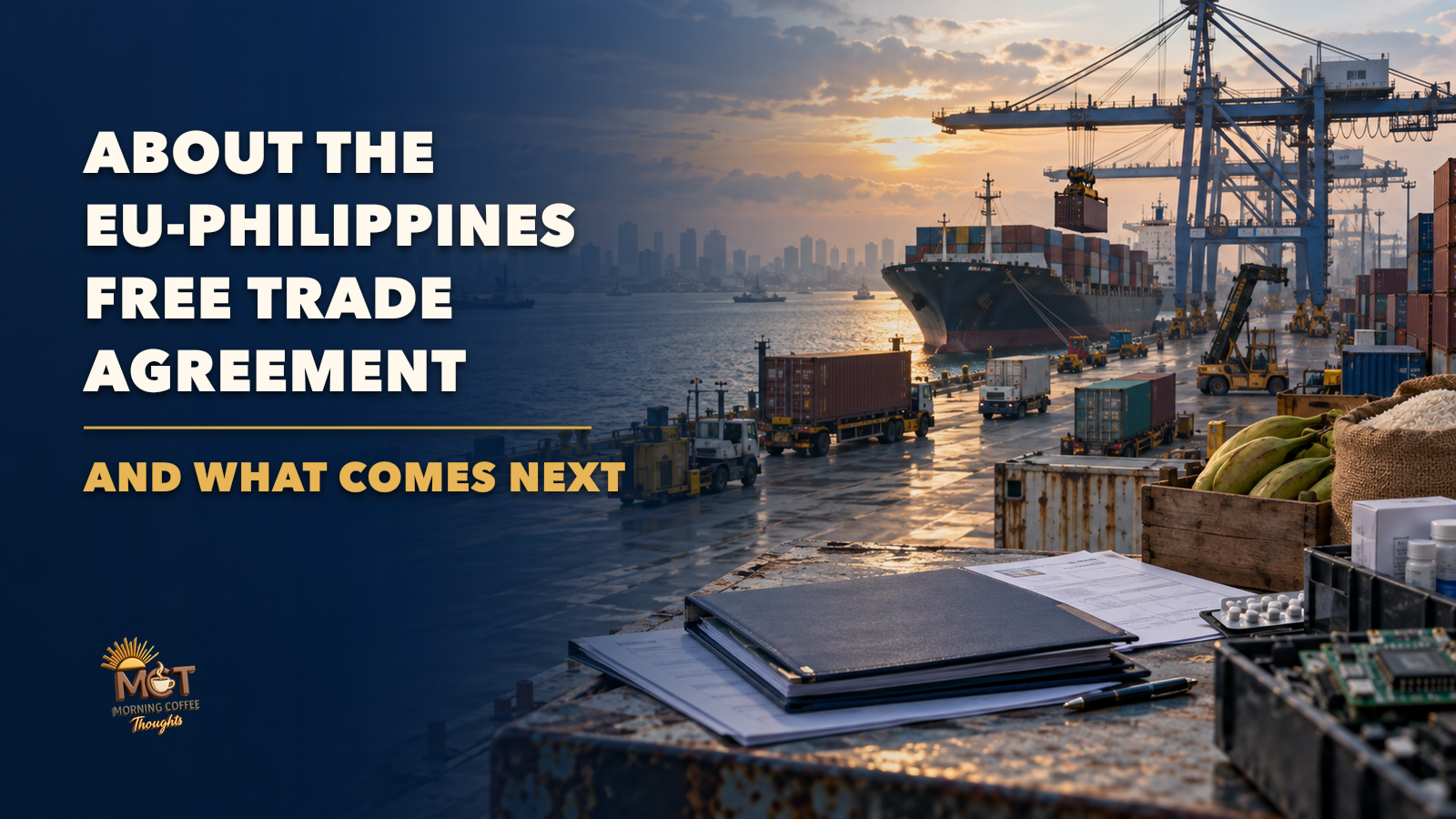
MCT cover about the EU-Philippines free trade agreement, showing Manila port operations, cargo, trade documents, agricultural goods, medicine, and electronics.

The Philippines and the European Union announced on September 22 that they had reached “substantial agreement” on a free trade agreement. The announcement sounds final. It is not.

Most of the major political and commercial terms appear to be in place, but negotiators still have technical details to settle. The text must also pass legal review, signing, and the required approval processes before its provisions can take effect.

The proposed agreement reaches far beyond cheaper imported goods. It covers services, investment, government procurement, digital trade, food-safety rules, intellectual property, energy and raw materials, labor rights, and environmental commitments.

Here are five things to know about what has been agreed, what could change, and what Filipino consumers, workers, farmers, and businesses should watch.

1

1. “SUBSTANTIAL AGREEMENT” DOES NOT MEAN THE DEAL IS ALREADY IN FORCE

The announcement marks a political breakthrough after the two sides resumed negotiations in March 2024. The European Commission says the agreement is now on a path toward final conclusion, while the joint EU-Philippines statement instructed negotiating teams to finish the remaining work as soon as possible.

EU officials also clarified that the agreement is still preliminary. Negotiators have to determine implementation provisions and finish technical details. The full legal text has not yet been published for the public to examine.

After the text is settled, the EU process normally requires the European Commission to submit it to the Council of the European Union. The Council decides on signing, the European Parliament considers whether to give consent, and the Council later decides whether to conclude the agreement.

The Philippines must also complete its constitutional and legal process. If the final instrument is submitted as a treaty or international agreement under Article VII, Section 21 of the Constitution, concurrence by at least two-thirds of all senators would be required.

For now, businesses should not change prices, contracts, or customs calculations on the assumption that the agreement already applies.

WHAT TO WATCH

Watch for publication of the final legal text, a signing date, the route chosen for Philippine approval, and a clear effective date. Those steps will show when the deal moves from an announcement to an enforceable agreement.

2

2. THE AGREEMENT WOULD REMOVE MANY TARIFFS, BUT THE PRODUCT-BY-PRODUCT SCHEDULE IS STILL IMPORTANT

The European Commission says the agreement would liberalize more than 94 percent of tariff lines covering over 97 percent of trade between the two sides. “Liberalize” can mean immediate removal for some tariffs and a gradual reduction for others.

The final schedules will show which products receive zero tariffs immediately, which are phased down over several years, and which sensitive products receive longer protection or remain excluded. Those details can affect food prices, farm income, factory orders, and the cost of imported equipment.

The EU currently sells the Philippines machinery, transport equipment, medicines, medical devices, meat, dairy products, and spirits. Philippine exports to Europe include electronics and machinery, coconut oil, prepared fish such as canned tuna, and other food and industrial products.

Lower tariffs can make Philippine goods more competitive in Europe and reduce the cost of some European products here. They can also expose local producers to stronger competition. A tariff headline cannot show who gains or loses until the schedules, transition periods, quotas, and safeguards are public.

WHAT TO WATCH

Watch the tariff treatment of pork, poultry, dairy, rice and other farm goods; Philippine exports such as electronics, coconut products, and tuna; and any safeguard that allows temporary action when import surges seriously harm a local industry.

3

3. THE PHILIPPINES ALREADY HAS GSP+ ACCESS, BUT AN FTA WOULD BE BROADER AND MORE PERMANENT

The Philippines has received preferential access to the EU market through the Generalised Scheme of Preferences Plus, or GSP+, since 2015. The program removes tariffs from many eligible exports in exchange for commitments tied to 27 international conventions on human rights, labor rights, environmental protection, and good governance.

An EU assessment reported that Philippine exporters used 80.4 percent of the GSP+ preferences available to them in 2024, the highest rate recorded for the country. It estimated that the preferences saved about €155 million in tariffs that year.

GSP+ is a unilateral EU program. Eligibility can change when a country crosses the program's income limits or fails to meet its obligations. A negotiated free trade agreement can cover more products and services and can provide a longer-term set of rules accepted by both sides.

The FTA would not simply replace one tariff list with another. It would add rules for services, investment, public procurement, digital transactions, intellectual property, food standards, and dispute procedures. It also includes commitments connected to labor, human rights, climate, and the Paris Agreement.

WHAT TO WATCH

Watch how the final deal handles the transition from GSP+, whether exporters keep continuous access while the FTA is being approved, and whether the final labor and human-rights provisions contain workable monitoring and enforcement procedures.

4

4. THE DEAL CAN CREATE OPPORTUNITIES, BUT THE BENEFITS WILL NOT ARRIVE AUTOMATICALLY

The EU and Philippine governments say the agreement can expand trade, investment, and jobs. Those are projections based on improved market access. Companies still have to produce goods that meet European standards, prove where their products came from, find buyers, handle shipping costs, and compete on price and quality.

Large exporters usually have legal, customs, and compliance teams. Smaller firms and farmers may need help with product testing, certification, traceability, packaging, financing, and European buyer requirements. A tariff reduction has limited value for a producer who cannot satisfy those conditions.

Consumers may see lower prices for some imports, but that will depend on the size and timing of tariff cuts, the peso-euro exchange rate, freight costs, taxes, distributor pricing, and local competition. No government can promise that every tariff saving will be passed on at the store.

Local producers may also face stronger competition from European goods and services. Transition periods, safeguards, competition policy, and government support will influence whether weaker sectors have time to adjust.

WHAT TO WATCH

Watch whether the government publishes sector-by-sector impact estimates and practical support for small exporters, farmers, and firms facing import competition. Also watch whether promised consumer savings appear in actual retail prices after the deal takes effect.

5

5. GOVERNMENT PROCUREMENT AND REGULATORY RULES MAY BE AS IMPORTANT AS TARIFFS

The planned agreement would open parts of Philippine government procurement to European bidders for the first time under an EU trade agreement. It would also create rules for services, investment, digital trade, sanitary and phytosanitary measures, technical standards, intellectual property, and geographical indications.

Government procurement affects large contracts funded by taxpayers. More bidders can increase competition and bring in specialized technology, but the rules must still protect transparency, accountability, security needs, and lawful opportunities for Filipino suppliers.

Food-safety and technical rules can help exporters when requirements are clear and decisions are timely. They can also become costly barriers if small producers lack laboratories, inspectors, records, or certification support.

The digital provisions deserve close reading because they can affect cross-border services, consumer rights, and data privacy. The intellectual-property chapter can affect medicines, creative work, brands, and the protection of named regional products.

These provisions will shape how the agreement works in daily life even when no consumer sees a customs form.

WHAT TO WATCH

Watch which public contracts are opened, what exceptions remain for national security and public services, how data privacy is protected, whether medicine access is affected, and whether small Philippine suppliers receive a fair chance to compete.

BOTTOM LINE

The EU-Philippines free trade announcement is a serious advance, but it is still an agreement under completion. No tariff changed on September 22, and no store price should be presented as a result of the deal yet.

The potential reach is wide. Philippine exporters could gain broader and more stable access to a large market. Consumers and businesses could pay less for some European products and equipment. Investment and services could expand.

There will also be pressure on local sectors that face stronger competition, and smaller producers may struggle to meet the standards needed to use the new access. Procurement, data, food safety, intellectual property, labor, and environmental provisions may affect people as much as the tariff cuts.

The public needs the full text, the product schedules, and honest sector-by-sector estimates before anyone declares a winner. The agreement should be judged by the rules that are finally signed, how they are carried out, and whether the gains reach more than the biggest companies on either side.

GOOGLE PREFERRED SOURCES

FOLLOW MCT ON GOOGLE

Google’s Preferred Sources feature lets you choose publications you want Google to prioritize for you. Select “Add to Preferred Sources” to make MCT easier to find in Top Stories and other eligible Google results. This does not subscribe you to email.

← Back to MCT home

SUPPORT MCT

HELP KEEP INDEPENDENT POLITICAL WRITING GOING.

Morning Coffee Thoughts is reader-supported. Contributions help pay for research tools, hosting, and the work required to verify and explain each development.

Choose the monthly support amount you are comfortable with.Continue through PayPal
Send support through GCash or Maya0969 314 4839