LATEST COMMENTARY

View all commentary →

FIVE THINGS TO KNOW

10:45 PM7-minute read

ABOUT THE OCTOBER WATER-RATE INCREASES

Metro Manila households served by Maynilad and Manila Water will see slightly higher water charges beginning October 1. The announced increases are small for many residential customers, but the figures vary by concessionaire and consumption level. That makes it easy to misunderstand a notice expressed only in centavos per cubic meter.

Read the explainer →
7:21 AM6-minute read

ABOUT THE NOTE HANDED TO GIBO TEODORO IN SEOUL

Defense Secretary Gilberto “Gibo” Teodoro Jr. was answering questions at the Seoul Defense Dialogue on September 8 when a man handed him a note. He read it aloud, challenged its rejection of the 2016 South China Sea ruling and objected to being interrupted that way.

Read the explainer →
9:55 AM8-minute read

ABOUT EL NIÑO AND PREPARING FOR LESS RAIN

It can be raining outside while PAGASA warns about El Niño. That can sound confusing when the immediate problem is a wet road or a flooded field. The two warnings describe different periods: the weather happening now and the rainfall conditions that may develop over the coming months.

Read the explainer →
5:30 AM8-minute read

ABOUT THE NEW ARREST WARRANTS AGAINST ZALDY CO, MARTIN ROMUALDEZ AND TWO OTHERS

The Sandiganbayan has ordered the arrest of Zaldy Co, Martin Romualdez and two other accused in the plunder case filed on September 7. By Monday evening, authorities had served Romualdez's warrant and carried out booking procedures at Cardinal Santos Medical Center in San Juan. His arrest is a confirmed development; it does not establish that his three co-accused are also in custody.

Read the explainer →
3:15 PM8-minute read

ABOUT THE PLUNDER CASE AGAINST MARTIN ROMUALDEZ

The Office of the Ombudsman filed a plunder case against former House Speaker Martin Romualdez at the Sandiganbayan on September 7 over his alleged involvement in flood-control kickbacks. The accusations have now reached the court that will handle the criminal case. Romualdez denies wrongdoing and remains presumed innocent.

Read the explainer →
1:18 PM7-minute read

ABOUT THE NEW SWS POVERTY NUMBERS

Self-rated poverty and food poverty declined in June, but the figures also show how many Filipino families remain under pressure and why lower household budgets do not necessarily mean life became cheaper.

Read the explainer →
2:02 PM11-minute read

ABOUT THE CHILDREN'S SOCIAL MEDIA SAFETY ACT

House Bill No. 9965 would bar children below 13 from having social media accounts, require parental consent for users aged 13 to 17, regulate platform algorithms, and impose fines reaching P50 million. It is still being deliberated in the House.

Read the explainer →
12:02 PM7-minute read

ABOUT THE SEALED BIR BOX

Marcos authorized the BIR to comply with the Senate subpoena. That did not open the records to the public or prove the unexplained-wealth allegation.

Read the explainer →

MCT READER PULSE · MCT-PULSE-2026-010

MCT READER SURVEY

Should Vice President Sara Duterte resign while her impeachment trial is ongoing?

Vote Now →

This is an informal survey of people who choose to participate. It is not a scientific or nationally representative sample.

View previous survey results →
September 24, 2026 · 7:00 PM6-minute read

ABOUT THE COA FINDINGS ON OVP RELIEF OPERATIONS

What COA found, what the OVP must explain, and what accountability should look like next.

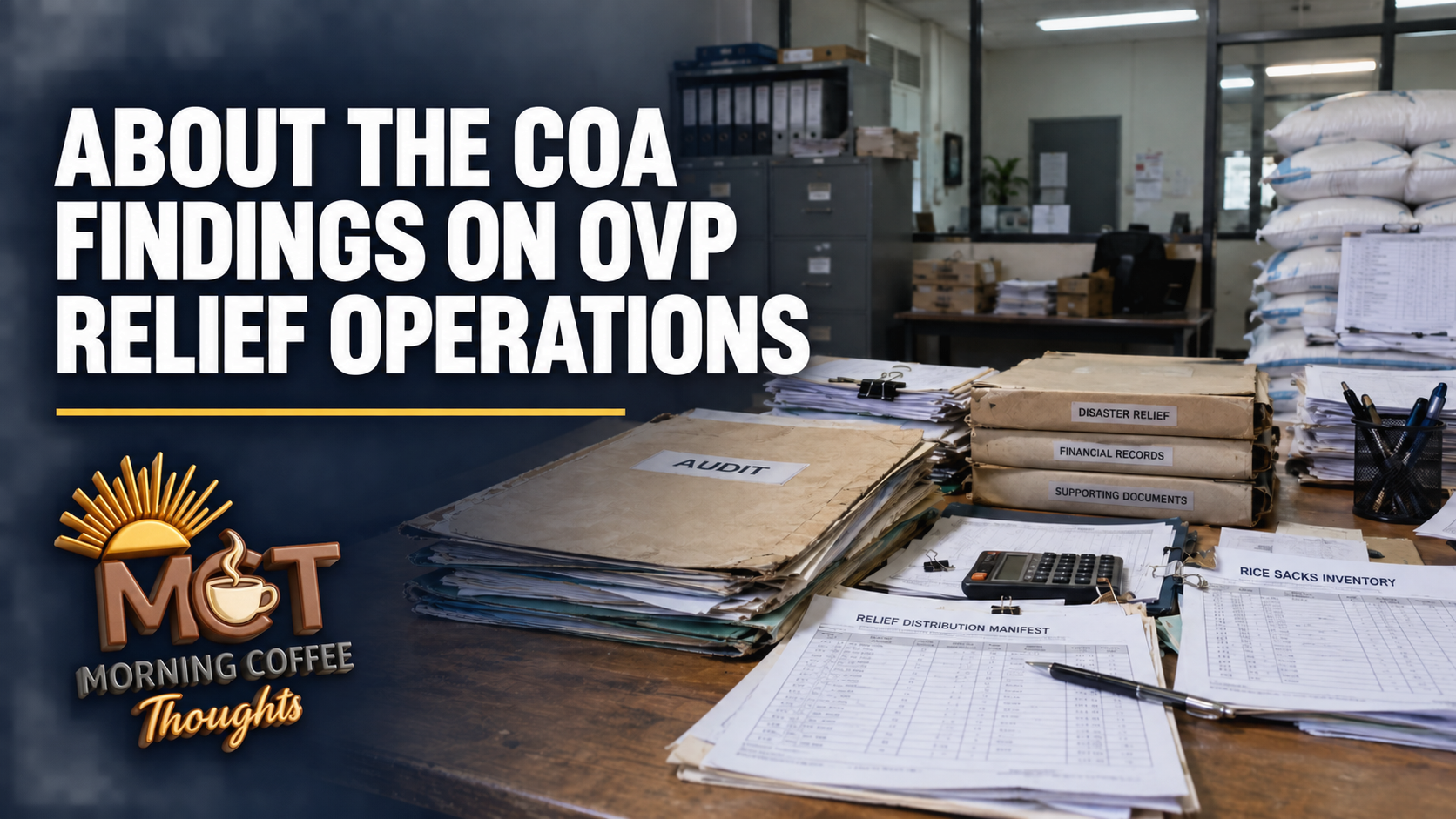
Audit folders, relief distribution records, rice sacks, and financial documents on a worn Philippine government office table.

The Commission on Audit found documentation and control problems in nearly ₱168 million worth of relief operations linked to the Office of the Vice President in 2025. The finding matters because relief work uses public money and because records are supposed to show who received assistance, what was distributed, and whether the spending followed the rules.

The report is an audit finding, not a criminal conviction. The OVP still has the opportunity to answer the observations, provide missing records, and explain or correct any transactions that did not meet the requirements.

Here are five things to know.

1

1. COA FLAGGED CONTROL AND DOCUMENTATION DEFICIENCIES

COA's 273-page report identified inconsistencies, deviations from required procedures, and missing or incomplete records in the OVP's 2025 relief operations. The reported amount was nearly ₱168 million.

An audit observation does not by itself prove that money was stolen or that every distribution was improper. It does mean the agency's records did not give auditors the level of support needed to establish that the operations were properly planned, documented, and accounted for.

WHAT TO WATCH

Watch the OVP's formal response, the supporting documents it submits, and COA's assessment of whether the observations are resolved or remain open.

2

2. SOME BENEFICIARY AND PRE-OPERATION RECORDS WERE INCOMPLETE

COA said 33,980 beneficiaries connected to about ₱25.27 million in assistance did not have complete pre-operation documents. The report also cited gaps involving situation reports, mission orders, beneficiary or distribution records, and other paperwork used to support relief activity.

These documents are not just office formalities. They help establish why an operation was needed, who was authorized to carry it out, what was bought or distributed, and whether the people listed actually received the assistance.

WHAT TO WATCH

Look for a clear, operation-by-operation explanation of the missing records and whether the OVP can now produce reliable beneficiary, delivery, and authorization documents.

3

3. THE ISSUE IS ACCOUNTABILITY, NOT A FINAL FINDING OF GUILT

COA's constitutional role is to examine how public funds and property are used and to require agencies to explain or correct deficiencies. Its observations can lead to notices, refunds, administrative action, or further investigation, but the audit report itself is not a court judgment.

That distinction matters. It is inaccurate to turn a documentation finding into a proven corruption conviction. It is equally inaccurate to dismiss the finding as harmless paperwork when the records are needed to verify whether relief reached the intended beneficiaries.

WHAT TO WATCH

Separate what COA documented, what the OVP admits or disputes, what it can prove with records, and whether another body makes a finding of administrative or criminal liability.

4

4. THE OVP NEEDS TO SHOW HOW THE OPERATIONS WERE CONTROLLED

The OVP should explain how it identified beneficiaries, approved relief missions, purchased or received goods, recorded distributions, and reconciled the money and supplies after each activity. If records were lost or incomplete, it should say what happened and what replacement evidence exists.

The response should also make clear whether the deficiencies were isolated mistakes, a repeated system problem, or a consequence of emergency conditions. Speed can matter in disaster response, but emergency relief still needs a traceable record after the immediate danger passes.

WHAT TO WATCH

Watch for a complete response rather than a general denial: the public should be able to see which observation is being answered and what document or corrective action supports the answer.

5

5. BETTER RECORDS SHOULD PROTECT BOTH RECIPIENTS AND PUBLIC OFFICIALS

A reliable relief system protects recipients from being omitted, duplicated, or used as names on paper without receiving help. It also protects honest workers and officials by showing what they did, when they did it, and why the spending was necessary.

The practical fix is not simply more forms. It is a usable chain of records: a needs assessment, an approved operation, a verified list, proof of delivery or receipt, a financial reconciliation, and an audit trail that can be checked without guessing.

WHAT TO WATCH

Look for a public corrective plan, consistent records for later operations, and follow-up from COA showing whether the OVP's controls actually improved.

BOTTOM LINE

The COA report raises a serious question about whether the OVP's 2025 relief operations were documented and controlled well enough to verify the use of nearly ₱168 million in public funds. It does not by itself establish a criminal conviction.

The next meaningful test is the response: can the OVP produce the records, explain the gaps, correct what needs correction, and show that future relief work can be traced from need to delivery? Until that happens, the public should treat the audit observations as unresolved accountability questions, not as either a final verdict or something to ignore.

GOOGLE PREFERRED SOURCES

FOLLOW MCT ON GOOGLE

Google’s Preferred Sources feature lets you choose publications you want Google to prioritize for you. Select “Add to Preferred Sources” to make MCT easier to find in Top Stories and other eligible Google results. This does not subscribe you to email.

← Back to MCT home

SUPPORT MCT

HELP KEEP INDEPENDENT POLITICAL WRITING GOING.

Morning Coffee Thoughts is reader-supported. Contributions help pay for research tools, hosting, and the work required to verify and explain each development.

Choose the monthly support amount you are comfortable with.Continue through PayPal
Send support through GCash or Maya0969 314 4839