LATEST COMMENTARY

View all commentary →

FIVE THINGS TO KNOW

10:45 PM7-minute read

ABOUT THE OCTOBER WATER-RATE INCREASES

Metro Manila households served by Maynilad and Manila Water will see slightly higher water charges beginning October 1. The announced increases are small for many residential customers, but the figures vary by concessionaire and consumption level. That makes it easy to misunderstand a notice expressed only in centavos per cubic meter.

Read the explainer →
7:21 AM6-minute read

ABOUT THE NOTE HANDED TO GIBO TEODORO IN SEOUL

Defense Secretary Gilberto “Gibo” Teodoro Jr. was answering questions at the Seoul Defense Dialogue on September 8 when a man handed him a note. He read it aloud, challenged its rejection of the 2016 South China Sea ruling and objected to being interrupted that way.

Read the explainer →
9:55 AM8-minute read

ABOUT EL NIÑO AND PREPARING FOR LESS RAIN

It can be raining outside while PAGASA warns about El Niño. That can sound confusing when the immediate problem is a wet road or a flooded field. The two warnings describe different periods: the weather happening now and the rainfall conditions that may develop over the coming months.

Read the explainer →
5:30 AM8-minute read

ABOUT THE NEW ARREST WARRANTS AGAINST ZALDY CO, MARTIN ROMUALDEZ AND TWO OTHERS

The Sandiganbayan has ordered the arrest of Zaldy Co, Martin Romualdez and two other accused in the plunder case filed on September 7. By Monday evening, authorities had served Romualdez's warrant and carried out booking procedures at Cardinal Santos Medical Center in San Juan. His arrest is a confirmed development; it does not establish that his three co-accused are also in custody.

Read the explainer →
3:15 PM8-minute read

ABOUT THE PLUNDER CASE AGAINST MARTIN ROMUALDEZ

The Office of the Ombudsman filed a plunder case against former House Speaker Martin Romualdez at the Sandiganbayan on September 7 over his alleged involvement in flood-control kickbacks. The accusations have now reached the court that will handle the criminal case. Romualdez denies wrongdoing and remains presumed innocent.

Read the explainer →
1:18 PM7-minute read

ABOUT THE NEW SWS POVERTY NUMBERS

Self-rated poverty and food poverty declined in June, but the figures also show how many Filipino families remain under pressure and why lower household budgets do not necessarily mean life became cheaper.

Read the explainer →
2:02 PM11-minute read

ABOUT THE CHILDREN'S SOCIAL MEDIA SAFETY ACT

House Bill No. 9965 would bar children below 13 from having social media accounts, require parental consent for users aged 13 to 17, regulate platform algorithms, and impose fines reaching P50 million. It is still being deliberated in the House.

Read the explainer →
12:02 PM7-minute read

ABOUT THE SEALED BIR BOX

Marcos authorized the BIR to comply with the Senate subpoena. That did not open the records to the public or prove the unexplained-wealth allegation.

Read the explainer →

MCT READER PULSE · MCT-PULSE-2026-010

MCT READER SURVEY

Should Vice President Sara Duterte resign while her impeachment trial is ongoing?

Vote Now →

This is an informal survey of people who choose to participate. It is not a scientific or nationally representative sample.

View previous survey results →
September 24, 2026 · 6:30 PM7-minute read

ABOUT THE EXPANDED SCHOOL VOUCHER BILL AND WHO IT COULD HELP

What the ratified voucher bill would change, who may qualify, and what families still need to know.

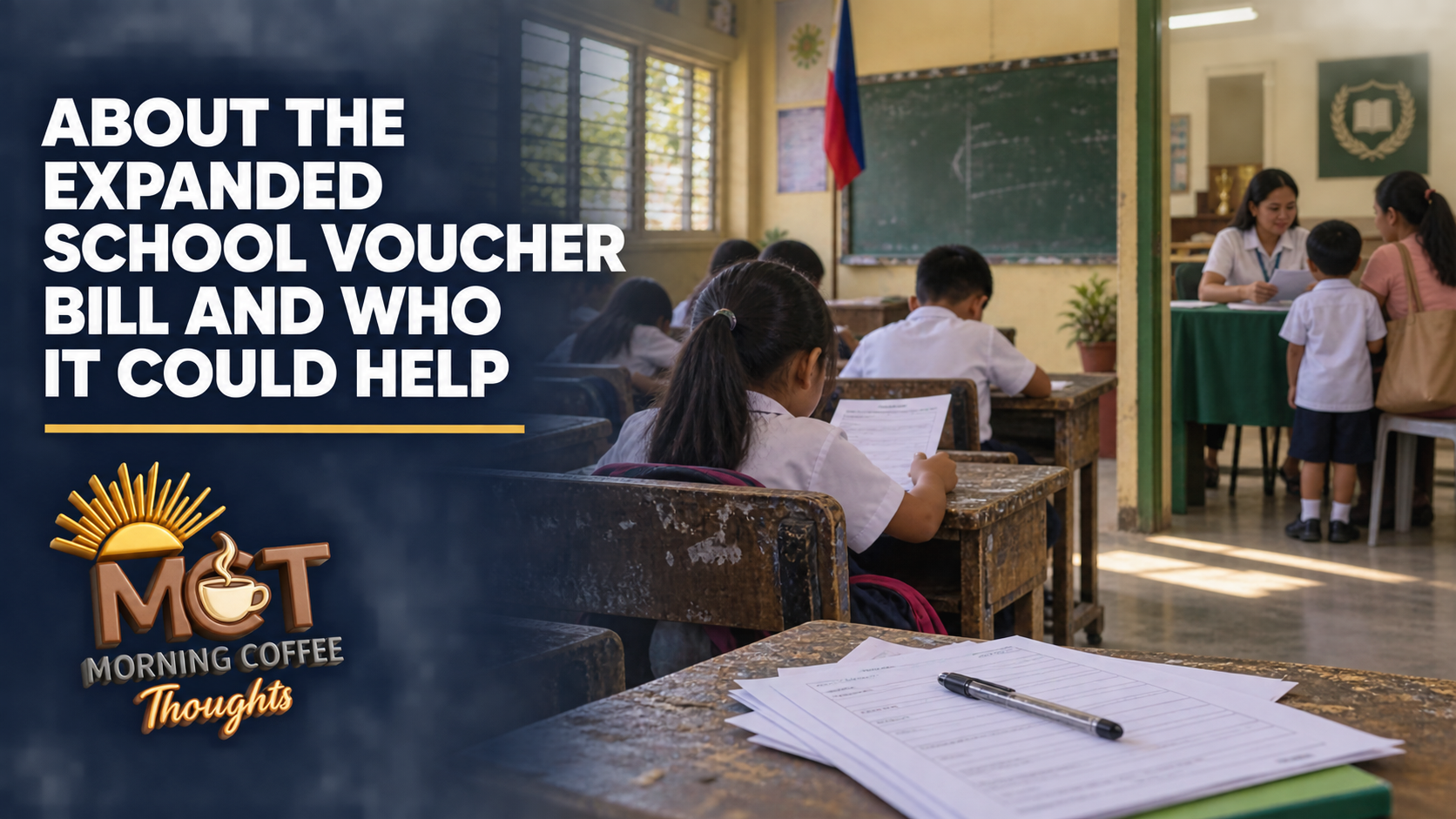
Philippine public-school classroom and private-school enrollment documents illustrating the expanded basic-education voucher proposal.

Congress has ratified a bill that would widen government-funded school vouchers to qualified learners from Kindergarten to Grade 12. The plan is meant to give some families access to available places in private schools, especially where public classrooms are crowded or no nearby public school can take the learner.

That sounds simple, but several details are still unsettled. The bill is not yet a law. A voucher may not cover every peso charged by a private school. Families also need to know who receives priority, which schools may participate, and what protection exists against weak teaching or false enrolment records.

Here are five things to know.

1

1. CONGRESS RATIFIED THE BILL, BUT IT IS NOT YET A LAW

The House and Senate ratified the bicameral conference committee report that reconciled House Bill No. 4744 and Senate Bill No. 1981. The proposed law is called the Basic Education Voucher Assistance Act.

Ratification means both chambers accepted the same final congressional text. The next step is transmission to the Office of the President for action. Until the President signs it or it otherwise becomes law under the constitutional process, families cannot claim a new benefit from the proposal.

Even after enactment, the Department of Education will need implementation rules, a budget, a school-participation process, and a schedule before the wider program can operate.

WHAT TO WATCH

Watch for presidential action, publication of the final enrolled bill, DepEd's implementation rules, and the school year when the expanded coverage will actually begin.

2

2. THE MAIN CHANGE IS COVERAGE FROM KINDERGARTEN TO GRADE 12

Government voucher programs already support many learners in private junior and senior high schools. The bill would place a broader Kindergarten-to-Grade-12 program in law and add qualified Kindergarten and elementary learners to the coverage.

The voucher would allow an eligible learner to enroll in a participating private basic-education school recognized by DepEd. It gives families another possible school option; it does not close public schools or end the government's responsibility to build classrooms, hire teachers, and improve public education.

The House said private schools have unused places that could accommodate some learners now attending congested public schools. Using those places may give some children relief sooner while new public classrooms are being built.

WHAT TO WATCH

Check whether the final law introduces the new grade levels all at once or in stages, and whether enough participating schools exist near the communities with the worst classroom shortages.

3

3. NOT EVERY LEARNER WILL AUTOMATICALLY RECEIVE A VOUCHER

The ratified measure gives priority to learners in public schools identified by DepEd as congested, those living where there is no nearby public school, and those in communities served by crowded public schools.

This means the program is intended to direct limited public funds toward learners facing an access or capacity problem. It should not be read as an automatic government payment for every child already enrolled in a private school.

The practical effect will depend on DepEd's definitions and records. Families will need clear instructions on residence, school capacity, grade level, transfer rules, deadlines, and the proof required for eligibility.

WHAT TO WATCH

Look for a simple eligibility checker, a public list of participating schools, an appeals process, and rules that prevent families from being rejected because of confusing paperwork.

4

4. A VOUCHER MAY NOT COVER THE FULL COST OF PRIVATE SCHOOL

A voucher is a government subsidy applied to a learner's education in a participating school. It should not be described as a promise of completely free private-school education unless the final amount covers all tuition and permitted fees at the chosen school.

The value can vary according to the rules, grade level, location, available funds, and the school's charges. Families may still face a balance, along with costs for uniforms, transport, meals, devices, books, projects, or other school requirements.

Parents should receive the voucher amount and the school's full list of charges before accepting a place. A family that saves on tuition can still struggle if transport and other daily expenses are high.

WHAT TO WATCH

Compare the voucher value with the school's total charges and ordinary household costs. DepEd should require participating schools to disclose any amount a family must pay before enrolment is confirmed.

5

5. ACCESS MUST COME WITH QUALITY AND ANTI-FRAUD CONTROLS

Sending public money to private schools requires reliable learner records, attendance checks, school recognition, financial audits, and a way to recover money paid for false or ineligible enrolments.

The expanded program also needs academic safeguards. A child moved out of a crowded public school should receive competent teaching, safe facilities, and support suited to the learner's needs. More school choices do not help if the participating school performs poorly or charges families costs they were not told about.

DepEd has previously proposed centralized verification, stronger audits, data sharing, and whistleblower protection for government education subsidies. Those controls should be visible in the final rules and actual enforcement.

WHAT TO WATCH

Look for public audit results, penalties for false claims, learner-protection rules, school-performance information, and a complaint channel that parents can use without risking the child's place.

BOTTOM LINE

The expanded voucher bill could help some children leave overcrowded classrooms or reach a school when no nearby public option is available. It may also use private-school seats that are currently empty.

It is still a proposal awaiting presidential action, and the benefit will depend on the details. Families need to know who qualifies, how much the voucher pays, what costs remain, which schools may join, and what happens when a school fails the learner.

Vouchers can ease pressure in specific communities, but they cannot replace the slower work of building and repairing public classrooms, hiring enough teachers, and improving the quality of public education for everyone.

GOOGLE PREFERRED SOURCES

FOLLOW MCT ON GOOGLE

Google’s Preferred Sources feature lets you choose publications you want Google to prioritize for you. Select “Add to Preferred Sources” to make MCT easier to find in Top Stories and other eligible Google results. This does not subscribe you to email.

← Back to MCT home

SUPPORT MCT

HELP KEEP INDEPENDENT POLITICAL WRITING GOING.

Morning Coffee Thoughts is reader-supported. Contributions help pay for research tools, hosting, and the work required to verify and explain each development.

Choose the monthly support amount you are comfortable with.Continue through PayPal
Send support through GCash or Maya0969 314 4839