
MCT CASE TRACKERTracking Sara Duterte’s impeachmentHearings, documents and disputed issues.Follow the trial → MCT CASE TRACKERTracking Rodrigo Duterte’s ICC caseCourt records, hearing dates and sourced notes.Follow the case →

LATEST COMMENTARY

View all commentary →

FIVE THINGS TO KNOW

7:23 AM5-minute read

ABOUT LINO CAYETANO AND THE CHANGE AT THE PCO

President Ferdinand Marcos Jr. announced on October 11 that Lino Cayetano would replace Dave Gomez at the Presidential Communications Office. He said Gomez had been bypassed by the Commission on Appointments and that the change would be formalized when they returned from Singapore.

Read the explainer →
6:10 PM4-minute read

ABOUT THE DISPUTE OVER CHANGING THE ORDER OF IMPEACHMENT WITNESSES

The argument at Thursday’s impeachment hearing was about which witness the prosecution could present next. It began with an absent lawyer and became a dispute over preparation and notice. Understanding the exchange helps explain why a courtroom can pause even when the parties, documents and another potential witness are already in the building.

Read the explainer →
3:01 PM3-minute read

ABOUT MARK VILLAR’S MOVE TO THE SENATE MAJORITY

Senator Mark Villar has formally left the Senate minority and joined the majority. The October 8 move strengthens the bloc supporting the chamber’s leadership and gives Villar two significant positions. Its implications for Sara Duterte’s impeachment trial, however, require more than counting political allies.

Read the explainer →
9:56 AM4-minute read

ABOUT THE MANAGER’S CHECKS AND THE QUESTIONS OVER SARA DUTERTE’S SALN

A bank balance can fall even when the value represented by the money has not disappeared. That distinction sits behind the prosecution’s questions about manager’s checks in Sara Duterte’s impeachment trial. To understand the October 7 testimony, we need to follow the instrument, the person entitled to its value and the declaration of assets for the relevant year.

Read the explainer →
9:08 PM3-minute read

ABOUT WHAT COA’S REJECTION OF THE OVP APPEAL MEANS

COA has rejected the request to reconsider the ₱73.287-million disallowance involving the Office of the Vice President’s December 2022 confidential expenses. The October 5 resolution became public on October 7. Its significance is easier to understand when the amount, the audit finding and the available legal remedies are kept separate.

Read the explainer →
7:47 AM3-minute read

ABOUT WHAT BANK SECRECY PROTECTS IN AN IMPEACHMENT TRIAL

The arguments over bank records in Sara Duterte’s impeachment trial involve several protections. The privacy of a peso deposit, the protection of a foreign-currency deposit, and the confidentiality of a report sent to the AMLC come from different rules. Understanding those differences helps explain what the court has allowed and what remains in dispute.

Read the explainer →
8:43 AM8-minute read

ABOUT THE AMLC RECORDS IN SARA DUTERTE’S IMPEACHMENT TRIAL

₱4.4 billion is a figure that can dominate a conversation before anyone asks what it counts. AMLC Executive Director Ronel Buenaventura presented that approximate total in the Senate impeachment court on October 5, covering reported transactions involving Vice President Sara Duterte and her husband, Manases Carpio. He also explained that a bank correction had reduced the earlier figure of ₱6.7 billion.

Read the explainer →
6:44 PM5-minute read

ABOUT THE COINS.PH CASH-IN RESTRICTION AND WHAT USERS SHOULD CHECK

If you use Coins.ph to receive money or pay bills, a failed cash-in can disrupt plans for the day. Coins.ph has announced that some incoming peso services are temporarily unavailable following a BSP directive to improve its internal controls. Its advisory also identifies services that existing customers can still use.

Read the explainer →
12:00 PM5-minute read

ABOUT THE PROPOSED RULES ON SECONDHAND PHONES

A secondhand phone can put a useful device within reach of someone who cannot afford a new one. The problem comes when the buyer has no clear information about where it came from, what condition it is in, or who will fix it if it fails.

Read the explainer →
8:35 PM6-minute read

ABOUT THE SUPREME COURT’S DECISION ON THE IMPEACHMENT VOTE THRESHOLD

The Supreme Court dismissed three petitions on September 30 challenging how the Senate impeachment court would count the votes needed to convict Vice President Sara Duterte. The dismissal leaves the Senate’s September 23 ruling in place, but it needs to be read carefully. A case can be dismissed because it does not meet the requirements for the Court to hear it, without settling whether the challenged action is constitutional.

Read the explainer →
6:12 AM6-minute read

ABOUT WHAT BASTE DUTERTE SHOULD HAVE CHECKED AS MAYOR

Davao City Mayor Sebastian “Baste” Duterte told the Senate impeachment court on September 29 that he had been unfamiliar with GenCorp Industries Inc. before it came up in the proceedings. He also said he did not know about Vice President Sara Duterte’s declared business interest in the company.

Read the explainer →
10:45 PM7-minute read

ABOUT THE OCTOBER WATER-RATE INCREASES

Metro Manila households served by Maynilad and Manila Water will see slightly higher water charges beginning October 1. The announced increases are small for many residential customers, but the figures vary by concessionaire and consumption level. That makes it easy to misunderstand a notice expressed only in centavos per cubic meter.

Read the explainer →
7:21 AM6-minute read

ABOUT THE NOTE HANDED TO GIBO TEODORO IN SEOUL

Defense Secretary Gilberto “Gibo” Teodoro Jr. was answering questions at the Seoul Defense Dialogue on September 8 when a man handed him a note. He read it aloud, challenged its rejection of the 2016 South China Sea ruling and objected to being interrupted that way.

Read the explainer →
9:55 AM8-minute read

ABOUT EL NIÑO AND PREPARING FOR LESS RAIN

It can be raining outside while PAGASA warns about El Niño. That can sound confusing when the immediate problem is a wet road or a flooded field. The two warnings describe different periods: the weather happening now and the rainfall conditions that may develop over the coming months.

Read the explainer →
5:30 AM8-minute read

ABOUT THE NEW ARREST WARRANTS AGAINST ZALDY CO, MARTIN ROMUALDEZ AND TWO OTHERS

The Sandiganbayan has ordered the arrest of Zaldy Co, Martin Romualdez and two other accused in the plunder case filed on September 7. By Monday evening, authorities had served Romualdez's warrant and carried out booking procedures at Cardinal Santos Medical Center in San Juan. His arrest is a confirmed development; it does not establish that his three co-accused are also in custody.

Read the explainer →
3:15 PM8-minute read

ABOUT THE PLUNDER CASE AGAINST MARTIN ROMUALDEZ

The Office of the Ombudsman filed a plunder case against former House Speaker Martin Romualdez at the Sandiganbayan on September 7 over his alleged involvement in flood-control kickbacks. The accusations have now reached the court that will handle the criminal case. Romualdez denies wrongdoing and remains presumed innocent.

Read the explainer →
1:18 PM7-minute read

ABOUT THE NEW SWS POVERTY NUMBERS

Self-rated poverty and food poverty declined in June, but the figures also show how many Filipino families remain under pressure and why lower household budgets do not necessarily mean life became cheaper.

Read the explainer →
2:02 PM11-minute read

ABOUT THE CHILDREN'S SOCIAL MEDIA SAFETY ACT

House Bill No. 9965 would bar children below 13 from having social media accounts, require parental consent for users aged 13 to 17, regulate platform algorithms, and impose fines reaching P50 million. It is still being deliberated in the House.

Read the explainer →
12:02 PM7-minute read

ABOUT THE SEALED BIR BOX

Marcos authorized the BIR to comply with the Senate subpoena. That did not open the records to the public or prove the unexplained-wealth allegation.

Read the explainer →

MCT READER PULSE · MCT-PULSE-2026-010

MCT READER SURVEY

If the Philippine presidential election were held today, who would you vote for as President and Vice President?

Vote now →

This is an informal survey of people who choose to participate. It is not a scientific or nationally representative sample.

View previous survey results →
October 12, 2026 · 10:17 PM5-minute read

ABOUT THE PROPOSED CHANGES TO SYSTEM-LOSS CHARGES

What the House committee decision establishes, how system loss is charged, and why households still need a final rule and a sample bill before calculating savings.

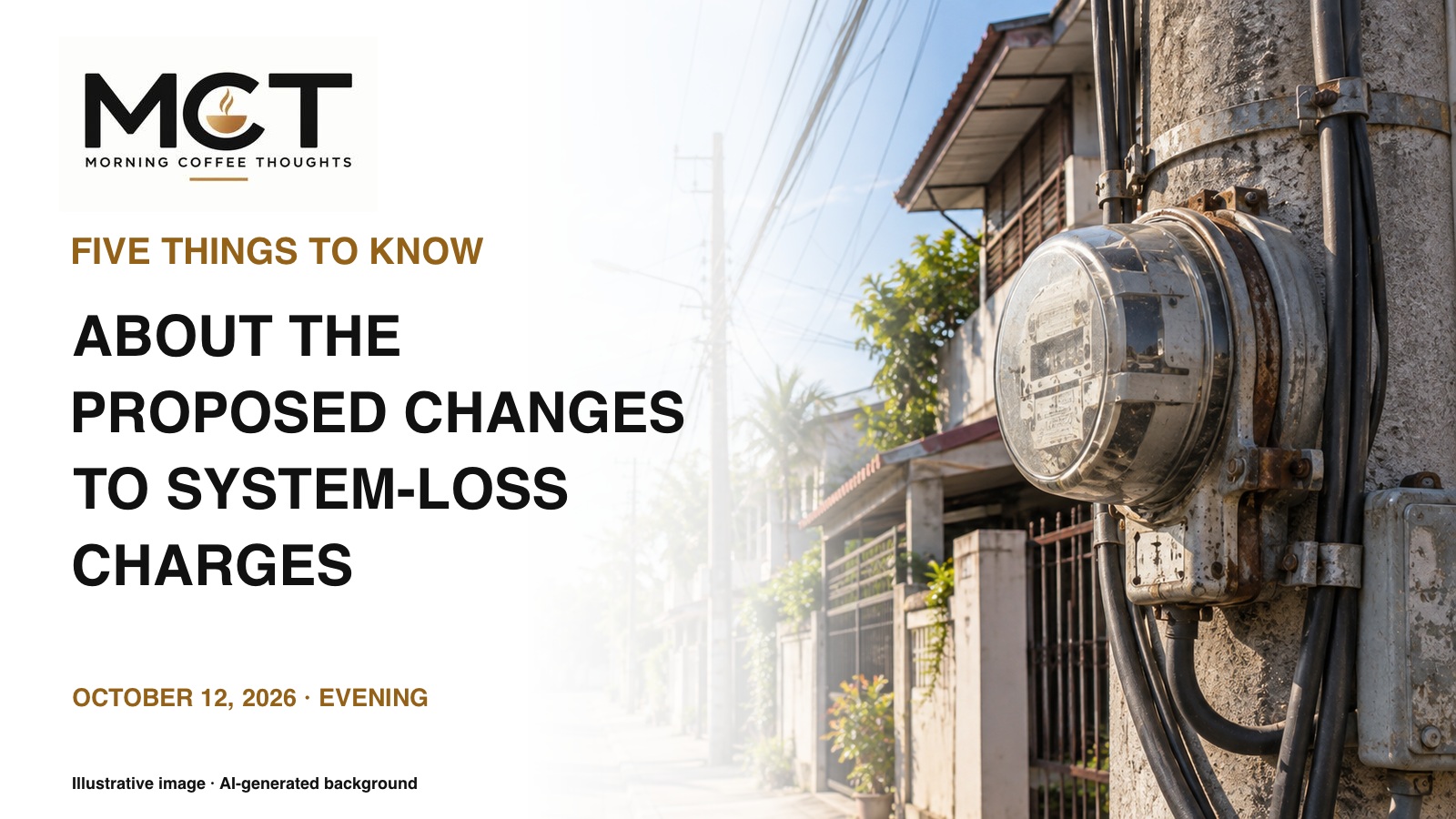
MCT Five Things cover illustrating an electricity meter on a Philippine residential street. AI-generated illustrative background; exact supplied MCT logo.

If you have ever looked at the system-loss line on an electricity bill and wondered why you were paying for power you did not use, Monday’s House energy committee decision deserves a closer look. The panel approved a substitute bill and committee report seeking changes to how those costs are borne by consumers.

The proposal concerns an expense that households already encounter. Understanding it requires separating the electricity lost in a network, the amount a utility is allowed to recover, and the legal steps needed to change the charge. Here are five things to understand before expecting a smaller bill.

1

COMMITTEE APPROVAL DOES NOT CHANGE TODAY’S BILL

The House Committee on Energy has advanced the proposal. That is the stage established by its October 12 announcement. It is not an announcement that a new law has taken effect or that a utility must immediately erase a line from your bill.

The Constitution requires proposed legislation to go through the lawmaking process. Further action in Congress, the final wording and the requirements for a law to take effect remain relevant. A headline about committee approval should identify that stage clearly.

For a household budgeting this month’s payment, the safe approach is to use the bill actually issued and check the utility’s applicable rules. The announcement gives consumers a measure to follow and questions to ask. It does not establish an immediate discount they can calculate or a payment they can withhold.

WHAT TO WATCH

The substitute bill’s published text and the next recorded plenary action. These will show whether the proposal progresses and whether its coverage changes before consumers can rely on it.

2

SYSTEM LOSS HAS BOTH TECHNICAL AND NON-TECHNICAL CAUSES

Electricity can be lost as it passes through wires, transformers and other distribution equipment. Meralco’s explanation identifies heat generated in wires and the passage of power through transformers as technical causes. Electricity theft and illegal connections are examples of non-technical losses.

Those causes require different responses. A discussion about improving equipment needs engineering evidence. A discussion about illegal connections needs reliable detection and enforcement. Calling all system loss theft obscures the part associated with delivering electricity through a physical network.

For readers, this is a way to question a proposal more precisely. Ask which losses it addresses, how those losses are measured and what changes the operator would have to make. A rule about who pays can change the financial responsibility; reducing the actual loss also requires attention to its cause.

WHAT TO WATCH

The bill’s definitions of covered losses and the regulator’s technical assessment. These can reveal whether the proposed rule distinguishes the causes accurately and can be implemented using measurable records.

3

THERE IS ALREADY A LIMIT ON WHAT UTILITIES MAY PASS ON

Meralco’s billing explanation says the Energy Regulatory Commission sets a maximum recoverable level. Losses beyond that level cannot be passed on to customers and must be shouldered by the distribution utility. The proposal therefore needs to be compared with the existing rules, rather than discussed as though every loss is currently recoverable without limit.

A consumer can ask for the basis of the charge appearing on the bill. The useful information includes the applicable rate, how it was calculated and the rule authorizing recovery. Those records help establish what the household is paying for.

If a new law shifts more of the cost to an operator, readers should look for the precise change: which loss stops being recoverable, when that change begins and how compliance is checked. Without those details, a promise of relief is difficult to translate into a household budget.

WHAT TO WATCH

The comparison between the final proposal and existing ERC rules, including the explanation of any transition. Consumers need to know which charge changes and when it changes.

4

THE VAT TREATMENT IS A SEPARATE QUESTION

The ERC has separately directed utilities to show allowable system-loss charges as a distinct government-mandated line item that is not subject to VAT. That addresses the tax treatment of an allowable charge. It does not establish that the underlying system-loss charge has been abolished.

This gives a reader two entries to examine: the system-loss amount and any tax treatment attached to it. Removing a tax from a charge and removing the charge itself would produce different results. Reports and captions should tell readers which change they describe.

A household comparing bills should also check its consumption and the other rates shown. A lower amount in one component can be offset by movement elsewhere. It is useful to follow the particular line being changed before attributing the entire month’s increase or decrease to one reform.

WHAT TO WATCH

Your utility’s billing explanation and the line items on the next issued bill. If the tax treatment is unclear, ask how the applicable ERC direction is reflected, rather than assuming that a system-loss amount should disappear altogether.

5

HOUSEHOLDS NEED AN ACTUAL SAVINGS CALCULATION

The proposal’s stated intention is consumer relief. The final assessment should show the result on an understandable sample bill and explain the assumptions behind it. Readers need to know what is removed, what remains and whether any other component changes.

For illustration, removing a ₱150 line from an otherwise unchanged bill reduces that bill by ₱150. This is a hypothetical example, not a forecast for a household or a claim about the proposal’s final coverage. It shows why the actual line item and final rule are needed before promising a peso amount.

The operator’s responsibilities should also be clear. Consumers can reasonably ask how losses will be measured, how avoidable losses will be reduced and how service reliability will be assessed. The ERC has previously emphasized both consumer protection and the operating conditions of utilities when discussing system-loss reform. Those questions belong in the review of the measure.

WHAT TO WATCH

An official cost-impact assessment, a clearly explained sample bill and the final implementation requirements. These would let consumers judge the proposal through its financial effect and the service they receive.

BOTTOM LINE

There is now a new committee decision to follow, while existing billing rules still need to be understood. Consumers deserve a clear account of the losses being charged, the limits on recovery and the effect of any proposed change. Before calling the measure a saving for every household, show the final rule and its calculation on a bill people can read.

GOOGLE PREFERRED SOURCES

FOLLOW MCT ON GOOGLE

Google’s Preferred Sources feature lets you choose publications you want Google to prioritize for you. Select “Add to Preferred Sources” to make MCT easier to find in Top Stories and other eligible Google results. This does not subscribe you to email.

← Back to MCT home

SUPPORT MCT

HELP KEEP INDEPENDENT POLITICAL WRITING GOING.

Morning Coffee Thoughts is reader-supported. Contributions help pay for research tools, hosting, and the work required to verify and explain each development.

Monthly PayPal subscription — choose your support amount.Subscribe monthly through PayPal

PayPal automatically charges your chosen amount every month until you cancel the subscription in PayPal.

Send support through GCash or Maya0969 314 4839